🇰🇷 South Korea’s stock market is down 44% in just 40 days.
Looks like Squid Game is recruiting again.
This time,
you don’t need a business card.
Just open your brokerage app. 🎴📉
What if this chart ends up being right?
Will your 2029 self look back at 2026…
and wonder why you thought these prices were expensive?
$BTC: $65K → $150K
$ETH: $1.9K → $7.2K
$SOL: $75 → $231
$BNB: $573 → $1,179
$XRP: $1.10 → $3.22
Will it happen exactly like this?
Nobody knows.
But every bull market has one thing in common.
When prices are still low…
most people are skeptical.
After assets double.
Triple.
Or 5x…
that’s when the crowd finally believes.
And that’s usually when they buy.
Life-changing wealth isn’t created by predicting the future.
It’s created by positioning yourself before everyone else is convinced.
The biggest gains don’t come from buying the exact bottom.
They come from holding through the entire cycle.
So here’s the real question:
Will 2026 be remembered as the top…
or the year everyone wishes they had bought more? 👀
$BTC $ETH $SOL $BNB $XRP
In 1971,
the purchasing power of a minimum-wage worker was equivalent to earning roughly $100,000 a year today.
Since then,
the U.S. dollar has lost around 87% of its purchasing power.
Most people think keeping cash in the bank is the safest option.
It isn’t.
The biggest risk isn’t investing.
It’s doing nothing.
Every day you hold cash,
inflation is making a trade against you…
and you’re on the losing side.
So the real question isn’t:
“Should I invest?”
It’s this:
Can your money outrun the money printer?
That’s why more people are allocating capital to:
🟠 Bitcoin
📈 Stocks
🥇 Gold
🏠 Real Estate
Because cash depreciates.
Scarce assets have the potential to preserve purchasing power.
The riskiest investment…
is believing cash is risk-free.
$BTC
In 1913,
$100 had $100 of purchasing power.
By 2026,
that same $100 buys less than $3 worth of goods.
Over 97% of its purchasing power is gone.
That’s why keeping money in the bank can feel safe…
while quietly making you poorer every year.
The biggest thief of wealth isn’t always a market crash.
It’s currency debasement.
That’s why more people are choosing to own:
🟠 Bitcoin
🟡 Gold
📈 Stocks
🏠 Real Estate
Because cash isn’t an investment.
It’s purchasing power waiting to be eroded by inflation.
You don’t have to buy Bitcoin.
But you can’t pretend fiat money isn’t losing value over time.
The real risk isn’t volatility.
The real risk is watching your purchasing power disappear…
year after year.
Save in cash.
Grow poor slowly.
Bitcoin is holding above $65,000.
Ethereum is back above $1,950.
Many people think the big move has already happened.
I think they’re watching the wrong thing.
The real catalyst isn’t price.
It’s regulation.
If the CLARITY Act becomes law,
the U.S. crypto regulatory framework becomes much clearer.
That could unlock the next wave of institutional capital.
Wall Street.
Public companies.
Large asset managers.
The biggest rallies in history were never driven by retail.
They were driven by the largest pools of capital finally deciding:
“Crypto is a legitimate asset class.”
When regulatory uncertainty disappears,
moves that seem extraordinary today…
may become the new normal.
So the real question isn’t:
Can Bitcoin make a new all-time high?
It’s this:
Will you still own enough Bitcoin when it does? 👀
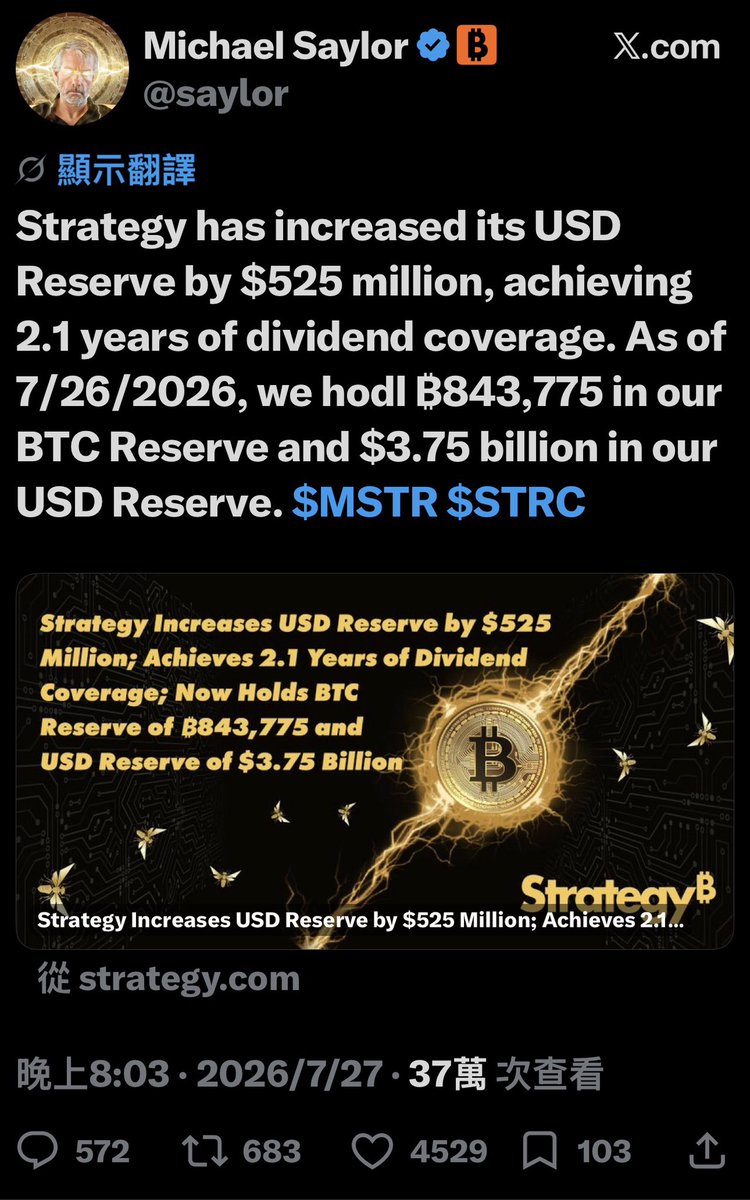
🚨 Strategy ($MSTR) just added $525 million to its cash reserves.
It now holds:
• 843,775 BTC
• $3.75 BILLION in cash
Most people expected Michael Saylor to go all-in on Bitcoin.
Instead…
he’s building a war chest.
That tells me one thing.
The best investors don’t fire all their bullets in a bull market.
They save ammunition for when the market offers extraordinary opportunities.
If Bitcoin keeps rising,
the cash is a safety buffer.
If the market crashes,
the cash becomes dry powder.
The real question isn’t:
“Why didn’t Strategy buy more Bitcoin?”
It’s this:
Does Saylor believe there could be even better buying opportunities ahead?
Every historic market opportunity had one thing in common.
The people who capitalized…
were the ones who still had cash.
So what’s your take?
🔥 A. Strategy is simply strengthening its balance sheet.
📉 B. Michael Saylor is quietly preparing for the next bear market.
👇 Cast your vote.
🚨 After BitMEX announced it was shutting down…
its exchange token launched in 2022 crashed 99.69%.
Liquidity vanished almost instantly.
But that’s not the real story.
BitMEX and BitMart didn’t disappear because they were hacked.
Not because customer funds were stolen.
Not because they suddenly became insolvent.
They shut down because they could no longer make money.
That’s a much bigger warning.
The crypto industry is changing.
Trading volumes are drying up.
The pie is getting smaller.
Meanwhile…
🇺🇸 The U.S.
🇰🇷 South Korea.
🇪🇺 Europe.
Regulation is pushing the industry onshore,
leaving less room for offshore exchanges.
The Chinese-speaking market is already dominated by the biggest players.
And smaller regions simply aren’t profitable enough.
This isn’t just the end of two exchanges.
It may be the beginning of the end for the second-tier offshore exchange era.
The next casualties of this bear market…
might not be altcoins.
They might be the exchanges themselves. 📉
An era has officially come to an end. 🥲
BitMEX,
once the undisputed king of crypto derivatives,
has announced it will shut down on September 23.
Many newer traders won’t remember this…
But before Binance Futures.
Before Bybit.
There was BitMEX.
Back in 2016,
BitMEX introduced the perpetual futures contract.
A product that went on to reshape the entire crypto trading industry.
It wasn’t just another exchange.
It changed how millions of people traded Bitcoin.
Last year, reports surfaced that the company was seeking a buyer.
Now, instead of a new chapter…
the story is coming to an end.
Bull markets create kings.
Bear markets replace them.
But history won’t forget this one.
BitMEX didn’t just dominate an era.
It helped build the crypto market we know today. 🫡
Bear market bottom…
or just the beginning? 📉
In the past 3 days,
two once-iconic crypto exchanges announced they were shutting down.
• BitMEX — once the king of crypto derivatives.
• BitMart — once a top-10 spot exchange globally.
During bull markets,
everyone remembers the ATHs,
the leverage,
the fortunes made overnight.
But bear markets are remembered differently.
They’re remembered by the giants that disappear.
Every crypto bear market leaves casualties.
Not always the smallest players.
Often the ones everyone thought were “too big to fail.”
History doesn’t repeat.
But it often rhymes.
Are we witnessing the bottom…
or just the beginning? 👀
The scariest thing in trading isn’t getting liquidated.
It’s gambling with someone else’s money.
A 26-year-old trader in Hong Kong allegedly misappropriated HK$50 million from his company…
…and went all-in on leveraged SK Hynix ETFs.
It didn’t end with a loss.
It snowballed into a HK$150 million hole.
Even worse:
Police say the positions haven’t been fully liquidated yet.
If the underlying keeps falling,
the damage could grow even larger.
This is why professional traders obsess over risk management.
Not because they expect to lose.
Because they know they can.
The market doesn’t care how confident you are.
It doesn’t care how much leverage you use.
And it definitely doesn’t care that you “can’t afford to lose.”
One uncontrolled position…
can destroy far more than a portfolio.
It can ruin an entire life.
COVID wasn’t 3 years ago.
It was 7.
Someone who’s 60 today was only 34 in 2000.
Read that again.
Years feel like months.
Decades feel like years.
Life moves insanely fast.
Don’t waste your time chasing things that don’t matter.
Build.
Take risks.
Own your time.
You have less of it than you think.
Time is the real scarce asset.
🚨 BITCOIN JUST FLASHED A RARE SIGNAL.
The last time this happened?
$BTC rallied 600%+. 📈
Not 60%.
600%.
Now, the same signal is flashing again.
Does that guarantee another massive rally?
Of course not.
History never repeats exactly.
But crypto has a funny way of making you remember one sentence:
“Last time, nobody thought it mattered either.”
So the question is…
Are we looking at just another boring $BTC signal?
Or something we’ll look back on years from now and say:
“It was right there the whole time.” 👀
$BTC
Bro literally bought a memecoin and retired. 💀
Someone turned $10 into $37,600,000.
Read that again.
$10 → $37.6 MILLION.
Not +100%.
Not 100x.
Not even 1,000x.
This man basically went from:
“Do I have work tomorrow?”
to:
“Which country should I wake up in tomorrow?” 😭
But here’s the most crypto part:
The next memecoin you buy after reading this will probably turn your
$10
into
$0.37.
Welcome to crypto. 🤝💀
Damn… Crypto is COLD right now. 🥶
Crypto VC funding is on track for its worst month since November 2020.
Remember the last bull market?
No product.
Tokenomics unfinished.
A sexy pitch deck.
Boom — billion-dollar valuation.
Now?
Retail isn’t buying.
VCs aren’t deploying.
Founders are struggling to raise.
The market is being forced to separate hype from businesses that actually have users, revenue, and a reason to exist.
But here’s where it gets interesting:
The last time funding was this dead was November 2020.
Right before one of the biggest crypto bull runs in history.
History doesn’t repeat perfectly.
But the best opportunities are rarely obvious when everyone is euphoric.
They’re usually being built when nobody cares.
So the real question is:
Is this the death of the crypto VC cycle…
or the quiet beginning of the next one? 👀
If you invested $10,000 in $ADA at its peak 5 years ago…
Today, you’d have just $600 left.
$10,000 → $600.
One of the biggest names in crypto.
One brutal reality check.
So what went wrong with Cardano?
$ADA
This is how most large-cap alts die.
When I was in college, $LTC was trading at $44.
When I got a job, LTC was trading at $44.
When I got married, LTC was trading at $44.
Now I have kids, and LTC is still at $44.
Not with a crash.
Just years of going absolutely nowhere.
Someone bought 80,000 Bitcoin in 2011.
Cost:
$260,000.
Bitcoin was just $3.25.
He survived every crash.
Never sold a single coin.
For nearly 14 years.
Then in 2025…
He sold everything.
For over $9 BILLION.
34,615x.
Conviction pays.