The world is deeply unfair.
Some of the most talented people I know are stuck in dead end desk jobs while some of the snarkiest narcissistic tyrannical workhorses are in positions of great power.
This has always greatly saddened me.
After a lot of analysis, I think there are 5 reasons this happens:
1. Refusal to believe / fear of failure. Loss of belief that where there is a will (to enact change), there is a way e.g. “I am just a cog in the wheel. If I say something, no one will listen.” or “if I do this, I will upset somebody”
2. Lack of purpose. You don’t really understand what you’re fighting for and what you believe in. You fight for inconsequential, often selfish, goals. e.g “Will doing this get me a promotion? Should I completely change everything to do this other project cause it will get me a promotion?”
3. Lack of self awareness. I will stand up to this thing I believe in and they will listen to me. e.g intern saying: “why doesn’t the ceo like my view on company strategy?”
4. Refusal to play. The failure to acknowledge that your worldview is only as powerful as your ability to influence others of your worldview OR a complete repudiation of the will to interact with those who don’t share your worldview e.g. “these guys just do what they want. They won’t listen to me. what will happen if I do this?”
5. Refusal to strategize or concede. The unwillingness to play and win a side quest that will ostensibly further your vote because you find the interim goal pointless. Or the inability to concede a battle to fight the war. e.g. “this direction is wrong. I need to fight it (even though it’s a small issue)”
Almost everyone who is bitter or feels stuck in their career boils down to one of these 5 failure modes 1, 2 and 3 are the most common. Many suffer consequences of 2-5 and end up in 1. I’ve personally seen some of my sharpest friends land up in 1 because they just don’t believe they can win.
One privileged part of my job is getting to interact with people who are willing to, against all odds, believe in something heretical, know why it’s important, know what needs to be done to make it real, do it, and make side quests to get it done. I think it applies to everyone doing anything.
My personal advice
June July Aug and Sept are the months where hiring will be in their peak
Start applying everywhere
Linkedin
Wllfound
Unlisted
Jobs24x
Cold Email
Cold Call everything
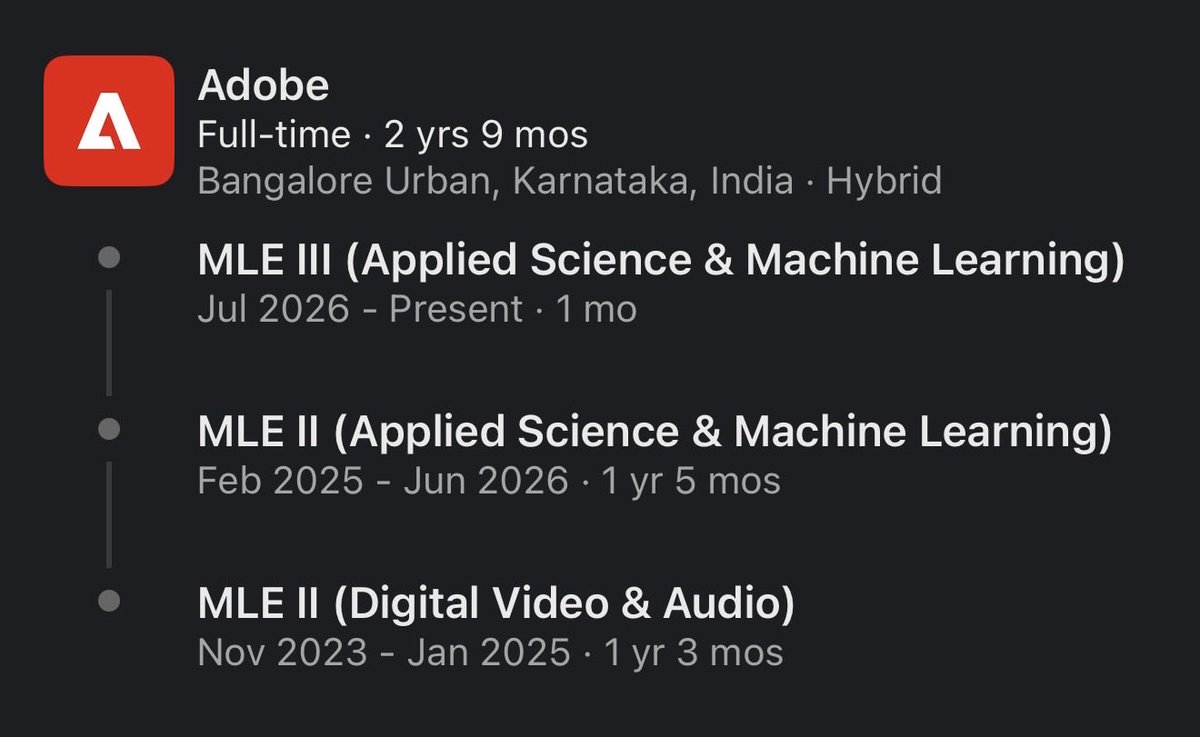
I made 4 switch in 4 years and all happened nearly in these 4 months.
Start Showing Up.
I can vouch for this.
I received 5 offers in the months of June and July last year.
Keep applying everywhere. Opportunities are in abundance during these months.
I don't know who needs to hear this, but start living.
The days are flying by, and all you do is work, pay bills, and stress.
Enjoy what you can-walks, sunsets, music, laughter. Joy doesn't have to be expensive. You deserve it.
Software hiring has become absurd.
At work, you’re expected to use AI to offload manual coding and move faster.
Then, to get your next contract, you’re asked to code from memory with no assistance.
Pass the interview - and you’re expected to use AI again.
It has never been this broken.
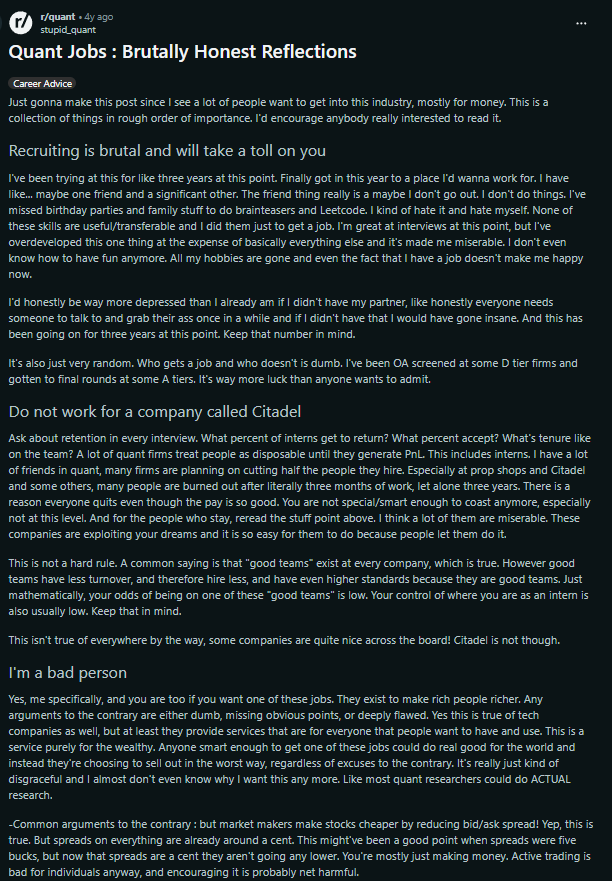
A guy finally landed the quant job he chased for 3 years.
Then he went online and torched the entire industry.
He calls himself a bad person. Says you are too if you want the job.
And he doesn't hold back on a single thing:
- "They exist to make rich people richer" his words
- He dismantles every excuse quants tell themselves to sleep at night
- Says people burn out in months and firms treat them as disposable
- Warns that half of new hires are already planned to be cut
- Names one firm specifically and says: do not work there
An L8 Principal Engineer at Meta shared his agentic workflow, chapter by chapter:
Most agent stack posts talks about models and prompts.
He shows the operating system around the model:
09:21 - Choosing agent harnesses
11:24 - Global and project memory
16:12 - Skills, and when they backfire
28:29 - Validating without becoming the bottleneck
33:12 - Long-running tasks with stop conditions
36:20 - Worktrees and parallel agents
The real upgrade is not a better prompt. It is learning to run the crew like a captain.
The Myth of “Love Learning”
People often ask me how to get better at chess. My answer is almost the opposite of what people expect.
You don’t have to love learning.
In fact, if you wait until you love the process, you’ll probably never become very good.
We romanticize improvement. We imagine great players waking up excited to study endgames, analyze losses, or memorize opening lines. Sometimes that’s true. Most of the time it isn’t.
Improvement is often boring.
The difference between an amateur and a professional isn’t that the professional enjoys every minute. It’s that they keep going when they don’t.
People say children are fearless learners. I’m not so sure.
Children quit things constantly. Piano. Swimming. Languages. Football. Chess. They usually continue only because someone else insists they do. Parents. Teachers. Coaches.
Discipline often comes before passion, not after.
The same is true for adults.
We tell people to “follow your curiosity.” That’s wonderful advice if curiosity happens to last. Usually it doesn’t.
Every meaningful skill has a point where curiosity runs out and routine takes over.
That’s where improvement actually begins.
Chess certainly did not always feel like play to me.
There were tournaments where the last thing I wanted to do after six hours of defending a miserable endgame was analyze another five hours.
There were openings I studied not because they fascinated me, but because my opponents forced me to.
There were positions I analyzed simply because they were objectively important.
Not because they were fun.
Because they needed to be done.
People often criticize schools for asking the wrong questions.
But there’s another side to that story.
If everyone only studied the questions they found interesting, most people would develop huge blind spots.
Sometimes someone else knows what you need to learn before you do.
Nobody is naturally curious about tax law before becoming an accountant. Or anatomy before becoming a surgeon. Or rook endings before losing enough of them.
External structure isn’t always the enemy of learning.
Often it’s the bridge that gets you to the point where genuine curiosity develops.
The biggest obstacle isn’t fear of looking stupid.
It’s our addiction to doing only what feels rewarding today.
Modern life gives us endless opportunities to switch the moment something becomes difficult.
A new opening.
A new productivity system.
A new app.
A new hobby.
Very few people simply keep doing the same useful thing for years.
That’s the superpower.
So when people ask how to improve at chess, I don’t tell them to fall in love with learning.
Love helps.
Curiosity helps.
Being willing to fail helps.
But none of those are reliable.
Build habits that survive the days when none of those feelings are there.
Because mastery isn’t built on motivation.
It’s built on showing up after motivation has left the room.
Ex google engineer acaba de soltar un curso completo de 1 hora para construir agentes de IA que se mejoran solos, desde cero:
00:00 – Cómo nace un agente que se construye a sí mismo
03:01 – soul.md: el archivo que lo controla todo
30:16 – RAG inteligente: solo traes 20 mensajes relevantes, no los 2.000
31:48 – El loop que sabe cuándo parar solo
35:14 – Detectar el error y arreglar el prompt en el momento
50:22 – Cómo Claude comprime y optimiza tu memoria automáticamente
1 hora de contenido práctico que vale más que la mayoría de cursos de pago sobre agentes.
Míralo completo, guárdalo📚
Gpt 5.6 sol will push anthropic to either put fable 5 in max plan or release opus 5, i don’t see anyone sticking with opus 4.8 anymore, the only problem with sol is its burning through the limits insanely
F5 > 5.6 sol > o 4.8 > 5.5
Major life hack: Don't complain, ever. Nobody likes a complainer. They drain the energy of everyone around them. It's exhausting spending time around someone who constantly complains about things outside their control. If it's within your control, go do something about it. If it's not, you're just wasting energy thinking about it. Complaining gives too much power to the thing. Take back that power.