The theorem behind Waggle
A mathematician's question from 1785
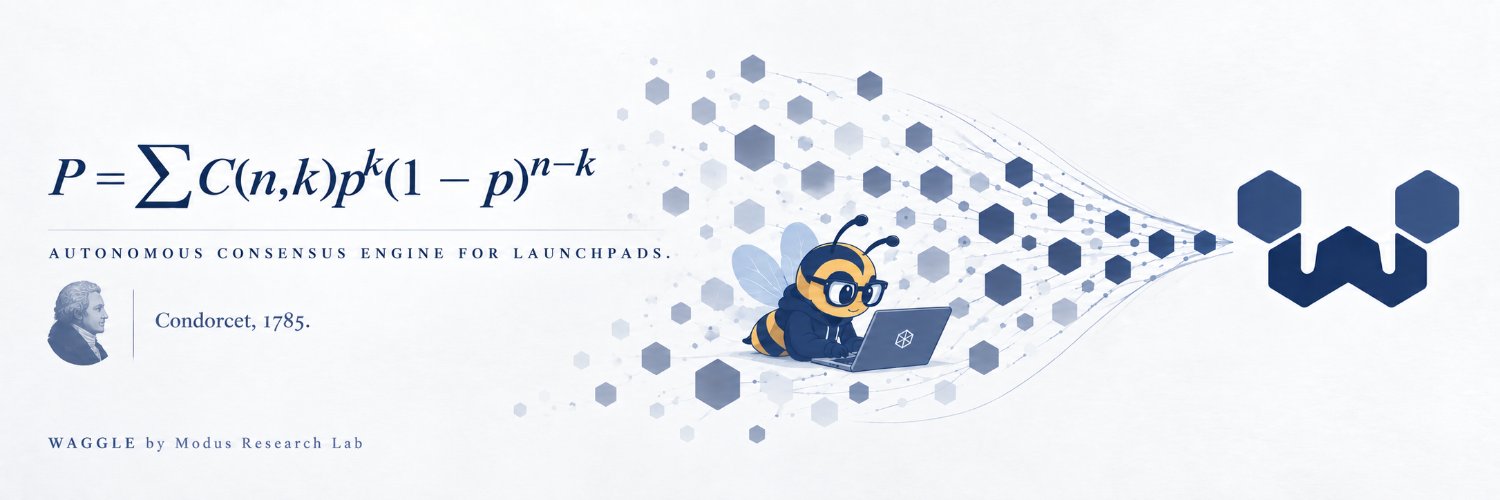
In 1785, the Marquis de Condorcet, a French mathematician and philosopher, asked a question that sounds simple: if a group of people each make a judgment, when is the group more likely to be right than any one of them?
His answer became known as Condorcet's jury theorem. Nine years later he died in a prison cell during the French Revolution, and his theorem sat mostly in political philosophy for the next two centuries.
We think it describes one of crypto's most confusing decisions better than anything built since: where should a token launch?
What the theorem says
Imagine a jury deciding a yes or no question. Each juror is only slightly better than a coin flip at getting it right. Condorcet proved two things:
If each juror is right more than half the time, and they judge independently, the chance that the majority is right rises as the jury grows.
As the jury grows large, that chance approaches certainty.
The formula:
P = Σ C(n,k) · pᵏ · (1 − p)ⁿ⁻ᵏ, summed over every k that forms a majority.
Here p is how often one juror is right, n is the number of jurors, and P is the probability the majority gets it right.
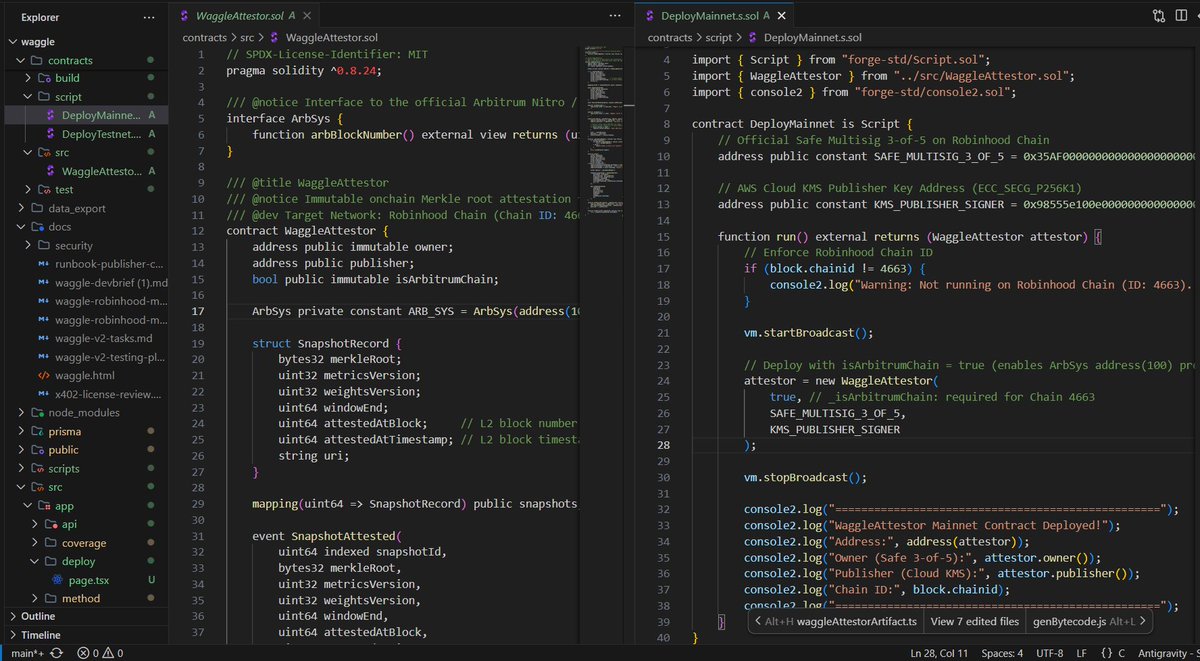
Waggle is going mainnet on Robinhood Chain 🐝
What that means:
→ every data snapshot fingerprinted onchain, hourly
→ any number on the site verifiable against the chain
→ all ~95 Robinhood launchpads indexed, not just the big ones
→ paid reports settled over x402, gasless
And no token. Just proof.
https://t.co/eYQgOsuOID
Two more ideas that shaped the design
Simpson's paradox. A pattern that holds inside every group can reverse when the groups are pooled. Launch hours are a clean example: the strong hours on one chain are not the strong hours on another, and pooling all chains together hides both. That's why Waggle shows a chain by hour matrix instead of one chart.
Many options, not two. Condorcet's original theorem covers yes or no questions. Waggle picks one chain from five and one launchpad from sixteen. List and Goodin (2001) extended the theorem to many options: as long as the right option is more likely than each wrong one, the majority still converges on it.
What the theorem cannot do:
The conditions are demanding, and in real markets they never hold perfectly. Franz Dietrich (2008) argued that independence and competence are difficult to justify at the same time. We agree. Waggle's filters are an attempt to get closer to the conditions, not a claim that they are fully met.
And there is one thing no onchain juror can see: whether a project already has an audience waiting. Survival correlates strongly with that, and no amount of launch data captures it. Waggle can tell you where your token structurally fits. It cannot tell you whether anyone is coming.
Why build it this way
A recommendation engine nobody can inspect is indistinguishable from an advertisement. Condorcet gives Waggle something most tools in this space don't have: a reason that can be written down and checked. The conditions are public. The filters that protect them are public. The weights and definitions are public, and they change in public.
Modus Research turns theorems into constraints and constraints into products. Borel gave us Emile. Condorcet gave us Waggle.
https://t.co/eYQgOsuOID
CA: 0x407ddd48f745916ac10a34feca21389938913af5
The theorem behind Waggle
A mathematician's question from 1785
In 1785, the Marquis de Condorcet, a French mathematician and philosopher, asked a question that sounds simple: if a group of people each make a judgment, when is the group more likely to be right than any one of them?
His answer became known as Condorcet's jury theorem. Nine years later he died in a prison cell during the French Revolution, and his theorem sat mostly in political philosophy for the next two centuries.
We think it describes one of crypto's most confusing decisions better than anything built since: where should a token launch?
What the theorem says
Imagine a jury deciding a yes or no question. Each juror is only slightly better than a coin flip at getting it right. Condorcet proved two things:
If each juror is right more than half the time, and they judge independently, the chance that the majority is right rises as the jury grows.
As the jury grows large, that chance approaches certainty.
The formula:
P = Σ C(n,k) · pᵏ · (1 − p)ⁿ⁻ᵏ, summed over every k that forms a majority.
Here p is how often one juror is right, n is the number of jurors, and P is the probability the majority gets it right.
How this becomes Waggle
There are now dozens of launchpads across Solana, Base, BNB Chain, Robinhood Chain and Arc. Birdeye counted 95 launchpads on Robinhood Chain alone, deploying more than 850,000 tokens in 92 days. No creator can evaluate that by instinct.
But every past launch carries a small piece of information: it launched on a certain chain, on a certain venue, at a certain hour, and it either survived or it didn't. One launch tells you almost nothing. Too many things affect a single outcome.
That's the jury. Every past launch is a juror. One is noise. Thousands, aggregated, point to where tokens of a given shape actually survive.
Waggle is built around the two conditions, not just the formula.
Protecting independence. In launch data, correlated jurors are everywhere: wash trading, bot swarms, the same pool detected twice, one deployer launching fifty copies of the same token. Each of these is one opinion wearing a thousand masks. Waggle filters wash flow, dedupes every pool by address, and shows raw next to filtered volume, so you can see what was removed.
Protecting competence. When a chain or venue has too few launches, the signal sits near chance, which is exactly where the dark mirror starts. Waggle enforces a minimum sample size. Below it, the result is marked low confidence, never averaged into a score as if it were solid. A chain with no data shows empty rather than estimated.
A third condition, less often stated. Every juror has to be answering the same question. If "survived" means something different for each launch, the votes don't add up. So Waggle freezes one definition of survival, publishes it, and versions it when it changes.
Why $WAGGLE launched on Pons.
We ran our own launch through Waggle before we did it. Across 16 venues on 5 chains, Pons came out on top where it matters most for a new token:
→ lowest first minute extraction: 37.3%
→ highest share still trading after 7 days: 60.0%
Full disclosure: this is our token, so check our work. Every number and the method behind it are public at https://t.co/eYQgOsugT5.
Launching something? Run it through Waggle first and see where your token actually fits.
Waggle is going mainnet on Robinhood Chain 🐝
What that means:
→ every data snapshot fingerprinted onchain, hourly
→ any number on the site verifiable against the chain
→ all ~95 Robinhood launchpads indexed, not just the big ones
→ paid reports settled over x402, gasless
And no token. Just proof.
https://t.co/eYQgOsuOID
Introducing Waggle: launch research for a market with too many launchpads
In 92 days, 95 launchpads on Robinhood Chain alone deployed more than 850,000 tokens. Add Solana, Base, BNB Chain and now Arc, and a creator faces a choice between dozens of venues, each with different mechanics, fees and audiences.
https://t.co/2Ac2bimQht
Almost nobody makes that choice with data. They pick the chain they used last time, the launchpad a friend mentioned, or whichever one paid for the loudest thread.
The cost of getting it wrong is invisible. CoinGecko found that 68.67% of https://t.co/5tWyIqYWRN tokens stop trading on launch day, and only 4.55% last beyond 90 days. When a token fails, nobody can tell whether it was the idea or the venue.
Waggle exists to answer that question.
What it does
Describe what you are launching. Waggle scores it against how past launches actually performed and returns three things: the chain that fits its shape, the launchpad on that chain whose mechanics suit it, and the launch hour window where similar tokens have held up best.
Every part of the answer comes with its sample size and a confidence level. Where the data is thin, it says so.
What you can explore
→ Chain by hour heatmap. Survival by launch hour, per chain. The strong hours differ from chain to chain, so timing advice that doesn't name a chain is worth very little.
→ Launchpad comparison. Sixteen venues across five chains on one scale: launches per day, median launch liquidity, first minute extraction, and how many tokens are still trading after seven days.
→ First minute extraction. The share of early volume taken by wallets that buy in the first sixty seconds and sell within thirty minutes. It puts a number on the sniper problem every launcher has felt.
→ Coverage map. Which chains and venues are indexed, from which sources, and what is not covered yet. A visible gap is credible. A guess presented as coverage is not.
The method
Waggle is built on Condorcet's jury theorem (1785): many weak signals, judged independently, aggregate into one reliable answer. Every past launch is one signal. One tells you nothing. Thousands tell you where tokens survive.
The theorem only holds under two conditions, and Waggle is designed around both. Signals must be independent, so wash trading and bot flow are filtered out. Signals must be better than chance, so anything below a minimum sample size is marked low confidence rather than averaged in.
The scoring weights, metric definitions and thresholds are published. They change in public, with a version number.
What Waggle will never do
It will not predict that your launch will succeed. It describes structural fit, not outcomes.
It will not take payment from any launchpad, for placement or for a score.
It will not hold positions in the venues it scores.
It will not show a number without its sample size.
It will not share or publish what you submit.
What it cannot see
Survival correlates strongly with whether a project already has an audience. No onchain data captures that, and Waggle does not pretend to. It tells you where your token fits. It cannot tell you whether anyone is waiting for it.
A recommendation engine nobody can inspect is indistinguishable from an advertisement. Waggle is built to be inspected.
Try it, check the method, and tell us where it is wrong.
100% Dev tokens lock!
🔒 19,808,045.74 $WAGGLE locked on RobinFlow — non-custodial and verifiable onchain on Robinhood Chain.
Unlocks November 25, 2026. https://t.co/3LXotLiTZ9
Introducing Waggle: launch research for a market with too many launchpads
In 92 days, 95 launchpads on Robinhood Chain alone deployed more than 850,000 tokens. Add Solana, Base, BNB Chain and now Arc, and a creator faces a choice between dozens of venues, each with different mechanics, fees and audiences.
https://t.co/2Ac2bimQht
Almost nobody makes that choice with data. They pick the chain they used last time, the launchpad a friend mentioned, or whichever one paid for the loudest thread.
The cost of getting it wrong is invisible. CoinGecko found that 68.67% of https://t.co/5tWyIqYWRN tokens stop trading on launch day, and only 4.55% last beyond 90 days. When a token fails, nobody can tell whether it was the idea or the venue.
Waggle exists to answer that question.
What it does
Describe what you are launching. Waggle scores it against how past launches actually performed and returns three things: the chain that fits its shape, the launchpad on that chain whose mechanics suit it, and the launch hour window where similar tokens have held up best.
Every part of the answer comes with its sample size and a confidence level. Where the data is thin, it says so.
What you can explore
→ Chain by hour heatmap. Survival by launch hour, per chain. The strong hours differ from chain to chain, so timing advice that doesn't name a chain is worth very little.
→ Launchpad comparison. Sixteen venues across five chains on one scale: launches per day, median launch liquidity, first minute extraction, and how many tokens are still trading after seven days.
→ First minute extraction. The share of early volume taken by wallets that buy in the first sixty seconds and sell within thirty minutes. It puts a number on the sniper problem every launcher has felt.
→ Coverage map. Which chains and venues are indexed, from which sources, and what is not covered yet. A visible gap is credible. A guess presented as coverage is not.
The method
Waggle is built on Condorcet's jury theorem (1785): many weak signals, judged independently, aggregate into one reliable answer. Every past launch is one signal. One tells you nothing. Thousands tell you where tokens survive.
The theorem only holds under two conditions, and Waggle is designed around both. Signals must be independent, so wash trading and bot flow are filtered out. Signals must be better than chance, so anything below a minimum sample size is marked low confidence rather than averaged in.
The scoring weights, metric definitions and thresholds are published. They change in public, with a version number.
What Waggle will never do
It will not predict that your launch will succeed. It describes structural fit, not outcomes.
It will not take payment from any launchpad, for placement or for a score.
It will not hold positions in the venues it scores.
It will not show a number without its sample size.
It will not share or publish what you submit.
What it cannot see
Survival correlates strongly with whether a project already has an audience. No onchain data captures that, and Waggle does not pretend to. It tells you where your token fits. It cannot tell you whether anyone is waiting for it.
A recommendation engine nobody can inspect is indistinguishable from an advertisement. Waggle is built to be inspected.
Try it, check the method, and tell us where it is wrong.
Robinhood built its chain for RWA. The memecoin market showed up on its own.
95 Robinhood Chain launchpads deployed over 850,000 tokens in 92 days, @ponsdotfamily and @flapdotsh dominated over 50% of it.
(❓) Sometimes you didnt get any numbers of information about trending launchpads. waggle gave you
Two ways:
Launching a token? Tell Waggle what it is and it tells you which chain, launchpad and hour it fits, based on how thousands of past launches did.
Trading? Check which launchpads have the highest sniper extraction and the lowest 7 day survival before you ape.
What we're building to upgrade Waggle:
1. Wider coverage. Robinhood Chain has 95 launchpads. We're expanding from the biggest venues to all of them.
2. Our own Arc indexer. Aggregators cover new chains last, and those are the chains creators are most confused about. So we're indexing Arc directly from RPC.
3. Cleaner counts. A new dedup layer so every pool is counted exactly once, plus a stronger wash filter.
4. A public scorecard. We're running Waggle on past launches as if they were new, then publishing how often it picked the venue where tokens actually survived. Including when the result isn't flattering.
5. Report links. Save your Waggle report and share it, with the exact data snapshot it came from.
6. An API for agents. Other agents will be able to ask Waggle where a token fits and pay per request.
Built in public. Method stays published.
https://t.co/eYQgOsuOID
WAGGLE UPGRADES IN PROGRESS.
What the bees are building right now:
🐝 Full Robinhood Chain coverage, every launchpad, not just the top ones
🐝 Arc indexed straight from RPC, no waiting for aggregators
🐝 Pool dedup engine, every launch counted once
🐝 Published hit rate: we score past launches and show how often Waggle was right
🐝 Waggle API, so agents can ask it where to launch
The engine never stops. Neither do we.
https://t.co/eYQgOsuOID
WAGGLE IS LIVE.
CA: 0x407ddd48f745916ac10a34feca21389938913af5
Autonomous bees scouting launchpads across 5 chains, running on a theorem from 1785.
https://t.co/I1udshegN4
Most tokens die quietly. We count them.
Pick a chain, pick a launchpad, pick a window, and see how many launches are still trading and how many went to zero.
Every number shows its sample size.
https://t.co/I1udshegN4
WAGGLE IS LIVE.
CA: 0x407ddd48f745916ac10a34feca21389938913af5
Autonomous bees scouting launchpads across 5 chains, running on a theorem from 1785.
https://t.co/I1udshegN4
📢 The Engine is Live!
40,818 launches ingested. 5 chains streaming live. ~86ms pipeline latency.
Every new pool on Solana, Base, BNB, Robinhood and Arc gets picked up, filtered for wash and bots. No human in the loop
This is what autonomous research looks like
A question worth asking: does launch venue actually change survival, or does it only feel like it does?
That is answerable. It just needs someone to count.