I wanted to test what 100x development actually looks like right now. So I gave myself 48 hours to build a video game.
This is what happened.
I built "It's Time to Build" for the Mistral hackathon, a top-down pixel art strategy game where you wake up as the Operator, a hooded Architect-Mage at the edge of a completely dark world. One agent. A handful of tokens. A wheel crank. Rogue AI already moving in the darkness outside your torch light.
You recruit AI CLI agents and assign them builds. They construct actual React applications using Mistral's Vibe CLI, not simulated work, real code.
When they finish, Claude grades it on a 1–6 star rubric. That rating directly multiplies the building's passive income. Code quality is a core game mechanic.
While your agents build, you explore. Personally. Into procedurally generated darkness to find blueprint fragments, token caches, and ruins of a pre-rogue civilisation. Your minimap only shows lit areas. The dark stays dark until you walk into it.
Your agents have names. Stats. Morale that degrades when they watch a teammate die. When a rogue Looper traps one in an infinite error loop you can see the distress in their log feed before you reach them.
When they die, their final transmission cuts mid-sentence. Then silence. The ambient server hum continues. Nothing marks the loss except a torn page in the Grimoire roster.
34 buildings across 5 civilisation phases, from a humble Todo App shack to a Transformer Model gothic cathedral requiring 4 agents working in coordination.
7 enemy archetypes. 5 weapon types named after terminal commands. Armour tiers flavoured as AI safety concepts. A secret ultra-rare find called Mum's Credit Card.
The game ends when you outlast the final Cascade siege. Not defeat. Outlast. The last screen is your fully lit village, agents moving between buildings, logs scrolling. One line:
build complete. what's next?
12 months ago I built a prompt chaining tool at a hackathon and thought that was ambitious.
We are not in the same era anymore.
Everyone is moving super fast (at least on Twitter), so I built myself an internal tool to get the most out of Claude Max. Every day I don't run out of tokens is a day wasted.
Been dogfooding this on client projects and side projects for a while now. Finally decided to ship it properly.
Thank you to you all for the encouragement, I am absolutely pumped to be releasing this! And even more pumped to make it even better with all of your help!
Quick rundown:
Multi-Session Orchestration — Run 1-12 Claude Code (or Gemini/Codex) sessions simultaneously in a grid (very aesthetic). Real-time status indicators per session so you can see at a glance what each agent is doing (hacked together an MCP server for this)
Git Worktree Isolation — Each session gets its own WorkTree and branch. Agents stop shooting themselves in the foot. Automatic cleanup when sessions close
Skills/MCP Marketplace — Plugin ecosystem with skills, commands, MCP servers, hooks. Per-session configuration so each agent can have different capabilities. Literally just put in any git repo, and we shall do the rest
Visual Git Graph — GitKraken-style commit graph with colored rails. See where all your agents are and what they're doing to your codebase
Quick Actions — Custom action buttons per session ("Run App", "Commit & Push", whatever). One click to send
Template Presets — Save session layouts. "4 Claude sessions", "3 Claude + 2 Gemini + 1 Plain", etc.
I've got a quick YouTube video here, running through all the features, if u wanna have a watch
https://t.co/wBCAEsF08i
It's currently a native macOS app. Fully open source. (I've got a full case of Redbull, so reckon I can pump out a Linux + Windows version over the weekend, using Maestro of course :) )
For shits and gigs, please check out the Product Hunt launch and come hang in the Discord. Star it, fork it, roast it, make it yours.
🚀 Product Hunt: https://t.co/vx6atsbiS6
⭐ GitHub: https://t.co/ouKMVDcZvN
💬 Discord: https://t.co/t3Mb37ahVO
Fellow VibeCoders, balls to the wall, it's time to build. Excited to see what you all ship.
Tempest AI BIP 35:
When our server inevitably crashes, users can now look at a beautiful 500 error I made in 5 mins. + a cool 404.
+ some other cool stuff (very secretive)
Tempest AI BIP 34:
Quick little refactor of the drag and drop logic for the visual scripting to make it slightly less annoying
Now you can independently drop blocks onto the canvas, and manually move nodes + remove edges.
Feeling a lot more fluid now, and easier to refactor visual scripting flows
Tempest AI BIP 33:
Did some super quick UI optimisations for the base pages, since I have been procrastinating on that for a while. Looking a little better
Roast me in the comments!
Tempest AI BIP 32:
Engine is getting a little unruly now, finished the debugger tool + finalised support for cached/dynamic arguments and nested functions as prompt variables for LLM logic blocks.
Smashed out a revamped explore page for the platform as well
Tempest AI BIP 31:
Today was spent mainly in visual scripting, trying to refine user experience.
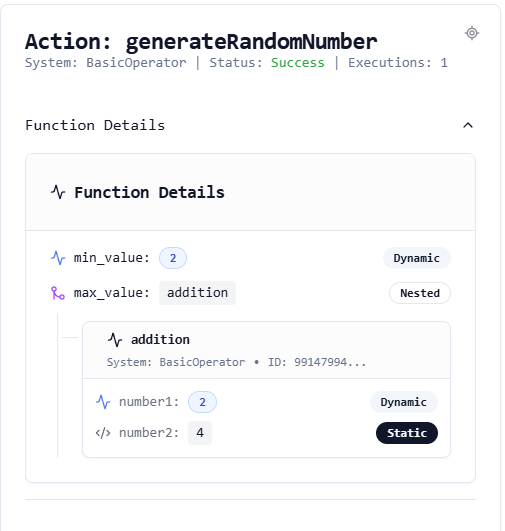
I added some improved logging for blocks. Now we can track nested arguments, and identify whether we are using dynamic, nested or static arguments, and see where exactly everything is coming from.
I also added support for nested functions + cached arguments for prompt templates. It is looking and feeling very cool now
Tempest AI BIP 30:
We finally have a tab view for the creation canvas, which is very useful for scripting + code generation
I also started working on some small QOL features for visual scripting
-Ability to iterate over cached arguments
-Ability to use nested functions + cached arguments for prompt variables
-Tool/Cached argument extraction: If we a LLM generates a schema we can now access specific components of the return
Tempest AI BIP 29:
Chore day today with lots of boring UI and bug fixing. Added the ability to regenerate a game title image, change name, description, etc. And restyled the Navbar, to be more aesthetic 🦋
Refactored the entity component attachment protocols, and remade a more robust "Component Reconciliation" process (If we change a component, we need to update entities that have that component and attempt to salvage data)
Tempest AI BIP 28:
We have added support for symbol representations of game assets, instead of images.
Using symbols we can generate over 200 game assets within 2 minutes, and it saves a lot on Image Generation costs. Perfect for minimalist games.
Lots of small UI optimisations, creation dashboard is looking a lot cleaner now.
Tempest AI BIP 27:
Added support for users to bring their own API key, with verification and encryption
Cleaned up a lot of small UI on the creation dashboard and basic pages
Improved the AI script generation, now we can automatically identify custom conditional blocks
We are approximately 12 days away from our launch, final stretch!