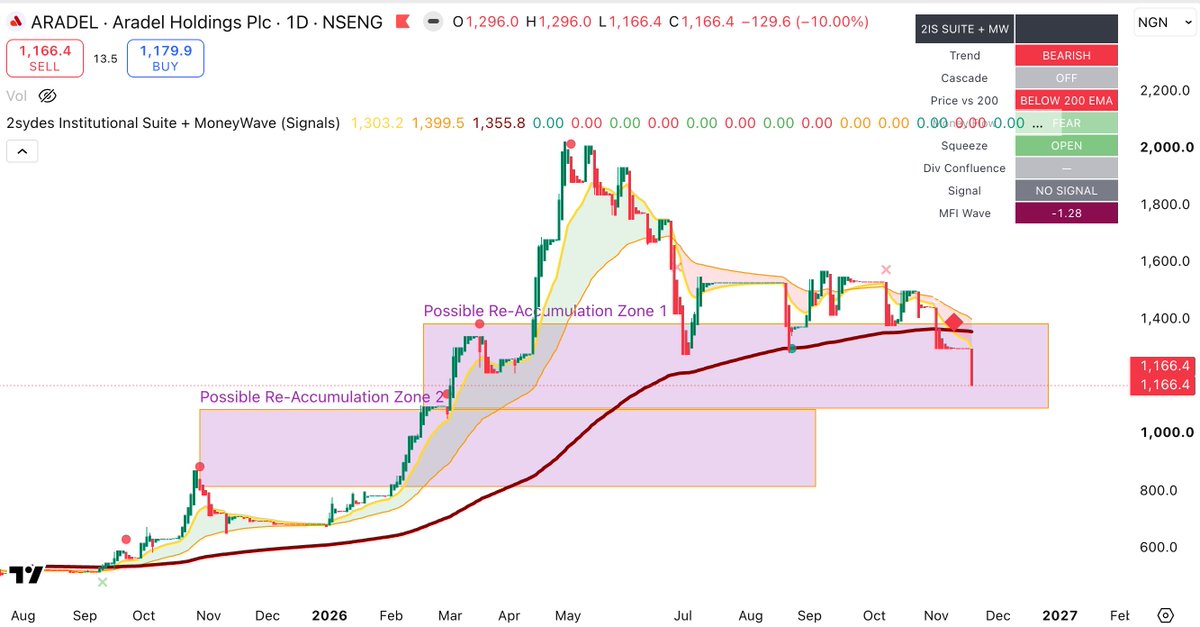
$Aradel Update!
Clearly expected aradel to have this walk down since June. The important 1400 level was lost... We are in re-accumulation!
Hold ₦1,400 → Trend intact. Lose 1400
Zone 1: ₦1,100 → next step Down:
Zone 2 (₦820–1,100).
#Aradel#NGX
It reeks of gross incompetence on the part of the BOT that this situation was allowed to happen in the first place, and I believe they should all seek God’s mercy. However, it also reminds us that we are human and prone to errors, even those entrusted with leadership in the Church. This is precisely why Paul repeatedly solicited prayers for himself and other leaders in the Body of Christ.
Thank God that He is now setting things right and that the earlier mistakes are being corrected.
The legacy of Pastors Taiwo and Bimbo Odukoya deserves to be preserved and honoured. They served God faithfully in their generation, and their labour in His vineyard should not be allowed to be undermined.
A few years ago, while I was at the Exchange, we assessed the policy that allows contributors to use part of their Retirement Savings Account (RSA) as an equity contribution toward a mortgage.
The aim was to evaluate the policy, assess how well it had been implemented, and recommend improvements.
Our assessment identified four connected constraints on access to housing in Nigeria:
✍︎ Low incomes and limited purchasing power
✍︎ High house prices relative to incomes
✍︎ High mortgage rates, reflecting the inflationary environment
✍︎ A shortage of long-term finance, leaving lenders reliant on shorter-term funding
These constraints reinforce one another. A lasting response must improve households’ purchasing power and bring the cost of suitable homes closer to what people can afford.
It must also build a deeper source of long-term housing finance. Expanding long-term funding alone will not raise incomes or bring house prices down.
MREIF is a worthwhile intervention. Its mortgages offer eligible borrowers a lower, more predictable rate and longer repayment terms, while its offtake guarantees are intended to help developers secure construction finance.
Like NELFUND, it uses public support to widen access, although the programmes work in different ways. I see it as subsidy-like, concessionary public capital that helps to support more affordable financing. I think that can make a real difference for some households, and it is better than having no such option.
Whether MREIF can become a durable solution that moves the needle remains to be seen. I doubt it can do so on its own. I also detest any noise suggesting that this thing will move the needle in the broad scheme of things.
It will not even solve 10% of the country’s housing deficit. Even that would be euphemistic. If I were being real, its impact would not be significant.
Mortgage finance addresses part of the problem, which is the gap between household incomes and the cost of housing.
That gap is shaped by incomes and job quality, the supply and cost of land, infrastructure, building costs, title and registration systems, and the availability of homes at prices ordinary households can afford.
A sustainable response has to work on these factors as well as on financing.
Too often, policies in Nigeria focus on the immediate effects of an imbalance (for example, trying to force rates down or restricting access to foreign exchange and imports, etc.), without resolving the conditions that produced it.
Such interventions may provide relief, but they are unlikely to last if the underlying problems remain unresolved. They also carry opportunity costs.
MREIF has already added value in some ways. The latest fund report records 2,195 mortgages and 475 housing units under active offtake guarantees. It also puts the average beneficiary age at 43.
To put the age in context, imagine someone who starts a career in banking at 21 and advances unusually quickly. By 42, that person might only have reached AGM or GM level. But please note that this is an illustration, not a formal MREIF eligibility threshold.
Grade structures and incomes vary, but it helps explain why a scheme requiring a substantial equity contribution and the capacity to make regular mortgage payments may still be inaccessible to many people, even after years in the workforce.
Then we have to ask the question, "Who, in practice, can afford to access MREIF"?
@sofaquila@FinPlanKaluAja1 Nope not at all true,there are no age restrictions to getting a mortgage, credit history and income are the only factors at play