We're two-thirds of the way there with our fundraiser now. But it's still not too late to support our 2026 campaign for better cycling conditions in Hull. Ride on! https://t.co/p77hMzqb3b
We're a third of the way there with our fundraiser. Thanks to everyone who has helped us to keep going for another year. For anyone else who would like to chip in, there's still time to support us https://t.co/p77hMzqb3b
We've launched our 2026 fundraiser. Please support us if you can and help us to provide a strong, independent voice for active travel in #Hull https://t.co/p77hMzqb3b
The water scam was exposed in 1993. Bills rose, bonuses boomed, and extractive controllers took billions. FOIs show the money came from bill payers, not investors. They took forty five pence of every pound we paid. A cash machine. #PeopleVSewage
60% of the British public agree: our voting system is not fit for purpose.
The upcoming Elections Bill is a chance to fix it.
I just signed a @MakeVotesMatter petition to the Democracy Minister, calling for PR. Add your name: https://t.co/ehbHAkAMIz
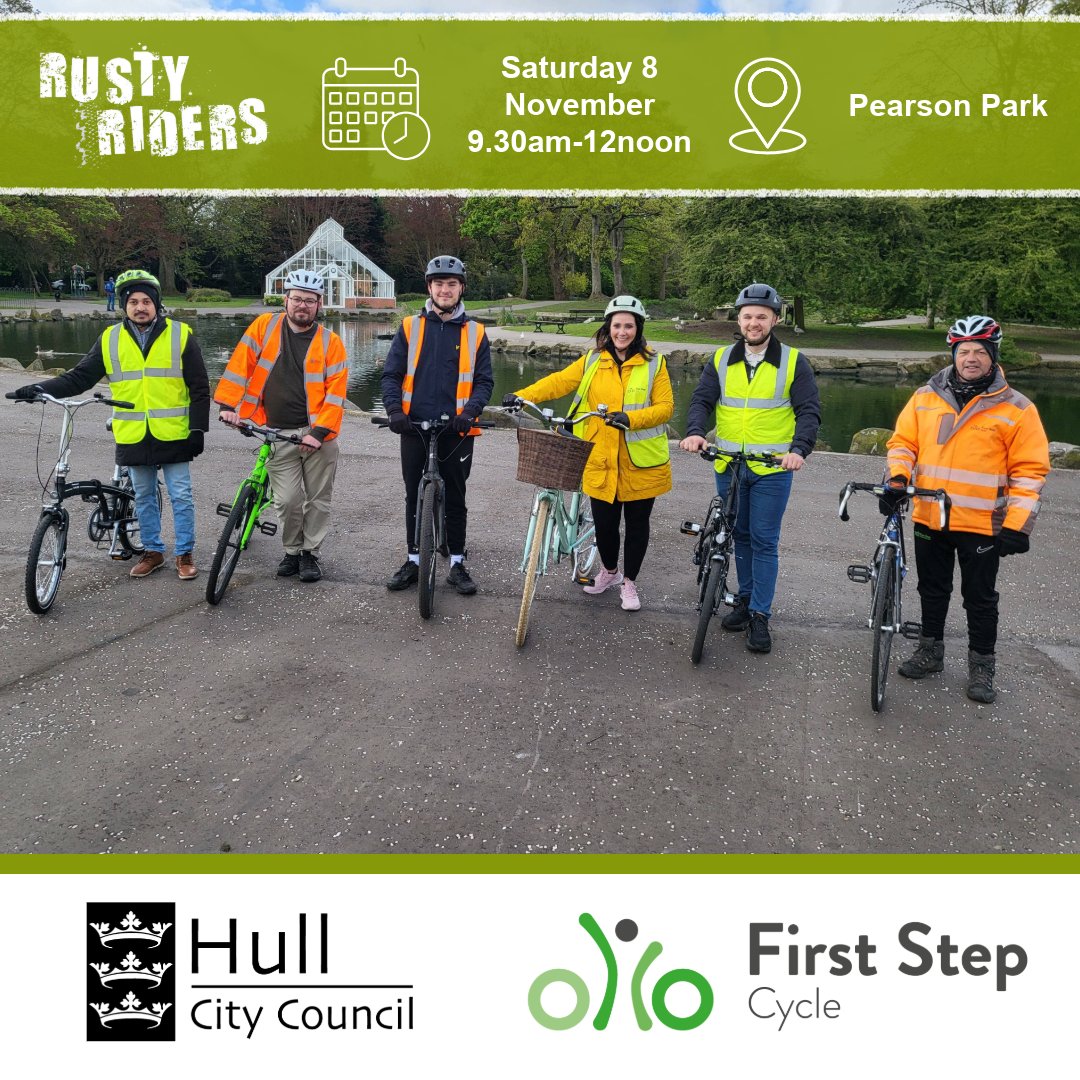
Want to boost your cycling skills? 🚲
Funded by @Hullccnews & delivered by @firststep_cycle, there is a free #RustyRiders session on:
🗓️ Saturday 8 November
📍 Pearson Park
Book your place ⤵️
🔗 https://t.co/dd1nqdE6AV
We all have a responsibility to #ShareTheRoad 🚗
At junctions, recent changes to the Highway Code give priority to people cycling straight on 🚴🏻 and pedestrians crossing 🚶
Check out the video to find out more ⤵️
@travel_hull@Hullccnews Did you invite anyone to this conference to represent the views of vulnerable road users? From a cyclists's point of view, Hull's biggest road safety issues are poor cycle infrastructure and bad driving - not bald tyres.
An Observation on Angela Rayner and the Labour Government:
One cannot help but feel a measure of sympathy for Angela Rayner. I know her well enough to say that she came into politics for the best of reasons: a desire to serve, a determination to improve the lives of people whose struggles she understood from her own experience.
But the further up the ladder one climbs in politics, the more insistent the temptations become. This is not simply about individual weakness or personal failing. It is structural. Over the past 40 years, Britain has built a society in which consumption, status, and proximity to wealth have become defining features of the political class. The gravitational pull of money is now so great that even those who arrive in Westminster with the clearest sense of purpose find their heads turned.
Angela’s story is not unique. She came from humble beginnings, but the wealth that circles political life today is more concentrated, more brazen, and more intrusive than in the past. The old checks and balances, party rootedness in mass membership, trade union accountability, a press less entangled with oligarchic interests, have all weakened. Where once honour, public service, even a sense of historical duty could command respect, today those values are dimmed in comparison to the pursuit of material position.
The mechanism is subtle but relentless. It is not corruption in the brown-envelope-under-the-table sense. It is the slow, almost invisible turning of heads. You are introduced to those who walked this path before you, former ministers who now sit comfortably in boardrooms or on the payroll of consultancies with six and seven-figure salaries. You are invited to corporate boxes at sporting events, to private dinners, to concerts and premiers. Lavish clothes or spectacles can be “within the rules,” provided they are declared. But by then the damage has been done.
The message is implicit but unmistakable: play the game, listen to us, and you too can enjoy more of this. The logic creeps into your personal life. You stretch to buy the house that can host the right gatherings. You measure your worth by the standards of a world that equates success with possessions and proximity to privilege. And once you are on that path, it is hard to step off.
This is, of course, a simplification of a complex socio-economic and political process. But as someone who came from a council estate myself, I see it all around me in Westminster. And it is not going to be changed by media witch-hunts, the tutting of ethics advisers, or even the occasional burst of public outrage.
As Gladstone once warned, “Nothing that is morally wrong can be politically right.” But in our current system, what is morally questionable is too often normalised, excused, and rebranded as “just the way things are.”
Real change will only come from a collective decision to choose a different path: to stop outsourcing our state to private interests, to end the revolving door between government and corporate boardrooms, to challenge the idea that the role of politics is to serve vast concentrations of wealth.
We can choose differently. We can once again put community, solidarity, and public service at the heart of our political life. We can insist that worth is measured not in the size of one’s house or the company one keeps, but in the contribution one makes to society and the integrity with which one serves.
Until we do, until we decide as a polity to hold up those values rather than the glittering prizes of private gain, hese scandals will not just recur. They will define the very character of our politics.
Reminder
The Tories, Labour, and Reform UK all back free zones.
There are several different types of free zones currently operating in the UK, they are
Food Enterprise Zones
AI Growth Zones
Freeports
Special Economic Zones
University Enterprise Zones
Investment Zones
Enterprise Zones
Industrial Strategy Zones
Sign my petition to call for transparency on deregulated free zones. These zones are Ponzi schemes for the asset classes funded with State aid, which is public money.
The UK is being privatised.
https://t.co/aH1mgtUni6
August 8 is the chance to respond to the draft LCWIP, Hull City Council's vision and key priorities for active travel infrastructure improvements over the next 10 years https://t.co/1C5o2Hgjrt
In its current form, the draft LCWIP is NOT the transformative plan that Hull needs to promote significant modal shift. It prioritises commuting routes, despite only 29% of cycle trips being work-related and places too much emphasis on maintaining the car-centric status quo.
CycHull have proposed amendments aimed at creating a more inclusive, ambitious, and effective cycling infrastructure that meets the needs of all. Read our blog summary here https://t.co/h8hXDqopaT
We’re really pleased to support this campaign to encourage people to think about others when travelling around. Active travel is the quietest, healthiest, cleanest and least congesting way to get round the city but also the most vulnerable.
🚨 No More First Past the Post Elections.
5 parties polling strongly, chaotic results, millions left unrepresented.
We need Proportional Representation — NOW.
@CompassOffice@UnlockDemocracy@MakeVotesMatter
✍️ Sign the petition: https://t.co/1XLB73ONUa