Wanderwort is German for "wandering word." Linguists use it for a word borrowed across a wide area, often through trade. Tea is one. Dutch traders adopted the Amoy word te as thee.
The posts here follow words like these across Asia and Europe. The cards list their sources.
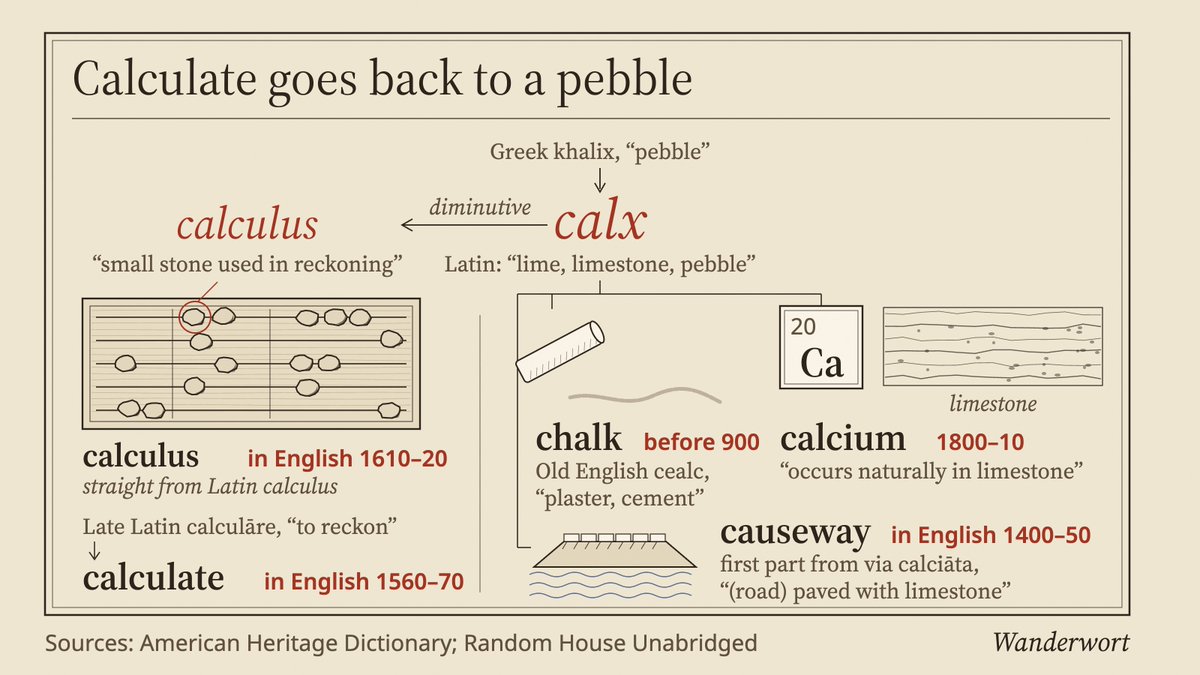
Calculate goes back to a pebble. Latin calculus was a small stone used in reckoning, a diminutive of calx, which also meant lime and limestone. The same calx is behind chalk, calcium and causeway, whose first part comes from Latin calciāta via, a road paved with limestone.
Alphabet is an ox and a house. Greek alpha comes from Phoenician ʾlp, "ox," and beta from bt, "house," the names of the first two Phoenician letters, and Greek joined them as alphabētos.
Alan Gardiner and others dated signs from Serabit el-Khadim, an Egyptian turquoise-mining site in Sinai, to the early second millennium BC. In Gardiner's reading, the letter that became A is an ox's head and the one that became B is the floor plan of a house.
@AMAZlNGNATURE Species comes from Latin speciēs, “appearance, form, sort, kind,” built on specere, “to look.” It is first recorded between 1545 and 1555.
@Reuters Mammoth was taken from Russian between 1690 and 1700. One dictionary calls its origin uncertain; another traces it, probably, to a Siberian Mansi word built from “earth” and “horn,” for fossil tusks.
@historyinmemes Jurassic is named after the Jura Mountains, and its -assic ending was lifted from Triassic. The word is first recorded between 1825 and 1835.
@mabian@AMAZlNGNATURE Latin had one too: ululāre, “to howl, shriek,” also of imitative origin. Its English descendant ululate can mean to hoot, as an owl does.
@historyinmemes Mattress came into English through Old French and Italian from Arabic maṭraḥ, “place where something is thrown, mat, cushion,” from a verb meaning “to throw.”