⚡️Kaspa 11
#6 - GhostDAG 👻
Kaspa’s GhostDAG protocol refines DAG-based technology to improve scalability and security while maintaining fair consensus. Unlike traditional DAG systems, which struggle to determine the main chain, GhostDAG assigns probabilities to blocks for fair inclusion and rewards.
This approach enables Kaspa to achieve Nakamoto Consensus, ensuring a secure and consistently agreed-upon transaction history without relying on a traditional linear blockchain.
ICYMI - May 5th, Kaspa delivers 10 BPS.
Learn all about this via the link in the thread.
"TN10 has fully and successfully transitioned to 10BPS"
𝆒 Crescendo Roadmap Update!
✅ Launch & Stabilize - Completed
✅ Identify bottlenecks- Completed
✅ Enhanced User Experience - Completed
✅ Additional Features - Completed
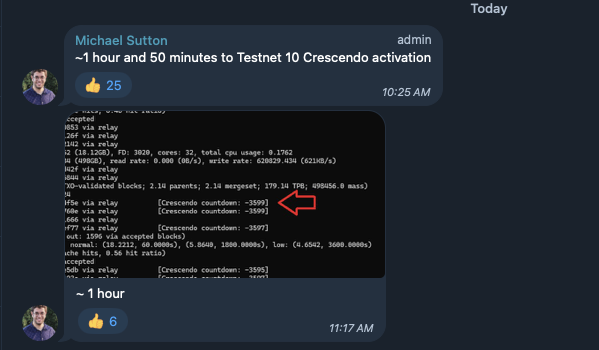
✅ TN 10 Activation - Completed
🎯 Feature Freeze - 95% (~March 20)
🎯 Main Hardfork Version - ~End of March
🎯 Mainnet Activation - ~End of April/beginning of May
Hello there Lorenzo! Thank you for reaching out to us on X. We are here to help you out. We understand and appreciate your enthusiasm and excitement regarding the reward distribution. Please keep in mind that sometimes due to technical issue there can be slight delays for distribution rewards. Our team is working and doing their absolute best to finish the deadline. Thank you for your patience and support. ^AE
@Igra_Labs : The Missing Piece in Kaspa’s Evolution
⚔️ Ethereum rollups aren’t solving the problem.
💀 Bitcoin smart contracts don’t exist yet.
🩸 Solana is centralized.
💡 Kaspa is fast, secure, and decentralized.
The only thing missing? Programmability.
That’s where Igra comes in.
Not another “L2.” Not another centralized sequencer. Igra makes #Kaspa programmable without breaking what makes it unique.
1. What is Igra?
📌 A Base Rollup built on Kaspa’s BlockDAG
📌 EVM-compatible (Ethereum dev tools work out of the box)
📌 Transactions go to Kaspa first (no centralized sequencer)
📌3,000 TPS, sub-second finality
📌No MEV manipulation (transactions can't be reordered for profit)
Ethereum rollups batch transactions off-chain and submit them later. That’s not real decentralization, it’s just outsourcing trust to another layer.
Igra does it differently:
Step 1 - Transactions hit Kaspa L1 first
Step 2 - L2 state is derived directly from the base layer
Step 3 - No extra consensus needed
This is what Ethereum calls a “Base Rollup” except Ethereum isn’t fast enough to support them yet. Kaspa already is.
2. Why Does This Matter?
Ethereum’s rollup model is breaking its own ecosystem:
📌 Centralized sequencers → Whoever controls ordering controls the market.
📌 Fragmented liquidity → Every rollup is isolated from the others.
📌 High costs → Ethereum’s L1 gas fees are still a bottleneck.
Bitcoin? Nowhere near ready for smart contracts. Even if it gets ZK rollups, they’ll lack sequencing and data availability.
Kaspa fixes the base layer. Igra makes it programmable.
Instead of launching yet another isolated rollup, Igra uses Kaspa as a decentralized sequencer.
Why does that matter? Because it means:
✅ No single point of failure
✅ No trusted middlemen
✅ No liquidity fragmentation
Kaspa is already what Ethereum wants to be. The only thing missing was programmability. Now that’s solved.
3. Why Not Just Add Smart Contracts to Kaspa L1?
Some people argue Kaspa should just have native smart contracts instead of a separate execution layer.
I feel that’s not the best approach.
L1 should stay optimized for speed and sequencing
Base Rollups scale better and don’t bloat the network
Programmability at L2 = Kaspa always remains lightweight and efficient
Trying to force smart contracts into L1 would slow everything down. Igra keeps Kaspa lean while adding the flexibility of a full smart contract system.
4. The ZK Roadmap: What Comes Next?
Igra starts as a Base Rollup. But the real unlock happens when zero-knowledge proofs (ZK) go live.
Kaspa prunes data every 3 days. Without ZK, past transactions wouldn’t be verifiable forever.
ZK allows Kaspa L1 to validate Igra’s state transitions trustlessly.
No more trusted bridges, assets can move between Kaspa & Igra without middlemen.
Ethereum is struggling to make ZK-native rollups work. Kaspa is built for them.
The moment Kaspa’s ZK opcode is live, Igra will be able to execute smart contracts at a scale Ethereum can’t match.
5. Beyond EVM: Igra’s Long-Term Vision
Igra launches with EVM compatibility because it’s the easiest way to bring developers in. But the endgame is much bigger.
Kaspa’s speed + Igra’s design = full VM interoperability.
This means:
Ethereum’s EVM → Already working.
Solana VM → Future compatibility.
Move, WASM → Will integrate over time.
Right now, every blockchain is its own walled garden. Igra’s long-term plan is to connect them all under one architecture.
Imagine a Move-based gaming app, an Ethereum DeFi contract, and a WASM verification system all interacting seamlessly. That’s where this is going.
6. Timeline
Testnet (invite-only): End of Q1
Public rollout: April
Mainnet: 2025 (aligned with Kaspa’s ZK opcode upgrade)
The only bottleneck? Waiting on Kaspa’s core team to finalize ZK opcode implementation which is likely happening as you are reading this.
If you’re still building on Ethereum L2s, you’re already behind.
Kaspa is the future. Igra just made it programmable.
🔥 I break down what actually matters in no hype, just facts. Follow me to stay ahead of the curve. 🔥
🚀Kaspa 11
1. It's FAST! ⚡️
Kaspa is the fastest Layer 1 Proof-of-Work blockDAG today, and its unique architecture allows it to scale beyond what traditional PoW chains can achieve. With fully confirmed transactions in 10 seconds, this makes Kaspa ideal for everyday transactions.
Crescendo HF, coming in ~April will offer 10 BPS!