Peking University.
Land carbon cycle at seasonal, interannual, and decadal timescales; Process-based AI model; Vegetation greenness and productivity; El Nino
We warn that such record-shattering global warming, potentially occurring periodically due to El Niño–amplified extremes, will pose a growing threat to the tropical carbon cycle, and ultimately the stability of the coupled carbon–climate system.
The global land carbon sink in 2024 shrunk to half of the average over the past decade, from our process-based AI model "Carbon Mind". Heat and drought as the key drivers behind the tropical carbon sink decline.
https://t.co/NEzxNCtGXx
Exciting finding! We found the record-high global vegetation greenness in 2024. But tropical rainforests were not greener. So the global land carbon sink in 2024 could not increase.
This study was also led by Yanchen Gui, Heyuan Wang, and Zhe Jin, guided by Shilong Piao, Tengjiao Wang, Tao Wang, Xiangjun Tian, and Wei Chen. Xiangyi @Xiangy_li and Hanzhi Deng also contributed.
The first result of our AI model based on ecosystem processes has been released! We found that the decline in tropical land carbon sink drove the record high atmospheric CO2 growth rate in 2023.
The paper @NSR_Family could be found at https://t.co/HOoSUFmdmz
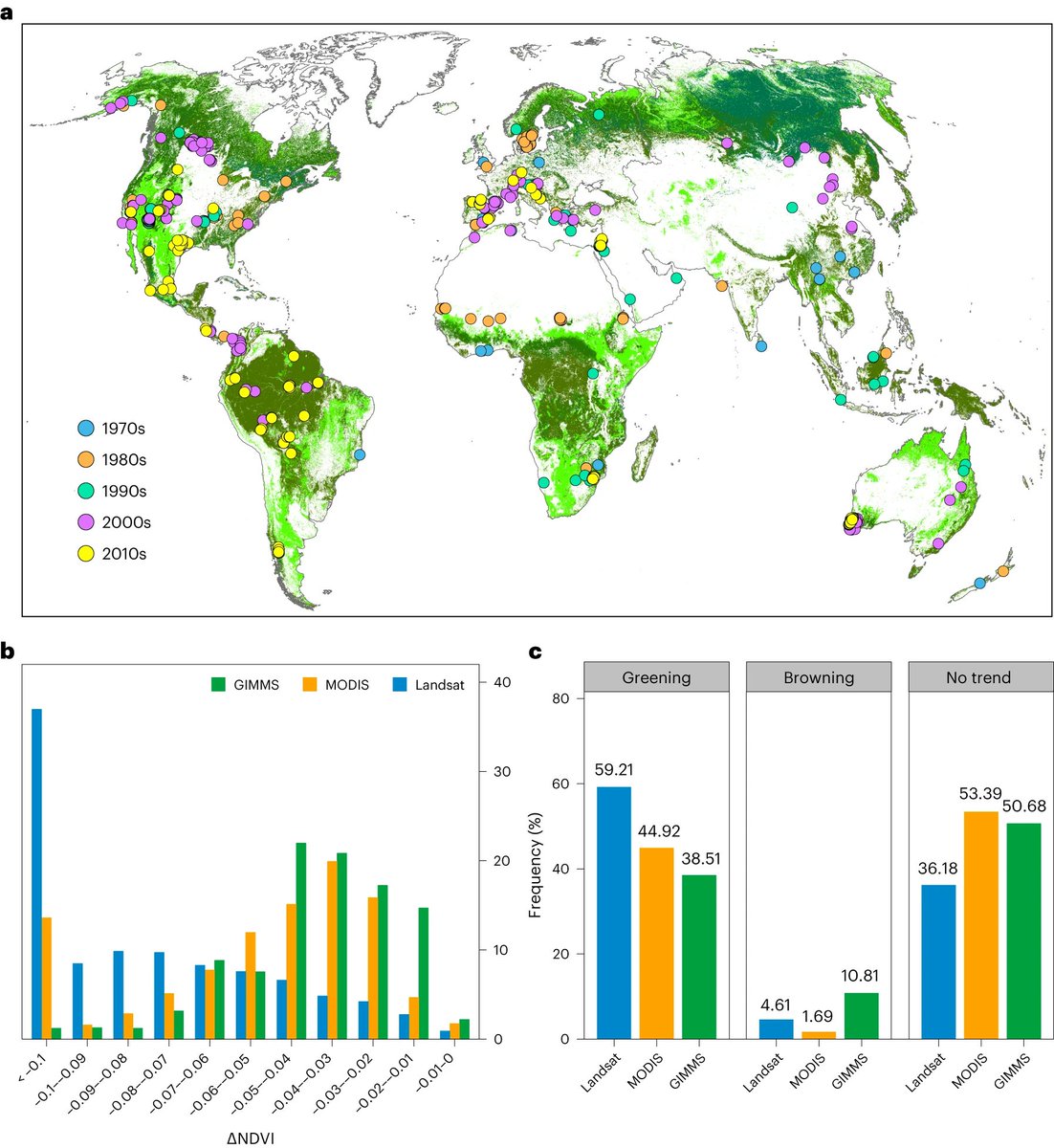
Very nice study led by Xiangyi! @Xiangy_li We have investigated the level of 2023 greenness among the recent 24 years. The "greening" of Earth continues for the recent decades, but climate extremes could modulate the long-term pace in greenness.
Xiangyi Li et al. (incl. @JosepPenuelas) write on vegetation greenness.
TL;DR: global greenness was the third highest on record, with strong greening and browning signals observed at regional scales.
https://t.co/KnfS4rz87s
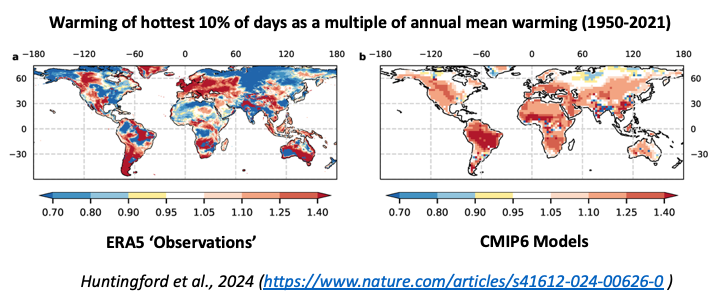
On many parts of the land surface, the hottest days are warming faster than the annual mean, according to a new paper by Chris Huntingford, @Lambda_Joe, @PDLRitchie et al. (@UKCEHPapers@GSI_Exeter@ExeterUniMaths ). Full paper available at: https://t.co/8sHRQLuJCv
@GlobalChangeBio In this paper, we further found that both decreased spatial coherence of tropical land temperature variability and land use change could cause more spatial compensation of net land flux variability, thus decreasing the regionally apparent temperature sensitivity.
The temperature sensitivity of tropical land carbon sink recently has declined! However, it is more likely a regionally integrated signal and local sensitivities did not change a lot.
A new paper published in GCB: https://t.co/BfK2IeUslG
@GlobalChangeBio
We have completed an improved and updated Global Nitrous Oxide Budget, now in review.
A report card on the state of natural and anthropogenic sources and sinks of N2O, the third most important GHG.
An effort by many led by Hanqin Tian & Rona Thompson.
https://t.co/RimrPVwPsc
Carbon dioxide removal (CDR) is not the same as carbon capture and sequestration (CCS), and we need to stop inaccurately conflating the two.
CDR removes atmospheric CO2. Its carbon negative.
CCS (w/fossil fuels) reduces the amount of CO2 emitted. It's at best carbon neutral.
What is the dominant driver of global land carbon uptake variability? Water or temperature? We provide a pathway to quantify how their regional and seasonal controls contribute their effects at global scale.
https://t.co/y1lrBPYmGM