From a scientific and financial perspective, CRVS CEO Miller's actions are reasonable; steady progress is key. Also, I'd like to say there's too much noise and idiocy; stay away from that. Return to scientific data. $CRVS
Day 3 of the dip. I see panicking retail venting, and I see "sudden experts" (short mercenaries) empty-shouting FUD.
See you guys at Phase 2 readout. We play the long game.#Soquelitinib $CRVS
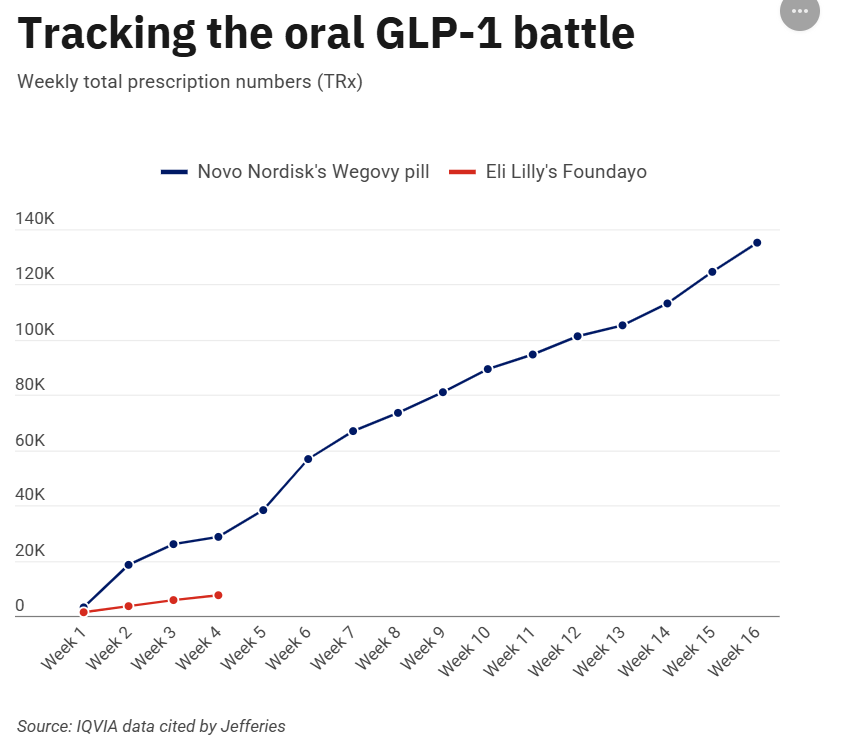
$NVO Wegovy’s total scripts rose by 1.3% week over week to nearly 446,000, as its share in the obesity GLP-1 market climbed 0.1 percentage point to 40.5%, according to Citi.
@tradingsssss My reason for buying CRVS is that it's heading towards the finish line, and I won't sell it until that day comes. I'll maintain my skepticism while also making friends with time.
@6758qcrctt@tradingsssss@HOThomasWPhelps If I remember correctly, from mid to the second half of 2026, Angel Pharma's multicenter data in Asia/China will be cross-referenced with US data. Please correct me if I'm wrong.
What Miller meant by expensive isn't just about cash it’s about the cost of time Dragging out an unnecessary 90day follow-up for Cohort 4 in a Phase 1 trial burns massive clinical ops capital and worse delays FDA data submission for Phase 2/3 registrational trials by months $CRVS
@semodough Miller $CRVS skips ER last week and comes with this instead?
He says that the 90 day follow up on cohort 4 was too expensive and they will do it in phase 2.
Besides, he was a total mess in his presentation.
I wish that was not the case.
The points made in the conference call were very clear. $CRVS Phase 1 final data at #SID2026 is a game changer. It’s not just about EASI scores; it’s about Immune Rebalancing.
@tradingsssss@HOThomasWPhelps Exactly The synergy between $CRVS and Angel Pharma isn't just about clinical data; it's a strategic alignment of the entire supply chain. Having CROs and CMOs as stakeholders ensures maximum efficiency and paves the way for rapid NRDL (reimbursement) integration in China
data reservoir'in China. High enrollment efficiency + lower costs = faster de-risking for AD and PTCL. These early signals significantly boost tolerance for error while the massive Asian dataset ensures a robust multi-ethnic safety profile potentially fast-tracking FDA approval
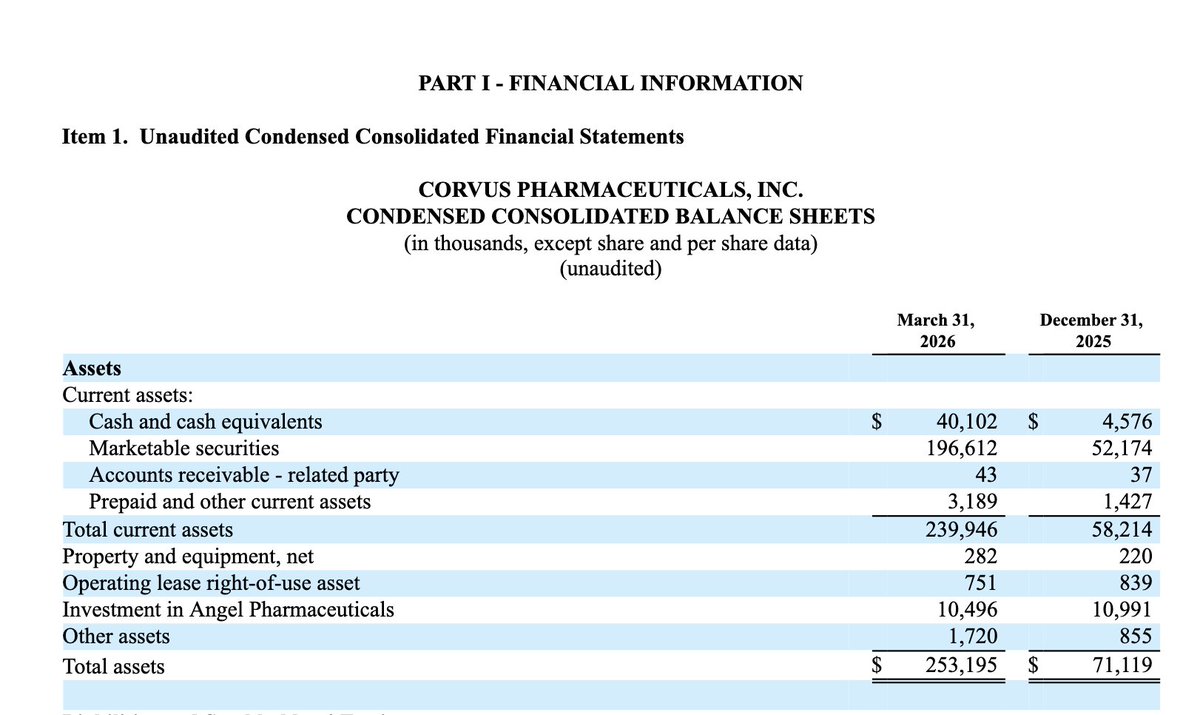
$CRVS very conservative in its carrying value of 49.7% ownership of Angel Pharmaceuticals, on balance sheet at $10.5M (Mar 31, 2026)
Could be significantly underestimating value of Chinese partner which is currently running 12 week atopic dermatitis Ph1/2 study
The deciding factor for Soquelitinib is its Treg-driven immune reset rather than its onset of action compared to Dupixent. If May’s SID results validate this logic, current price levels are but the base of a long-term upward curve.thank you for the insights. $CRVS #Soquelitinib
$CRVS Explanation I have been working on to explain #soquelitinib durability in atopic dermatitis w/ 90% of patients showing AD remission still 90 days post-treatment due to novel short-term Signal 1 interference v other Signal 3 blocking approaches = leading to "immune reset" and long-lived iTregs for durable disease control.
My hypothesis below fits w/ comments from Corvus they are seeing changes in JAK/STAT pathway and Tregs that they will disclose at SID in May.
My thoughts:
"A mechanistic hypothesis that selective ITK inhibition stabilizes induced FOXP3+ Tregs through suppression of the IL-4/STAT6 epigenetic destabilization axis"
Background:
Induced regulatory T cells, or iTregs, are an attractive therapeutic concept in autoimmune and inflammatory disease because they offer the possibility of restoring immune balance rather than merely suppressing downstream inflammation. In principle, a durable increase in stable FOXP3+ suppressive T cells could reset the relationship between effector and regulatory immunity and produce benefits that persist after treatment ends. In practice, however, iTregs are often unstable. Inflammatory cytokine environments can weaken FOXP3 expression, reduce suppressive function, and permit reversion toward effector phenotypes. This fragility is a central limitation of many immune-rebalancing strategies.
A particularly important destabilizing pathway is the IL-4/STAT6 axis. IL-4 promotes #Th2 polarization, but it also acts as an antagonist of iTreg differentiation and maintenance. Through IL-4Rα and downstream #JAK/#STAT6 signaling, inflammatory Th2 conditions can oppose the establishment of a stable FOXP3 program. This is relevant because durable Treg biology depends not only on transient induction of FOXP3, but on maintenance of an epigenetic state at the FOXP3 locus that supports continued transcription and resists inflammatory reprogramming.
Selective ITK inhibition raises a potentially important question in this context. ITK sits upstream in T-cell receptor signaling (Signal 1) and is especially important for programs that support inflammatory helper T-cell differentiation, including Th2 and Th17 responses. If selective ITK inhibition reduces Th2-driving circuitry and IL-4 production while also favoring Treg-skewed differentiation, it may influence both the generation and the long-term stability of induced FOXP3+ Tregs. That possibility leads to my central hypothesis: selective ITK inhibition may stabilize induced FOXP3+ Tregs through suppression of the IL-4/STAT6 epigenetic destabilization axis.
Mechanistic Model - The proposed model has two linked stages:
The first stage is differentiation bias. Selective ITK inhibition weakens proximal TCR signaling (i.e., CD28) and thereby reduces support for inflammatory effector programs, especially Th2 and Th17 differentiation. In parallel, this signaling shift may favor the emergence of FOXP3+ induced Tregs. In this sense, ITK inhibition may function as a lineage-biasing intervention, moving the immune system away from inflammatory helper states and toward a more regulatory balance.
The second stage is stability. This stage may be the more important or most important for explaining durable benefit. The model proposes that selective ITK inhibition reduces GATA-3 (strongly shown by Corvus) and IL-4 output from effector T cells, which in turn lowers activation of the IL-4Rα-JAK-STAT6 pathway. Reduced STAT6 signaling then relieves a major source of iTreg destabilization. Under these conditions, induced FOXP3+ Tregs may be more likely to preserve an epigenetic state compatible with durable lineage identity.
Next, three candidate regulatory nodes I have identified seem especially relevant in this framework. First, reduced STAT6 signaling may lower #DNMT1 activity or expression, helping preserve demethylation of the FOXP3 Treg-specific demethylated region and supporting continued FOXP3 transcription. Second, reduced IL-4/STAT6 signaling may decrease #HDAC9 activity or expression, favoring retention of histone acetylation across key FOXP3 regulatory elements such as CNS1 and CNS2. Third, histone acetyltransferase (#HAT1) activity may become relatively favored, potentially increasing chromatin accessibility at the FOXP3 locus. The combined effect would be a more transcriptionally open FOXP3 region, more persistent FOXP3 expression, and a more stable suppressive iTreg phenotype.
This model does not require ITK inhibition to bind directly to chromatin regulators. Instead selective ITK inhibition may act upstream of the epigenetic program by changing the cytokine and transcription-factor environment that determines whether induced Tregs remain stable or become plastic.
Supporting Evidence in Literature:
Several lines of evidence support this framework, although they do not yet establish the full mechanism.
1. ITK biology supports the differentiation component of the model. ITK is a key signaling node downstream of the TCR and has a recognized role in inflammatory helper T-cell differentiation. Studies of ITK-deficient or ITK-inhibited systems support the idea that dampening ITK can shift the balance away from inflammatory effector programs and toward regulatory phenotypes. Avery August paper even showed that CPI-818 (soquelitinib) inhibition of ITK act like a switch diverting Th17 destined effector T-cells to the regulatory iTreg phenotype. This provides a plausible basis for the idea that selective ITK inhibition may increase formation of induced FOXP3+ Tregs in vivo.
2. The IL-4/STAT6 pathway is a credible destabilization axis for iTregs. IL-4 is not merely a Th2 cytokine; it also interferes with Treg differentiation and stability. Work on IL-4/STAT6 signaling has shown that this pathway can reduce Foxp3-associated chromatin accessibility and promote epigenetic conditions unfavorable for stable Treg identity. This makes STAT6 an especially meaningful intermediate between altered cytokine signaling and altered FOXP3 stability.
3. Epigenetic control of the FOXP3 locus is known to be central to Treg persistence. Stable Treg identity is associated with an accessible and appropriately demethylated FOXP3 locus, including key regulatory regions such as CNS1, CNS2, and the Treg-specific demethylated region (#TSDR). By contrast, transient or unstable FOXP3 induction is more vulnerable to loss under inflammatory conditions. This literature strongly supports the general principle that durable Treg function requires more than temporary transcriptional activation.
4. Prior work suggests that STAT6-deficient settings favor more suppressive Treg biology. Even Ibrutinib has shown to do this. Studies in STAT6-deficient systems have shown increased Treg abundance and the ability of relatively modest Treg increases to reduce allergic inflammation and impair recruitment of inflammatory effector T cells into tissues. Additional work has linked reduced STAT6 signaling to more favorable FOXP3-associated epigenetic states, including reduced DNMT1-related pressure. These findings do not prove the soquelitinib mechanism, but they strengthen the plausibility of the pathway being proposed.
5. Transcriptomic work in ITK-deficient T cells has identified changes in genes related to chromatin regulation, including HDAC9 and HAT1-associated signals. These findings are hypothesis-generating rather than definitive, but they support the idea that ITK biology may intersect with epigenetic regulators relevant to FOXP3 stability. In particular, the directionality of reduced HDAC9 and increased acetyltransferase-related signaling is consistent with a more open FOXP3 chromatin state.
Taken together, these strands support a coherent upstream-to-downstream logic: ITK inhibition may reduce inflammatory T-cell programming and IL-4 production; reduced IL-4 may dampen STAT6 activation; reduced STAT6 activity may lessen epigenetic pressure against stable FOXP3 expression; and the resulting iTregs may be more durable and suppressive than iTregs generated under inflammatory conditions.
What I am watching for that we may hear about at SID:
1. Whether selective ITK inhibition with soquelitinib reduces IL-4/STAT6 signaling in relevant immune compartments and pSTAT6 in the relevant human T-cell and Treg compartments to a biologically meaningful degree. This is central to the hypothesis.
2. Whether DNMT1, HDAC9, and HAT2 acetyltransferase-related pathways actually change in the predicted direction within induced Tregs generated under soquelitinib exposure.
3. Related to FOXP3 locus specificity including FOXP3 TSDR methylation analysis, chromatin accessibility testing such as ATAC-seq, and chromatin immunoprecipitation or related assays for histone acetylation across the FOXP3 promoter, CNS1, and CNS2, TSDR regions. This would establish whether the proposed upstream signaling changes actually produce the predicted local epigenetic consequences.
4. Whether any induced Tregs formed under ITK inhibition remain stable after drug withdrawal and inflammatory rechallenge. This is arguably the most important question of all. The hypothesis is ultimately about durability. It is not enough to show more FOXP3+ cells on drug. It must be shown that these cells retain FOXP3 expression and suppressive function after washout, particularly when exposed again to destabilizing cytokines such as IL-4.
5. If data supports formation of stable iTreg lineage conversion, not merely transient FOXP3 induction. Many systems can increase FOXP3 expression temporarily without generating truly stable suppressive cells. A durable clinical effect would require stable iTregs, but Corvus already seeing a durable effect in atopic dermatitis which is highly suggestive they are.
The current framework is best presented as a mechanistic hypothesis with strong biologic coherence and literature support and high potential significance/benefit, but not yet as an established mechanism. Together, such data would convert the current model from a plausible hypothesis into a mechanistically supported explanation for post-treatment durability.
Conclusion:
Selective ITK inhibition may have effects that extend beyond transient anti-inflammatory suppression. A coherent mechanistic model is that it first biases T-cell differentiation toward induced FOXP3+ regulatory states and away from inflammatory helper programs, then stabilizes those induced Tregs indirectly by suppressing the IL-4/STAT6 axis that normally drives epigenetic destabilization. In that setting, reduced DNMT1 and HDAC9 pressure, along with a more accessible FOXP3 locus, could help maintain persistent FOXP3 expression and durable suppressive function.
The significance of this hypothesis is HIGH because, if validated, it would offer a biologically plausible explanation for benefit that persists beyond active dosing. It would also position selective ITK inhibition as a true "immune-rebalancing strategy" rather than simply another anti-cytokine or downstream suppressive approach that reverses as soon as treatment is stopped.
If my hypothesis is validated, it is potentially game-changing not just for atopic dermatitis but for a broad range of I&I indications because it would move soquelitinib out of the standard “anti-inflammatory suppressor” bucket and into an “immune reset/stability-restoration” bucket. That is a much bigger claim. Scientifically, it would suggest that ITK inhibition is upstream enough (Signal 1) to alter not just cytokine output but the long-term lineage stability of suppressive T cells. Therapeutically, that would support intermittent dosing and off-drug durability rather than simple chronic suppression. This would be a revolutionary approach and paradigm shift in treatment of auto-immune diseases.
@pmill145 On March 26, 2026, The Vanguard Group, Inc. filed a 13G/A (amended notice) regarding CRVS, which showed that the beneficial ownership was indeed 0 shares (0%). The notice explicitly noted that Vanguard completed its internal restructuring on January 12, 2026.