A cement company just launched a 53-episode microdrama.
JK Super Cement, from one of India’s biggest cement groups, is turning homebuilding into entertainment instead of just running ads.
It’s not random: microdrama has exploded from China into the US and beyond, with billions in annual revenue.
The shift is simple:
Product → Story → Entertainment → IP
If even cement can become content, why are brands still just buying banners?
Paysafe just launched a “Video Gaming Arena” connecting game publishers to its 19M+ consumer network through game discovery, rewards, community and payments.
Does it make sense that a payments company just launched a gaming platform?
Payments know who spends.
Social knows who watches.
Creators know who cares.
Game engines know what they play.
Everyone is slowly invading everyone else’s business.
The weirdest gaming companies of the next decade probably won’t start as gaming companies.
Dr. Dre woke up and chose violence:
“The only people that see AI as a threat are the people who have trouble creating.”
He compared AI critics to people who hated drum machines and synthesizers.
Brutal.
But the interesting part:
AI doesn’t make everyone creative.
It makes execution cheap.
Very good news if your edge is taste.
Very bad news if your edge was just knowing how to use the tools.
Booming Games just got fined C$70K because auto-play was left enabled on some slots in Ontario.
Imagine that Jira ticket:
Priority: Low
“Disable auto-play.”
6 months later:
Priority: C$70,000
This is exactly where QA + compliance agents should help. An agent can continuously check:
→ banned features by market
→ RTP / game-setting mismatches
→ UI behavior against local rules
→ release configs before deployment
→ whether a “small” change quietly breaks compliance
Humans still own the decision. But machines are much better at checking the same boring rule 10,000 times without getting tired.
Booming Games doesn’t just need QA.
It needs a QA + compliance agent.
DRX won Worlds and apparently decided esports wasn’t enough.
Now they’re doing K-dramas + game publishing + content IP.
The future entertainment company probably won’t be a “game studio” or “drama studio.”
It’ll own an audience and turn the same IP into whatever format works.
DRX is slowly becoming Disney with keyboards?
Apple is reportedly cutting jobs across Siri, Vision Pro immersive video, and a Vision Pro gaming team — with the gaming group largely being shut down.
Apple spent years trying to make VR gaming feel like the future.
Gamers responded:
“Cool. Does it run on my phone?”
The lesson from consumer tech keeps repeating:
Better technology ≠ better product.
If users need a new habit, new hardware, and a new reason to care at the same time…you’re probably asking for too much. One step at a time
Makers Fund just raised another $250M for gaming.
At the same time, everyone keeps telling you:
“Gaming is a terrible market.”
“VCs don’t fund games.”
“Consumer is dead.”
Capital didn’t leave gaming.
It just became much pickier about what deserves to exist.
Probably healthy.
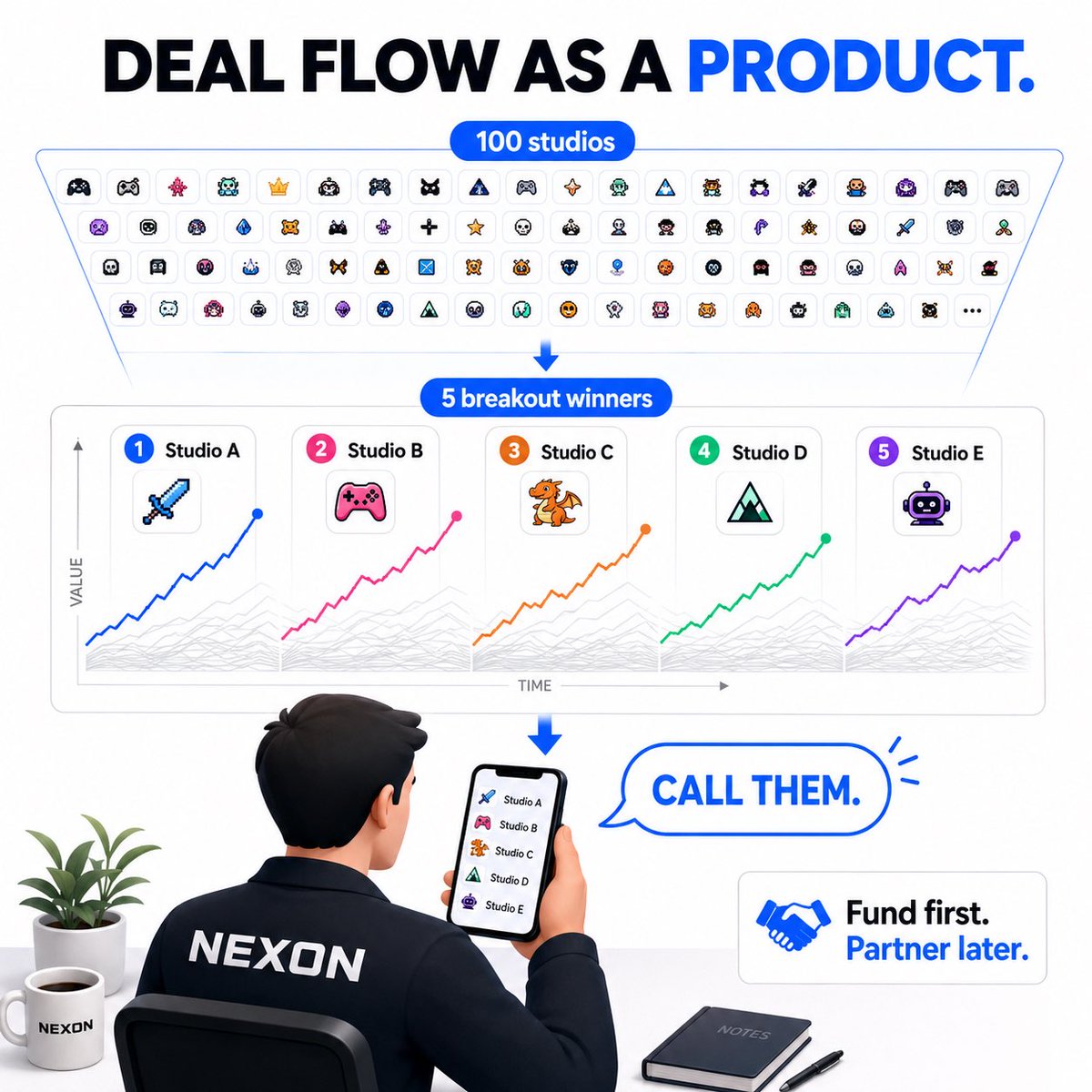
Nexon launched a $179M gaming fund.
But the smartest part?
They don’t require founders to publish with Nexon.
That’s not generosity.
It’s deal flow as a product.
Give 100 studios money + independence.
Watch which 5 become monsters.
Then make the phone call.
Sometimes the best acquisition strategy is just getting very early access to the leaderboard.
Funny that the “best AI model” debate may end up mattering less than:
Does it remember anything?
Can it use tools?
Does someone check its work?
Turns out agents need infrastructure, not just IQ.
A Roblox event in Japan just pulled 1M visits in 48 hours — up from 190k in 2024.
Average playtime: 41 minutes.
Meanwhile brands are still celebrating when someone watches their 15-second ad to the end.
Maybe the future of advertising isn’t better ads.
It’s giving people somewhere they actually want to hang out.
Patreon helped creators escape the algorithm.
Now it’s adding Clips, discovery, recommendations and communities.
So basically:
Monetize audience → realize you still need audience → build TikTok.
Every creator platform eventually discovers the same problem: distribution wins.
On August 20, Meta rolled Pocket out across the U.S.—an experimental app where people prompt AI to create small playable games and then share/remix them.
Meta launching an AI game maker is not the interesting part.
The interesting part is that they called it Pocket.
Because apparently every AI company eventually discovers the same product roadmap:
Chat with AI
Code with AI
Make videos with AI
Make games with AI
Put all of it in a feed
Pray it becomes TikTok
Everyone can be a builder now.
But building the generator is becoming table stakes.
Building the behavior around it is the actual product.
AI video is approaching 1¢ per second.
Bad news for agencies charging $30k to debate whether the button should be blue.
At this price, the new workflow is:
Generate 1,000.
Post 100.
Keep 10.
Scale 1.
Creative Director, 2027:
“Which concept did we approve?”
“All of them.”
On August 19, Aristocrat Gaming’s Awager launched on BetMGM in New Jersey, letting online players remotely operate actual physical slot machines through a live video stream rather than a digital simulation.
We spent 20 years turning casino machines into software. Now we’re turning software back into casino machines.
Aristocrat just launched live-streamed physical slots on BetMGM. You sit at home. A real slot machine sits somewhere else. You remotely press the button. The reels physically spin.
Apparently cloud gaming wasn’t complicated enough, so we invented cloud gambling hardware. 😂
But there’s actually something interesting here. If players value provable physical reality, the future of online casino may not be 100% digital. Live dealer already proved this. Slots might be next?