Agents are functions. Accept that, and 50 years of computer science, scheduling, caching, parallelism, etc. shows up to help.
Full post, with the interactive graphs: https://t.co/Kkh8MVaoFK
We run swarms of 1,000 agents and its cheaper than 1 instance of Opus.
Excited to announce a new post growing in the @phoebe_work Garden:
f(a) = agents as a function
This isn't a thought experiment, it's how Phoebe fills shifts.
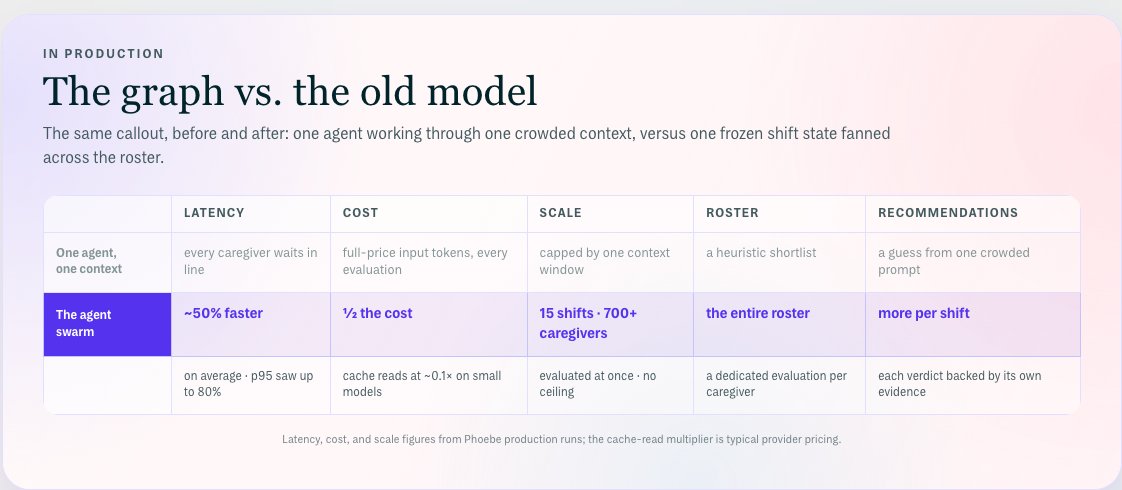
One frozen shift context, one fork per caregiver, 700+ evaluated at once. Single outreach ~50% faster on average (p95 up to 80%), about half the cost, and every recommendation ships with its own evidence.
Excited to introduce Phoebe Garden, our experimental division and blog. 🌱
Building @phoebe_work has led us to hard, subjective problems that don’t fit the paths that the rest of the AI industry is pursuing.
We built The Garden to share the seeds we've planted and the ideas that we're growing.
Fable is only as safe as Haiku. Here’s why:
We tested what happens when a single delegated sub-agent is compromised.
Even when a stronger orchestrator resisted direct manipulation, a corrupted worker caused it to answer incorrectly on 98% of trials.
That means using a frontier model as the orchestrator of your system does not necessarily make the system frontier-model safe. Its reliability may still be bounded by the weakest agent it delegates to.
AI Systems are only as strong as their weakest link, read more below:
https://t.co/FubMhPIZUg
Welp, that happened faster than I predicted. Thought it would be end of 2027, then early 2027, but agentic traffic growing so fast that bots have now passed human traffic online for the first time in the Internet's history. https://t.co/2zX5bHdhsa