List of those Senates opposing the CLARITY ACT vote them out. The real number 1 evil agenda senator ELIZABETH . Please share.
POST THIS ON ALL SOCIAL MEDIA LET IT GO VIRAL
✓YOUTUBE
✓TWITTER
✓WHATSAPP
✓FACEBOOK
✓SNAPCHAT
✓INSTAGRAM etc
Opening the Way for Pi.
---
CLARITY Act and the Under-20% Ownership Threshold: Ripple, Stellar, and Pi Network
One of the key criteria under the CLARITY Act for a blockchain to be recognized as a Mature Blockchain System is that no issuer, development team, or affiliated party owns or controls 20% or more of the total token supply. This is the Distributed Ownership requirement, alongside other standards related to decentralized governance and network operation.
Applying this criterion to several major blockchain networks:
Ripple (XRP): Ripple Labs still controls a substantial amount of XRP through its escrow accounts. Although these tokens are released on a scheduled basis, regulators may still consider them assets owned or controlled by Ripple. If so, Ripple would likely have difficulty meeting the under-20% ownership requirement. As a result, XRP is widely viewed as one of the projects most significantly affected by this provision.
Stellar (XLM): Stellar is generally more decentralized than Ripple, but it is less certain whether it satisfies the ownership threshold. After burning more than 55 billion XLM in 2019, the Stellar Development Foundation (SDF) still holds approximately 15.75 billion XLM, representing around 31–32% of the current total supply. If the CLARITY Act counts all XLM controlled by the SDF, Stellar would not yet meet the under-20% requirement. However, the SDF is a nonprofit organization that continues to distribute these tokens to support ecosystem development, meaning its ownership percentage is expected to decline over time.
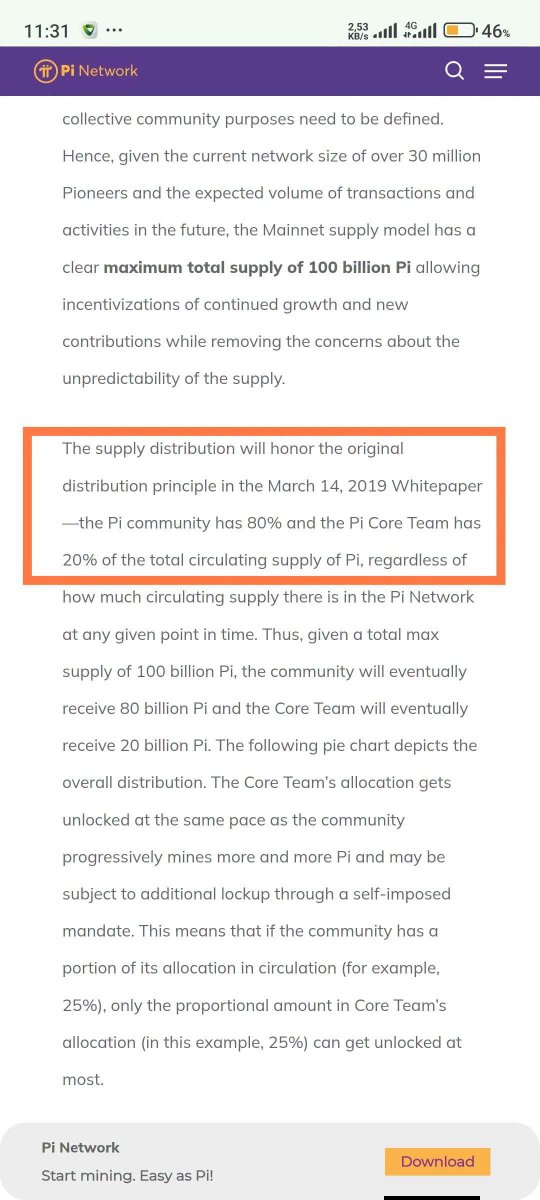
Pi Network: Based on publicly available information, the Pi Core Team currently holds about 20% of the total token supply. If this share falls below 20% as token distribution continues, Pi would be better positioned to satisfy the CLARITY Act's Distributed Ownership criterion. In addition, Pi would still need to meet other requirements, including ensuring that no individual or organization controls the network, no party holds more than 20% of the voting power, and the blockchain operates through a decentralized consensus mechanism.
Ultimately, the 20% threshold in the CLARITY Act is more than just a limit on token ownership. It reflects the broader objective of the legislation: encouraging blockchain networks to transition from organization-controlled models to genuinely decentralized ownership and governance.
https://t.co/ffsll5aESh
The Pi mining app side menu and app profile page have been redesigned!
As the first step of a broader mining app design refresh, this update makes important Pioneer info and ecosystem features easier to find, understand, and navigate. Tap the hamburger (☰) icon in the top left of the Pi mining app to check it out.
Since the mining app is a central part of the Pioneer experience and its interface has supported the Pi community’s growth to over 60 million engaged Pioneers, changes to its design and user experience must be introduced thoughtfully and iteratively to improve clarity, style and usability while maintaining core functionalities.
Go to the Pi mining app to learn more, and provide feedback on the new design and style!