Started with $20 and reached +$95 after the first 5 trades
He let Claude keep coding overnight.
Woke up to:
• a completed script
• +$95 from the first 5 trades
According to him, he didn't change anything.
Then he came across this wallet:
0xb27b...b82
• $384,858 profit
• 13,070 predictions
• $18.5K biggest win
• Started March 2026
His take: almost nobody is paying attention to it.
He says that, while developing the script, he copytraded it to check the math.
The starting amount was $80.
→ $4,218 in a few weeks
All positions share the same structure.
As he puts it: one equation that runs while you sleep.
The post gives these examples:
$17,839 → $36,318 (+103%)
$3,112 → $15,011 (+382%)
$10,676 → $22,178 (+107%)
This is the framework he gave Claude:
1. Temporal bias
Identify BTC time windows with >65% edge, as the post describes it.
Ignore everything else.
2. Kelly sizing
Adjust position size according to confidence.
Never use fixed bets.
f* = (p × b − q) / b
3. Volatility filter
Avoid high volatility.
Trade only in clean conditions.
4. Bayesian updates
Recalculate probabilities after every trade.
The goal is for the estimates to improve over time.
According to him, Claude built the entire system overnight.
He funded it with $20.
Minutes later, the first trade fired.
The author's copytrading link: https://t.co/a85oQImyKH
The setup he states: Claude + a device + 1 hour/day.
He's giving it away free for 24 hours. To get it:
Follow me @hornyhov (so i can DM you)
My main takeaway: checking results should be part of an AI agent’s workflow.
Start with one repetitive task, clear quality criteria, and a way to measure time saved. If it works, scale it
Is there really $1 trillion in AI agents? Only if they stop talking and start working.
It is named Agentic AI Developer. GH-600.
You can begin building the capabilities behind it with a single repetitive task.
Here is a straightforward framework 👇
🎯 GOAL — Specify the result and what “complete” means.
🧠 PLAN — Split the work into stages.
⚙️ ACT — Use tools to complete the work.
🔍 CHECK — Confirm the results against the objective.
🔄 IMPROVE — Address gaps and retry.
Consider finding prospective customers.
Give your agent a clear goal:
“Locate 20 fintech companies that fit our ideal customer profile. Include why each qualifies, supporting sources, and a tailored outreach draft.”
Construct the workflow around it:
→ Investigate companies.
→ Assess them against your criteria.
→ Arrange the findings in a spreadsheet.
→ Verify sources and eliminate duplicates.
→ Draft outreach messages for your review.
A company does not fit? Find a substitute.
A claim lacks a source? Mark it.
A tool fails? Try again or request help.
That CHECK → IMPROVE cycle is where a convincing-looking list turns into something you can truly use.
Begin with one task. Give the agent tools, clear limits, and a way to confirm its work.
Track accuracy, qualified leads, and time saved before scaling.
Keep this framework. Choose one task to test it on this week
The AI agent uprising already started. GitHub is John Connor now.
No one was expecting the resistance to come with a certification exam, but here we are. GitHub’s Agentic AI Developer certification, GH-600, covers operating and supervising agents in software development, including evaluating their work and setting limits on their autonomy. I find that reassuring and slightly unsettling. Delegating work to software sounds wonderful until you have to decide how much of its work you trust.
You can start figuring that out with one repetitive task. The framework is simple:
1/Goal: define the outcome and what counts as done.
2/Plan: break the assignment into steps.
3/Act: give the agent the tools and permissions it needs.
4/Check: compare the results with your original criteria.
5/Improve: correct the failures and check again.
Say you need a list of potential customers. Give the agent a concrete assignment: "Find 20 fintech companies that match our ideal customer profile. Explain why each qualifies, include supporting sources, and prepare a personalized outreach draft for my review." Define the qualification criteria before it starts. Then have it research companies, assess their fit, and organize the findings in a spreadsheet.
The spreadsheet is the satisfying part: everything has a row, and the links make it look credible. Then you open them. Does the source support the claim? Does the company meet your criteria, or does the explanation just sound reasonable? Remove duplicates, replace companies that don’t qualify, and flag unsupported claims. If a tool fails, the agent should retry or ask for help. Check the revised result before approving the outreach drafts.
GitHub is giving people a way to learn how to supervise the machines. I’m hopeful about that, though I suspect we’ll spend more time checking their homework than the films prepared us for. Try one task this week, with clear boundaries and a way to verify the result. Measure accuracy, qualified leads, and time saved before expanding the workflow.
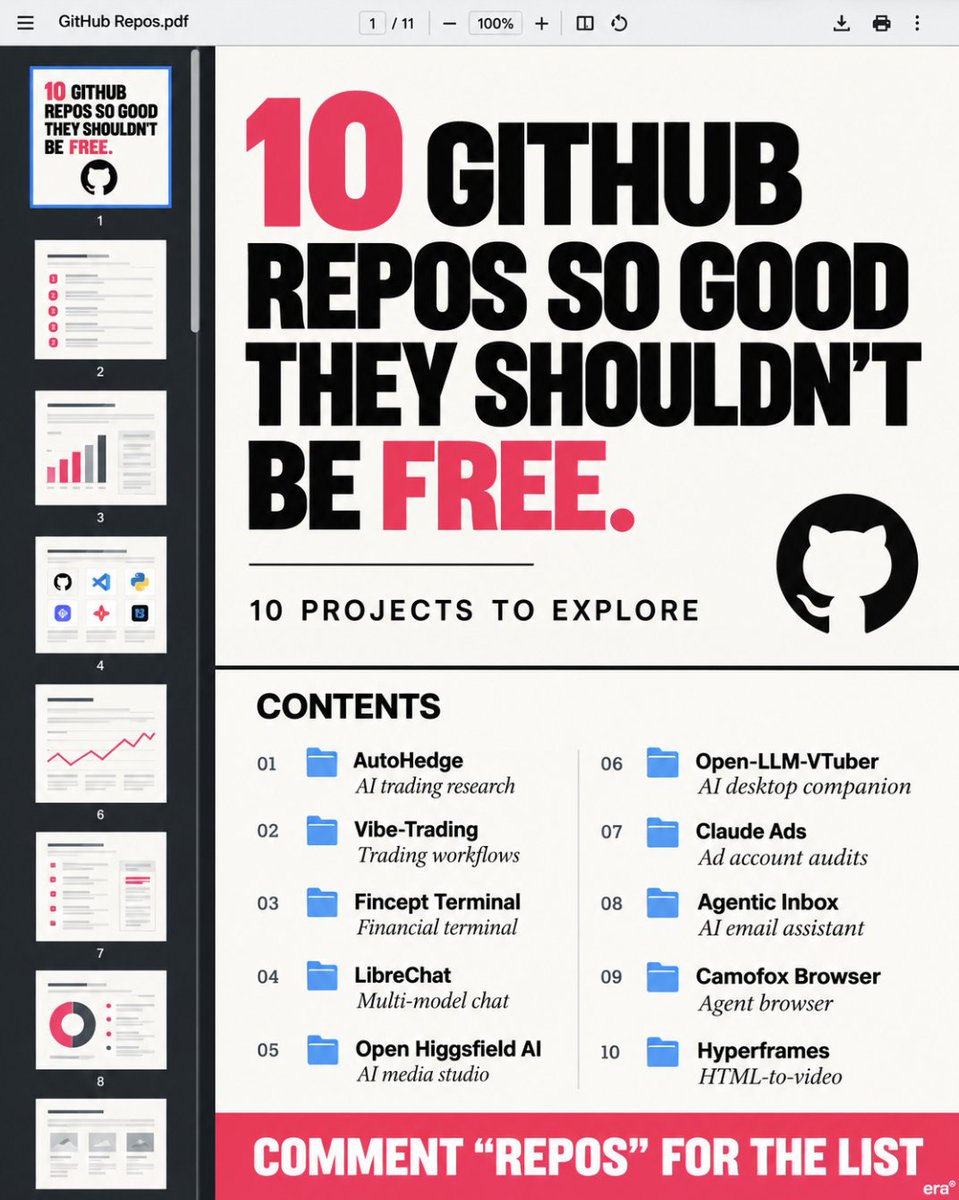
Open source just nuked half the SaaS industry.
10 GitHub repos that prove it:
1. AutoHedge
An autonomous hedge fund built in Python with four AI agents. A director generates investment theses, a quant validates them, a risk manager decides position size, and an execution agent places orders. It runs live on Solana. `pip install -U autohedge` and you can start trading immediately.
repo → https://t.co/kF1qI8SjuJ…
2. Vibe-Trading
A trading system using a Directed Acyclic Graph model. 64 finance skills. 29 preset specialist agent swarms. Analysis methods include Ichimoku, Elliott Wave, SMC, Black-Scholes, full Greeks, and risk parity. Its crypto desk provides liquidation heatmaps and token unlock tracking. You can observe agents debating strategies in real time.
repo → https://t.co/OmnNV3Iaf0…
3. Fincept Terminal
A Bloomberg Terminal replacement that runs on your laptop. CFA levels 1, 2, and 3 analytics. 20+ investor AI agents (Buffett, Dalio, Soros). 100+ data connectors, including Polygon, World Bank, and IMF. Bloomberg charges $24,000 a year. This is free.
repo → https://t.co/GIEvDJec3V…
4. LibreChat
Every model ChatGPT runs, plus Claude, Gemini, DeepSeek, and 20 more. Self-hosted. Native MCP support. You own the data, the history, the infrastructure. OpenAI charges $20/month to use their wrapper. This costs nothing to use your own.
repo → https://t.co/tcsRcjiZN0
5. Open Higgsfield AI
A self-hosted cinema studio with 200+ AI models. Flux, Midjourney, Sora, Kling, Veo, GPT-4o, SDXL all in one interface. Text to image. Image to video. Cinema mode with pro camera controls. No subscription. Your data stays local.
repo → https://t.co/3T786XT18I…
6. Open-LLM-VTuber
A Live2D AI companion that runs offline, sees your screen, hears your voice, and never forgets. Inner thoughts are shown as a separate text layer, so you watch the reasoning happen before words come out. Pet mode floats it on your desktop. Swap the LLM in one config line.
repo → https://t.co/3PmXqjl4cv…
7. Claude Ads
A free Claude Code skill that runs 190 audit checks across Google, Meta, YouTube, LinkedIn, TikTok, and Microsoft Ads. 6 parallel subagents fire at once. It consolidates into a single Ads Health Score ranked by revenue impact. Agencies charge $4,000 a month for this.
repo → https://t.co/2iab3GQQgK…
8. Agentic Inbox
Cloudflare just open-sourced an email client where an AI agent reads your inbox and drafts your replies. It runs entirely on Cloudflare Workers. Each mailbox lives in its own Durable Object. Your email never leaves your Cloudflare account. One click deploys it.
repo → https://t.co/4ngIQsSFtc…
9. Camofox Browser
An open source headless browser that makes AI agents invisible to bot detection. It spoofs navigator properties, WebGL, AudioContext, and WebRTC at the C++ level. The browser does not look modified because it genuinely is not. Accessibility tree output drops token cost by 90%.
repo → https://t.co/uS6FTmd8tc…
10. Hyperframes
HeyGen open-sourced a video framework that does everything Remotion does without React, without JSX, without teaching your AI agent a new format. The agent writes HTML. The framework renders MP4. GSAP, Lottie, and Three.js all work. Same HTML always produces the same file.
repo → https://t.co/rEFD7DLdCj…
These are not toys. Each one replaces a paid product you’re still being charged for.
Pick one. Install it. Plug it into your workflow.
100% free. 100% open source.
These 10 GitHub repos replace $2,000/month of SaaS for free
1. AutoHedge
An autonomous hedge fund built in Python with four AI agents: a director generates investment theses, a quant validates them, a risk manager decides position size, and an execution agent places orders. It runs live on Solana. With `pip install -U autohedge`, you can start trading right away.
repo
2. Vibe-Trading
A trading system built on a Directed Acyclic Graph model, with 64 finance skills and 29 preset specialist agent swarms. It includes Ichimoku, Elliott Wave, SMC, Black-Scholes, full Greeks, and risk parity. Its crypto desk gives liquidation heatmaps and token unlock tracking. You can watch agents debate strategies in real time.
repo
3. Fincept Terminal
A Bloomberg Terminal replacement that runs on your laptop. CFA levels 1, 2, and 3 analytics. 20+ investor AI agents (Buffett, Dalio, Soros). 100+ data connectors, including Polygon, World Bank, and IMF. Bloomberg charges $24,000 a year. This is free.
repo
4. LibreChat
Every model ChatGPT runs, plus Claude, Gemini, DeepSeek, and 20 more. Self-hosted. Native MCP support. You own the data, the history, the infrastructure. OpenAI charges $20/month to use their wrapper. This costs nothing to use your own.
repo
5. Open Higgsfield AI
A self-hosted cinema studio with 200+ AI models. Flux, Midjourney, Sora, Kling, Veo, GPT-4o, SDXL all in one interface. Text to image. Image to video. Cinema mode with pro camera controls. No subscription. Your data stays local.
repo
6. Open-LLM-VTuber
A Live2D AI companion that runs offline, sees your screen, hears your voice, and never forgets. Inner thoughts show as a separate text layer, so you watch the reasoning happen before words come out. Pet mode floats it on your desktop. Swap the LLM in one config line.
repo
7. Claude Ads
A free Claude Code skill that runs 190 audit checks across Google, Meta, YouTube, LinkedIn, TikTok, and Microsoft Ads. 6 parallel subagents fire at once. It consolidates into a single Ads Health Score ranked by revenue impact. Agencies charge $4,000 a month for this.
repo → https://t.co/nQfCP2WBDV…
8. Agentic Inbox
Cloudflare just open-sourced an email client where an AI agent reads your inbox and drafts your replies. It runs entirely on Cloudflare Workers. Each mailbox lives in its own Durable Object. Your email never leaves your Cloudflare account. One click deploys it.
repo
9. Camofox Browser
An open source headless browser that makes AI agents invisible to bot detection. It spoofs navigator properties, WebGL, AudioContext, and WebRTC at the C++ level. The browser does not look modified because it genuinely is not. Accessibility tree output drops token cost by 90%.
repo →
10. Hyperframes
HeyGen open-sourced a video framework that does everything Remotion does without React, without JSX, without teaching your AI agent a new format. The agent writes HTML. The framework renders MP4. GSAP, Lottie, and Three.js all work. Same HTML always produces the same file.
repo
These are not toys. Each one replaces a paid product you’re still being charged for.
Pick one. Install it. Plug it into your workflow.
100% free. 100% open source.