Nina invests money in Sacco >>> Nina’s sacco money is invested in road >>> Nina pays tolls to access the road her money was invested in >>> Nina pays more consumption taxes because toll payment is not enough to repay investors, including Nina - oh and Nina has to continue paying to use the road she’s invested in twice over.
Nina is a happy bunny. 🐰
With all the stealing/looting currently going on by this regime, who in their right mind believes SACCOS Funds, saved by Members will not be stolen by this regime using the Infrastructure Fund as the conduit after Parliament locked out
Auditor General and Controller of Budget?
Kenyans must stop trusting words like propose, intend or plan, because by the time government says it publicly, the deal is usually already deep inside the system.
What remains is procedure, rubber stamps and propaganda to calm you.
The government propagandists have now arrived with the usual confidence of people who call others ignorant after swallowing fake talking points without even chewing it properly.
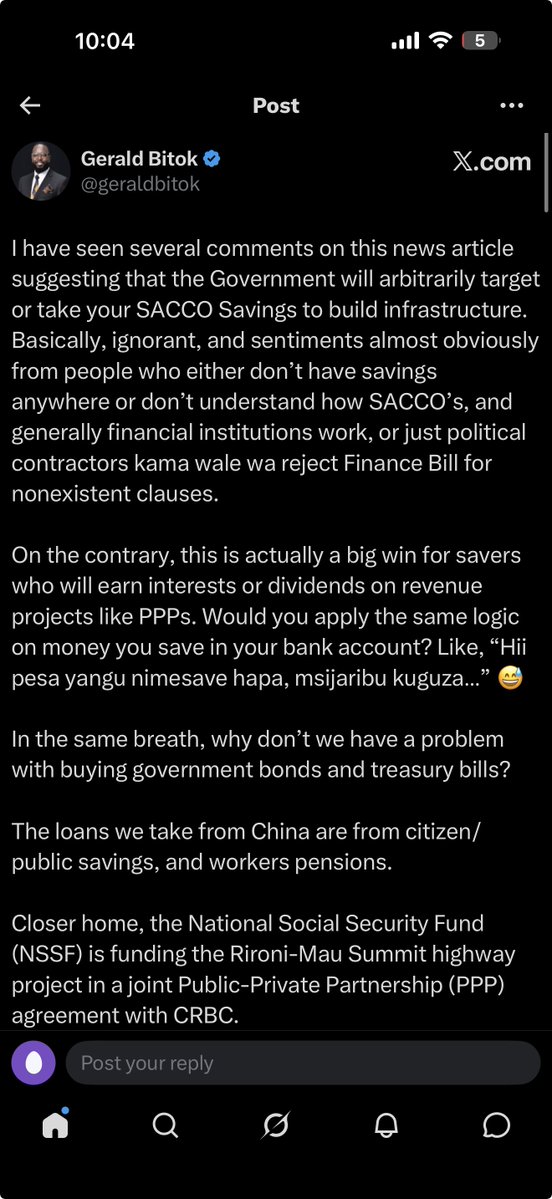
Their new argument is that SACCO members should stop worrying, since pension funds invest in roads, people buy Treasury bills, China borrows from public savings, and the same logic should now make ordinary Kenyans relax as government eyes SACCO money.
This is the kind of clever nonsense that sounds educated until you remember that buying Treasury bills is voluntary, pension funds have separate long-term mandates, and SACCO savings are member money used daily for school fees, emergencies, businesses, land, hospital bills and small loans.
A Kenyan putting money in a SACCO is not asking Treasury to turn his private sacrifice into a road project, the same way a person putting money in M-Pesa is not inviting government to call his balance domestic capital.
The propagandist wants Kenyans to compare SACCO savings with government bonds, yet he conveniently forgets that a bond buyer chooses the risk, chooses the amount, chooses the maturity date and knows the government is the borrower before sending money.
SACCO members joined savings societies for affordable credit, member support and personal financial safety, not to become silent lenders to a government that has borrowed everywhere, taxed everything, sold public assets and now wants to look clever near private savings.
The NSSF example does not rescue the propaganda either, since NSSF itself has had to defend the Mau Summit and Rironi road exposure by saying its role is limited, regulated and tied to an equity portion, which already proves that member money in infrastructure is sensitive business requiring answers.
The CPF example also proves the opposite of what they think, since organised pension and capital market players raising project finance for a toll road is not the same as government staring at SACCO savings built by teachers, nurses, police officers, farmers, boda riders and mama mbogas.
If this thing was such a clean win, government would not need bloggers to insult citizens into silence, and Treasury would not need kindergarten examples about China and Treasury bills to calm people asking whether their savings are safe.
Ignorance is bad, but propaganda being pushed as financial literacy is worse, because it teaches citizens to clap while their private money is being measured by the same state that cannot explain where the borrowed trillions went.
What we dont want is 'walking' into a SACCO to ask for your own money or business boost loan, only to find Mbadi standing in the same line with a bigger bowl, just like they did with banks!
When international credit lines dry up and commercial banks max out, the predatory gaze of a desperate state turns inward to SACCOs. This isn't strategic development; it is unstructured survivalism. Raiding domestic savings to stay afloat just delays the reckoning.
We do not want government inside SACCOs, because they already messed up banks, made loans harder to access, killed small businesses and now want to follow Kenyans into the last place they still borrow from.
All factors held constant, government should not compete with ordinary Kenyans for money.
We know the Ruto regime is broke, that one is no longer a debate, because every new policy now looks like Treasury searching under mattresses for money.
We know that even if they are handed Sh1 trillion from SACCOs, the same tender games will start, costs will balloon, projects will be revised, brokers will appear, and politically connected tender boys will become richer overnight.
They are telling SACCO members that their money will go into infrastructure, but nobody is explaining when those roads, airports or projects will zaa matunda and return real money to the teacher, nurse, farmer, trader or boda rider whose savings were touched.
Kenyans have already seen this movie, where a project starts with clean English, moves into inflated contracts, disappears into tender corridors, then returns years later as a scandal that nobody is punished for.
Why are we pretending this is development financing when everybody can smell the scam from the gate, especially after the same government borrowed everywhere, taxed everything, sold assets and still came back for private savings.
Call it what it is.
This is a scam in an infrastructure helmet.
UPDATE: The Pattern Behind Kenya's Manufactured Unrest
Information I’ve received points to a disturbing but familiar pattern of organised political goonism, ethnic profiling and manufactured chaos aimed at destabilising the country ahead of 2027. The pattern stretches from the matatu strike to planned chaos in parts of Mount Kenya, inflammatory remarks meant to provoke ethnic anger, the All Saints Cathedral attack and the recent Kuresoi violence. Taken together, these events raise serious questions about a wider operation by people seeking power by hook or crook, using communities as raw material for their ambitions. I call on patriotic citizens to come forward with information about planned mayhem, ethnic mobilisation, hired goons, suspicious meetings, payments and instructions meant to destabilise Kenya.
During the matatu strike, my sources say a plan was set in motion to create chaos in Murang'a, Nyeri and Kirinyaga, then blame the Kikuyu community, while deliberately sparing Meru, Tharaka Nithi and Embu. The alleged goal was to divide Mount Kenya East and West and manufacture political animosity. First the chaos is organised, then the blame is ethnicised, then the same people who lit the fire pretend to be shocked by the smoke.
The strike was allegedly organised by three political leaders, with about 40 kamageras selected to implement parts of the operation and seven Mount Kenya leaders acting as back-stoppers. My sources name Muge, Farouk and Sudi as ring leaders, with Muge described as a key planner, and allege the involvement of senior civil servants, including figures in the OP and Interior ministry, and senior security officials. These are extremely serious claims that must be investigated urgently.
My sources further alleged the same group scripted Hassan Omar's remarks at Kericho Tea Hotel, not as genuine historical debate but to provoke anger and shift political heat onto one community, 40 vs 1, and that he was paid for it. Sudi's remarks about Kenyatta and land were allegedly part of the same messaging.
The Cathedral attack fits this pattern: when goons can storm a civic forum in broad daylight, the intention goes beyond disrupting one meeting, they are sending a message. Kuresoi exposes the same disease. Political actors increasingly use gangs as instruments of power while hiding behind community narratives, money and possible state protection. For them it is business; for ordinary Kenyans it can become displacement, death and national trauma.
The Catholic Church, the Kikuyu Council of Elders and NCCK have already warned against ethnic profiling and political goonism. The CS Interior, NCIC, DCI, NIS and Parliament must stop this before rumours become mobs and mobs become national wounds. The President must answer a simple question: how will he act if those being named are his close allies and public servants? Public office cannot become a theatre where people plan disorder in the morning, deny it in the afternoon and pose as peacemakers by evening.
To all Kenyans: your security begins with you. If you know of goons being recruited, money distributed, transport arranged, statements scripted or violence planned, speak up: to trusted people, credible media, religious leaders, civil society and responsible security officers. Kenya must not be sacrificed at the expense of a few greedy mfs.
If Kenyans accept government entering SACCOs, they are finished, because this is worse than the Finance Bill since government already messed up bank lending, choked small businesses, killed markets and pushed ordinary people into SACCOs as the last place they could still borrow.
Once Treasury follows you into that last corner, competing with teachers, nurses, traders, farmers, boda riders and mama mbogas for the same savings, just know the government is no longer looking for development money, it is looking for survival money.
We need to take this SACCO issue seriously.
Confidence is the foundation of every SACCO. Once members lose trust, the consequences can be severe. Those without loans may rush to withdraw their deposits, while some borrowers may decide there’s little incentive to keep repaying if they believe their savings are at risk. That is how healthy financial institutions end up under unnecessary pressure.
Many Kenyans are now asking whether the earlier push for a delegates system in SACCOs was part of a broader plan to increase control.
The direction we’re taking should concern everyone, regardless of political affiliation. Weakening institutions that millions of ordinary Kenyans depend on is a dangerous path.
If you still can’t see where this is heading, you may not realize you’re the one at risk.
Iran couldn’t get visas. They didn’t intervene.
A Somalian referee couldn’t get a visa. They didn’t intervene.
Fans of Muslim countries couldn’t get a visa. They didn’t intervene.
Ronaldo got a red card. Intervened.
USA player got a red card. Intervened.
F*** FIFA. Corrupt.
After SACCOs, Banks And M-Pesa Are Next As Kenyans Become Guarantors For A Debt Crisis They Never Ate
Kenyans must stop asking why Kenya has not defaulted and start asking who is being prepared to carry the default when the music finally stops.
Ghana was here.
Sri Lanka was here.
Zambia was here.
Argentina was here.
Lebanon was here.
The script is always the same, because a broke government borrows until lenders get tired, taxes until citizens are dry, leans on banks until credit disappears, pushes pain into pensions and domestic savings, then tells the public that sacrifice is needed to save the country.
That is why the SACCO story should scare Kenyans more than they currently seem scared, because SACCO savings are not government money, they are the private sweat of teachers, police officers, nurses, farmers, matatu people, boda riders, mama mbogas, small traders and workers who ran there after banks abandoned them.
In every default story, the government does not stand alone at the edge of the cliff, because it drags citizens there as guarantors through inflation, taxes, currency pain, bank losses, pension restructuring, frozen credit and forced patriotic nonsense dressed up as national recovery.
Banks already formed a comfortable debt circle with government, where lending to Treasury became safer and sweeter than lending to SMEs, which slowly choked biashara, starved the real economy and turned ordinary Kenyans into beggars inside their own banking system.
Now the same government that fed banks with public debt is walking into SACCOs, looking at the last pool of money ordinary Kenyans still controlled after taxes, deductions, mobile money charges, fuel prices, school fees and rent had already eaten their pockets.
The anus cannot be stitched to stop diarrhoea.
A debt crisis cannot be solved by raiding SACCOs, squeezing banks, eyeing M-Pesa, selling public assets and pretending that every desperate grab is an infrastructure plan.
Ghana called it domestic debt exchange.
Sri Lanka called it restructuring.
Argentina called it emergency controls.
Lebanon left people staring at bank balances they could not freely touch.
Kenya will give it a cleaner name, maybe national development, domestic resource mobilisation, infrastructure financing or patriotic investment, but the meaning will be the same.
The citizens are being prepared as guarantors for debts they never ate.
Kenyans are not angry enough, because if they understood where this road ends, they would know SACCOs are not the final target, they are the warning shot before banks, M-Pesa and every private pool of money still breathing outside Treasury’s hands.
The money is finished.
Read a bit about what happened in Lebanon and how it crashed.
It started exactly like this.
Govt should have zero, and I mean zero influence on savings, other than providing safe guard mechanisms.
When government starts pulling SACCO money into infrastructure, small businesses will feel the pain first, because SACCOs are the last credit corner left for ordinary Kenyans who were already locked out, ignored or punished by banks after government started competing through internal debt.
Kenyans who lived through Kibaki’s time remember an economy where businesses were breathing, banks were chasing customers with tents outside branches, and ordinary people were being begged to take loans.
Let Ruto accept he has lost it, we default and he resigns then we investigate these odious debts.
No matter the tricks, the diarrhoea will explode.