No, you won’t be able to “service 5-12” people with a bunch MacBooks hooked to each other
That larper didn’t even know what an MoE is 4 months ago and now he’s acting like an expert and spreading misinformation
When did lying become so normalized in this space ffs
hot take: if you are a programmer you should be able to invert a binary tree from memory, AI or not. It's ridiculously easy and if you can't do it, you should not have a computer science degree
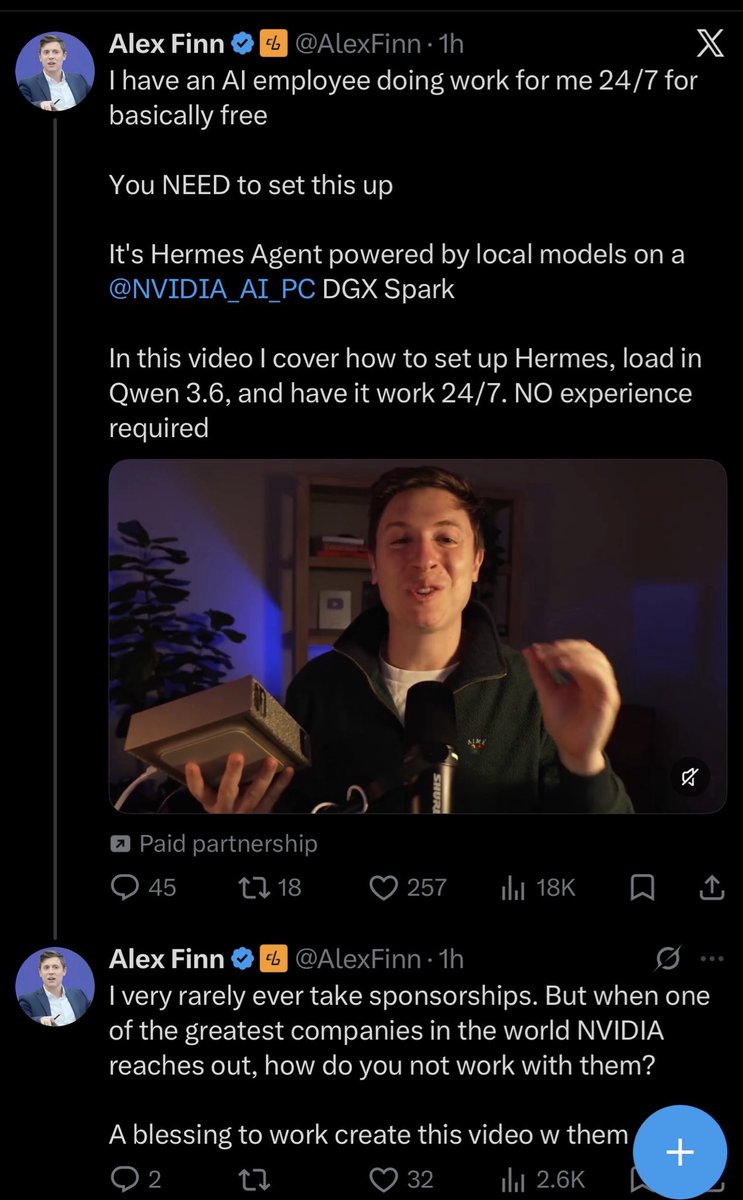
This is Alex Finn
He’s costed so many people their hard earned money during his Mac mini grift
Now he’ll reuse the same script for the DGX Spark
He doesn’t know how to highlight any hardware strengths/weaknesses
Zero substance or knowledge of local AI
Go grift something else
I’ve never been this excited about search.
6-7 years ago, IR got an influx of the paradigms we still use, all enabled by the big headroom MS MARCO and then BEIR created. Then progress slowed.
Today, Diane releases perhaps the most ambitious IR benchmark to date: OBLIQ-Bench.
Queries in it are meant to be increasingly opaque to current first-stage retrieval paradigms. Oblique queries put the bottleneck very early in the search process, as the relevance of a document to the query is quite latent.
I can't wait for core IR research on fundamentally more powerful paradigms for first-stage search to be reignited again. Stay tuned for more stories about this, and read Diane's thread and her paper below!!
In this letter, the CEO of Coinbase talks about non-technical teams shipping production code. Honestly, I don’t think he knows what he’s talking about.
Using AI agents makes it possible for teams who are not deeply technical in the syntax of a language to ship production code. But that team had better be very deeply technical in managing the structure and quality of the code that is produced.
What the agents give us is the ability to disengage from deep syntax. But they do not give us the ability to disengage from modular design and architecture. You still need to be deeply technical in those topics in order to produce good production quality code.
I think Dario Amodei is right when he says:
"Coding is going away first, then all of software engineering."
At least in his world at Anthropic.
They tell us they don't write code any more.
Their status page shows us they don't do software engineering.
I think that @DarioAmodei does not understand software engineering and that he is working feverishly to pump up the valuation of his company in anticipation of its forthcoming IPO.
I love this
I don't say it because I'm somehow anti-ai, I say this because it's destructive for your life.
You're going to have disrupted sleep, you're going to have disrupted relationships, your whole life will be lived between thinking of the next prompt and results of the current one.
This ain't it king
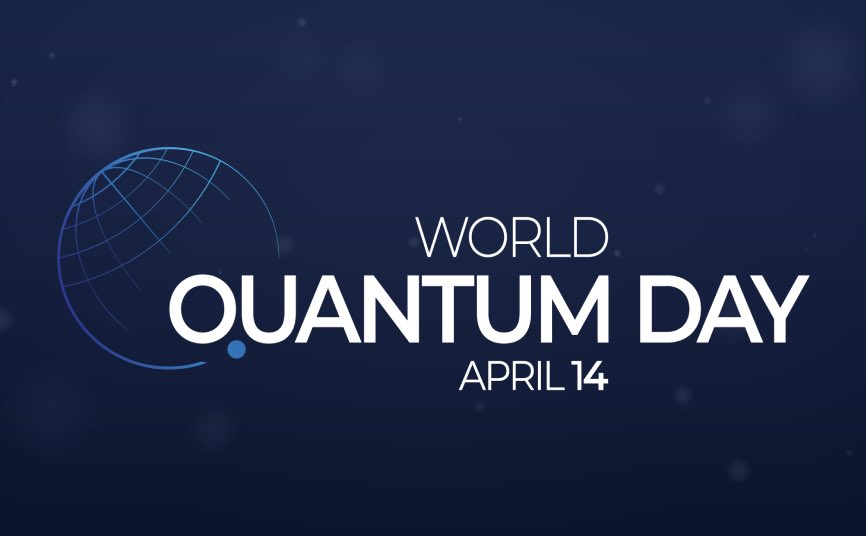
Happy World Quantum Day, 14 April 2026! ⚛️
The clock keeps ticking, and somewhere in the world, it's World Quantum Day!
🌍 https://t.co/jZtEM8x0pU
Let's quantum!
#WorldQuantumDay
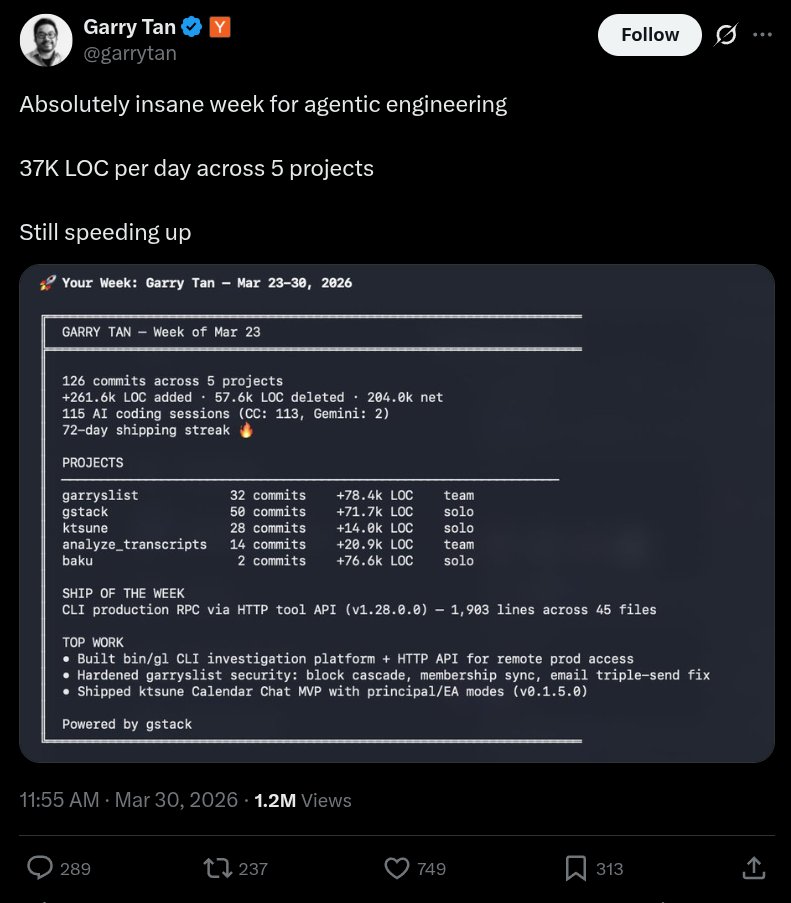
so... I audited Garry's website after he bragged about 37K LOC/day and a 72-day shipping streak.
here's what 78,400 lines of AI slop code actually looks like in production.
a single homepage load of https://t.co/TqaEZsF44N downloads 6.42 MB across 169 requests.
for a newsletter-blog-thingy.
1/9🧵
After interviewing CS students, one thing is clear: too many are drinking the koolaid that software engineering is unimportant because coding models are getting better. So they try to "differentiate" by pivoting to product, GTM, or CoS.
Do not stray from the tech.
Most founders, myself included, are looking for deeply technical people regardless of role. In a world where AI makes you 100x, it pays to know how to build agents that are robust. Every founder's fear is that your agents are brittle because you have no production software engineering experience.
It's also easier than ever to learn. You can genuinely become top 10% in a week and top 1% in a month. The bar is on the floor because no one wants to learn it.
I saw a tweet from a huge CEO saying "it's actually better to NOT know how to code." Holy COPE.
If you're a student "pivoting from just SWE," chances are you're neither here nor there. It's not ok to be mediocre at GTM/Product while simultaneously being mediocre at SWE. And it's much easier to become an exceptional self-taught engineer in college than an exceptional self-taught GTM/Product person, which almost never happens without real business experience.
Learn software engineering, you will be rewarded.
A Vercel user reported an issue that sounded extremely scary. An unknown GitHub OSS codebase being deployed to their team.
We, of course, took the report extremely seriously and began an investigation. Security and infra engineering engaged.
Turns out Opus 4.6 *hallucinated a public repository ID* and used our API to deploy it. Luckily for this user, the repository was harmless and random. The JSON payload looked like this:
"𝚐𝚒𝚝𝚂𝚘𝚞𝚛𝚌𝚎": {
"𝚝𝚢𝚙𝚎": "𝚐𝚒𝚝𝚑𝚞𝚋",
"𝚛𝚎𝚙𝚘𝙸𝚍": "𝟿𝟷𝟹𝟿��𝟿𝟺𝟶𝟷", // ⚠️ 𝚑𝚊𝚕𝚕𝚞𝚌𝚒𝚗𝚊𝚝𝚎𝚍
"𝚛𝚎𝚏": "𝚖𝚊𝚒𝚗"
}
When the user asked the agent to explain the failure, it confessed:
The agent never looked up the GitHub repo ID via the GitHub API. There are zero GitHub API calls in the session before the first rogue deployment.
The number 913939401 appears for the first time at line 877 — the agent fabricated it entirely.
The agent knew the correct project ID (prj_▒▒▒▒▒▒) and project name (▒▒▒▒▒▒) but invented a plausible-looking numeric repo ID rather than looking it up.
Some takeaways:
▪️ Even the smartest models have bizarre failure modes that are very different from ours. Humans make lots of mistakes, but certainly not make up a random repo id.
▪️ Powerful APIs create additional risks for agents. The API exist to import and deploy legitimate code, but not if the agent decides to hallucinate what code to deploy!
▪️ Thus, it's likely the agent would have had better results had it not decided to use the API and stuck with CLI or MCP.
This reinforces our commitment to make Vercel the most secure platform for agentic engineering. Through deeper integrations with tools like Claude Code and additional guardrails, we're confident security and privacy will be upheld.
Note: the repo id above is randomized for privacy reasons.
I've just released a new version of typeagent, a Python library I've been working on since mid last year --more and more using Claude-- that implements memory for agents.
Not originally my idea, I mostly ported the TypeScript version by Steve Lucco and Umesh Madan. This release was improved a lot by Bernhard Merkle.
To install, use "pip install typeagent". Changelog: https://t.co/5tuMTxthTd
One thing we know about the mass tech layoffs attributed to "AI" is that they follow a trend of mass tech layoffs that firms were formerly forced to admit were the result of their businesses contracting sharply after the lockdowns ended, when users didn't need nearly so many cloud services. By blaming the continuing layoffs on "AI," companies whose business continues to contract can tell investors that they are on the bleeding edge, not the contracting tail.
In related news: yesterday, Block announced it was firing half its engineers to make a "big bet on AI."
Block used to be called "Square" and it had a very successful business as a payment processor. It changed its name to Block when it went all in on crypto.
Block's mass "AI" layoffs coincide with a *50%* drop in Bitcoin, with concomitant collapses in other cryptos. Crypto market watchers warn that the industry is so overleveraged that this could lead to total collapse.
And yet, we're told that Block's - a company that is totally exposed to crypto volatility and would face a mass selloff by investors (and possibly a run) if news got out that it was in danger - undertook mass layoffs to "make a big bet on AI" (and not to paper over the terrifying prospects for its crypto-exposed business with high-gloss tales about being on the cutting edge of the Next Big Thing).