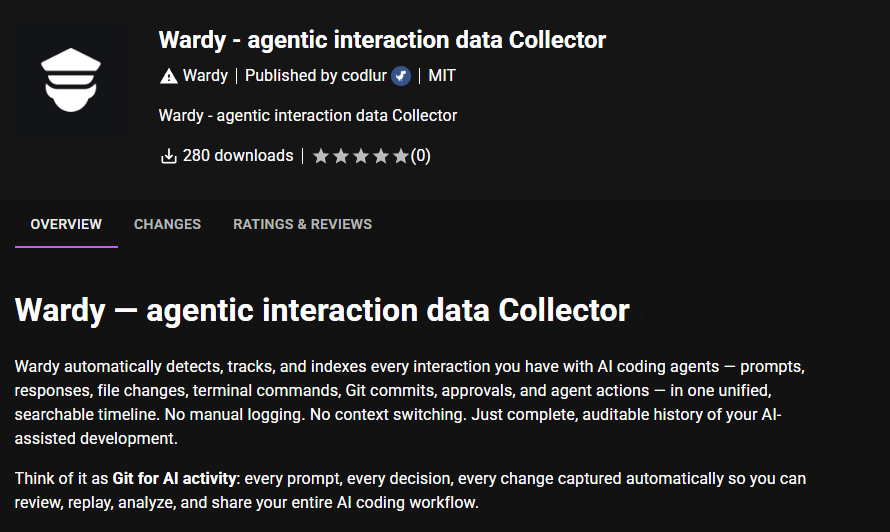
Today we're launching the first version of Wardy.
An extension for AI-native editors like Cursor, VS Code, Windsurf, Qoder, and more that automatically collects, organizes, and indexes every interaction you have with AI coding agents.
0x23a3a66e940d07ff75e2ba10f30b2f5fa4a2cba3
Live in 5 with @suggestionii talking about @wardy_ai
I actually pre-recorded it this afternoon because Portugal is playing now.
Gucci impressed me as a young builder in Nigeria and serves as a reminder that with a device and internet connection you really CAN just build things.
It was also his very first Livestream podcast. I'm here to support builders of all sizes and live true to the core value that @base is the builders chain
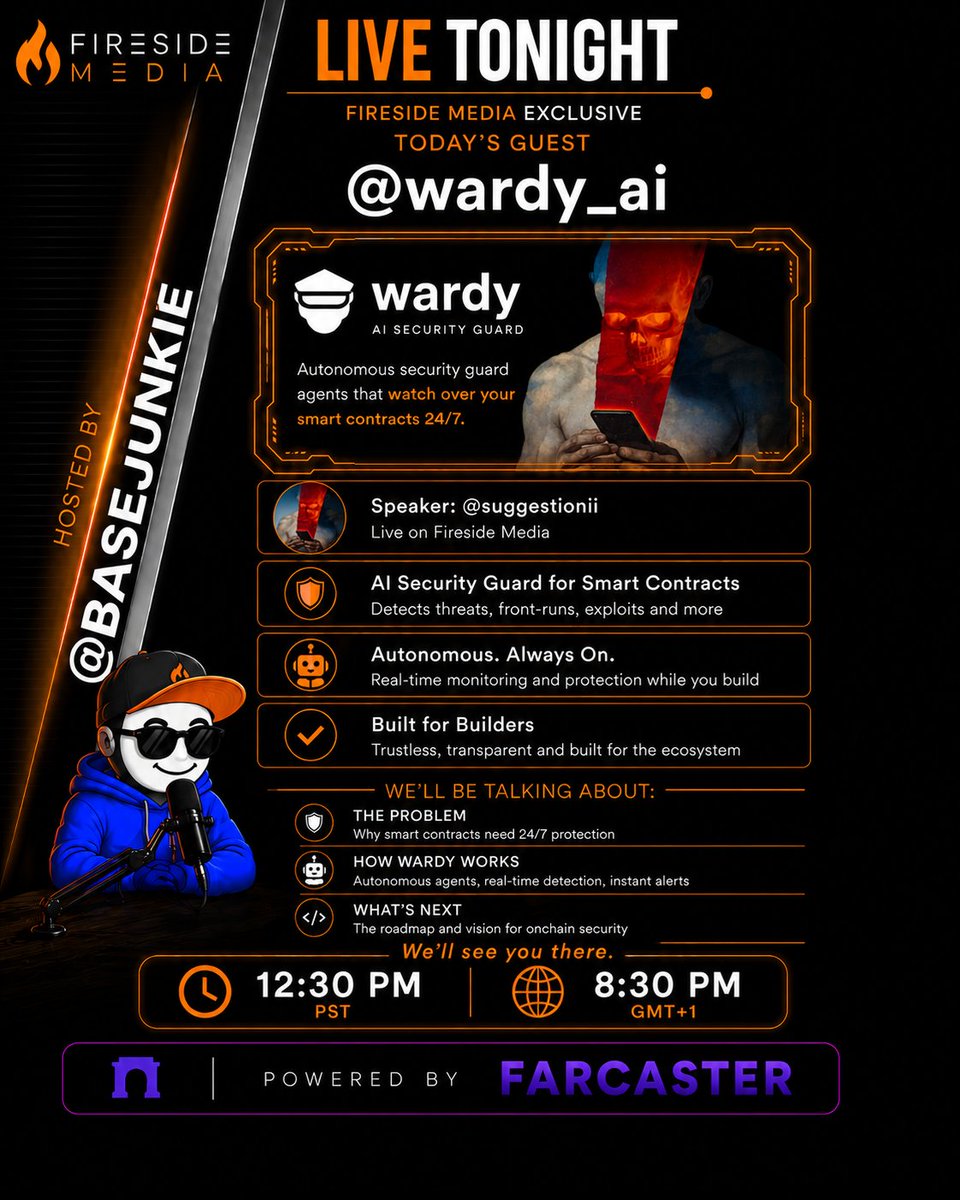
🔥 LIVE TONIGHT on Fireside Media 🔥
We’re joined by @suggestionii to talk all things @wardy_ai — autonomous security guard agents, smart contract protection, the journey so far, and what’s next.
Powered by @farcaster_xyz.
⏰ 12:30 PM PST
⏰ 8:30 PM GMT+1
See you there tonight 🔥
🔥 LIVE TONIGHT on Fireside Media 🔥
We’re joined by @suggestionii to talk all things @wardy_ai — autonomous security guard agents, smart contract protection, the journey so far, and what’s next.
Powered by @farcaster_xyz.
⏰ 12:30 PM PST
⏰ 8:30 PM GMT+1
See you there tonight 🔥
We're getting ready to roll out the Wardy Cloud Platform soon
The idea is simple: give organizations a place to collect, version, collaborate on, and build with their agentic data.
Inspired by GitHub's collaborative workflow, Wardy Cloud becomes the shared home for the Agentic Data generated by your team and AI agents whether they're running locally or in the cloud.
With Wardy Cloud you'll be able to:
• Connect your IDEs, AI tools, agents, and applications, then securely push agentic interaction data into your organization.
• Organize interactions across repositories, projects, teams, and agents instead of losing them across chats and tools.
• Search, analyze, replay, and share prompts, workflows, tool calls, reasoning, MCP activity, payments, and generated outputs.
• Generate documentation, Markdown files, reports, datasets, and reusable knowledge directly from your interaction history.
• Build MCP servers, internal knowledge bases, and AI workflows powered by your own organizational data.
• Ask the Wardy AI assistant questions about your organization's interactions and instantly retrieve the context, decisions, workflows, and assets you need.
Still early, and we'd love to hear what you'd want to see in the first version
Yes! That's actually one of the problems we're actively thinking about
AI interactions are fragmented across chats, IDEs, browsers, and different agents. Developers end up manually creating Markdown files or copying context around just to preserve their work
We're exploring technology inspired by Git & GitHub but for agentic interaction data. The idea is to version, organize, sync, and collaborate on AI interactions across projects, agents, and teams, so valuable context doesn't disappear between sessions or tools.
It's still early, but that's very much the direction we're heading with Wardy
@suggestionii Is it possible to link Wardy with Grok application? I use grok to help me on my project but the biggest paint is to shared information between chats, I have to created md files manually and store manually
If you're building AI agents, MCP servers, x402 infrastructure, or anything in the agentic ecosystem, I'd love to hear where the current tooling falls short.
We're far more interested in solving real workflow problems than shipping features for the sake of it.
Open to ideas, feedback, and even half-baked thoughts.
We've been working on a new direction for Wardy, and we'd love feedback from developers building in the agentic ecosystem before we ship it.
As AI agents begin paying for APIs, MCP servers, models, and services through protocols like x402.
Today you can inspect network requests, debug APIs, and monitor infrastructure but you can't easily inspect an agent's payment history, routing decisions, or financial interactions.
So we're building support for agentic payments inside Wardy extension .
The idea is to let any AI agent or framework send structured payment events to Wardy through a simple local API.
POST /api/payment
POST /api/payments/batch
GET /api/payments
GET /api/health
Alongside that, we're adding native integrations for platforms like Bankr and Litebeam , allowing developers to automatically normalize x402 payment events, routing metadata, LLM gateway usage, wallet activity, receipts, latency, provider selection, costs, and much more into a single searchable timeline.
A single payment event can include things like:
• Agent name
• Prompt that triggered the payment
• Wallet address
• x402 challenge & receipt
• Endpoint called
• Provider selected
• Routing decisions
• Alternative providers considered
• Cost & settlement amount
• Latency
• HTTP response
• Transaction ID
• Result metadata
The goal is to make every payment inspectable nnot just whether it succeeded, but why it happened and what the agent was trying to accomplish.
This also opens up things like:
• Payment Explorer
• Payment Replay
• Search across payments, prompts, agents, wallets, endpoints, and projects
• Cost analytics
• Routing analytics
• Local-first audit history
• APIs for any framework to push payment events into Wardy
Everything remains local-first. No telemetry. No payment data leaves your infrastructure unless you choose to sync it.
We're still deep in R&D, and this is one of the areas we're most excited about.
If you're building with x402, Bankr, Litebeam, MCPs, or any agentic payment infrastructure, what debugging, observability, or developer tooling do you wish existed today?
Would love to hear your ideas before we build the first release.
I’ll be able to update any information from the official account.
Will be able to use @bankrbot publicly on the timeline.
A lot update to come thanks for everyone support us. 🫡💙
Today we're launching the first version of Wardy.
An extension for AI-native editors like Cursor, VS Code, Windsurf, Qoder, and more that automatically collects, organizes, and indexes every interaction you have with AI coding agents.
0x23a3a66e940d07ff75e2ba10f30b2f5fa4a2cba3
@Timur_Yessenov Yes sir wardy can collect and scan past session data too but it requires a connector to connect with the agent so wardy can collect the data properly and organize it
Researching and developing products under @wardy_ai has been crazy. Exploring new ideas in the agentic economy has opened our eyes to how much valuable interaction data AI agents generate.
We've been testing across different code editors and codebases, running everything locally, collecting and analyzing the data. We were genuinely amazed by how this data can be used to improve teams, train future agents, preserve workflows, and build better AI systems. There's still a lot of R&D to do in this space, and we're committed to building the best infrastructure for agentic interaction data.
Right now, most of our technology runs locally to ensure your data stays within your own infrastructure. At the same time, we're researching a cloud version of (WARDY) that can securely connect web services, integrations, and multiple data sources while keeping users in control of their data.
We'll also be sharing our next update soon. It's focused on agentic payments and an x402 data collector. It's still in the research phase, but we're excited to show what we've been working on.
Our next step is partnering with organizations and engineering teams to help them capture, organize, and utilize their agentic data turning everyday AI interactions into reusable knowledge that makes both developers and AI agents more effective.
Today we're launching the first version of Wardy.
An extension for AI-native editors like Cursor, VS Code, Windsurf, Qoder, and more that automatically collects, organizes, and indexes every interaction you have with AI coding agents.
0x23a3a66e940d07ff75e2ba10f30b2f5fa4a2cba3