Today, we are excited to announce that Warrant has been acquired by @WorkOS!
We are incredibly excited to join forces with the WorkOS team and add Warrant’s global scale authorization service to the platform.
Check out the blog post for more details https://t.co/79Wh6Ze1hQ
I'm thrilled to announce that @WorkOS has acquired https://t.co/WSmd3grpOr (YC S21), the Fine Grained Authorization (FGA) service for developers.
What problem does this solve? Why are we acquiring them? And why now?
We added some big features & DX improvements last month, including:
- Use AuthN provider tokens to check permissions 🪙
- Policy Support in the Query API 🔎
- Graph Visualizations 📈
- Perf improvements
Read the March changelog below for all the details
https://t.co/tvzKOUyp6Y
We're back with our second change log of the year! 📣
This month we made two big additions to Warrant:
(1) We introduced Admin Keys for performing management operations on organization-level resources.
(2) We added an Environment Management API! Use these endpoints to create, update, and delete environments programmatically (perfect for automated testing of your authz model) 🧪
The first month of 2️⃣0️⃣2️⃣4️⃣ is in the books! We shipped some major updates in January! 🚢
Highlights include:
- Revamped event/audit log 🪵
- Org-level roles for dashboard users 🔒
- Tons of dashboard UX improvements 🔎
Read the full update below 👇
https://t.co/ypOPFGO2iH
With only a few days left in the year, we wanted to take some time to reflect on an action-packed 2023👇.
A big thank you to all those who helped us make Warrant better this year, see you all in 2024! 🎆
https://t.co/56PLsw6AmJ
Happy Friday! It's the final day of Launch Week! 🚀
Throughout the week, we've talked about various upgrades to the Warrant platform that bring improved performance, resiliency, and safety to the APIs and core authorization service.
Today, we're excited to introduce Warrant templates, a repository of pre-defined and purpose-built object types schemas designed to get you up and running with Warrant in minutes. Simply pick a template that matches your application use-case and deploy it into your Warrant environment instantly using the CLI.
#authorization #launch #opensource #accesscontrol
It's day 4️⃣ of Launch Week at Warrant! 🚀
Today's launches are about testing authorization models for correctness and managing changes to authorization models, both of which are equally important to performance & reliability in an authz service.
We're excited to launch two useful development lifecycle workflows using the Warrant CLI:
(1) Automated testing of authorization models 🧪
The Warrant CLI now supports test assertions! Developers can easily write test cases using the CLI to test their authz models for correctness.
(2) GitOps-based management of authorization models 🔒
Warrant's object types are similar to a relational database's table schema. Both define a schema that drive the underlying data-model. To facilitate safer updates to object types, we're launching a GitOps workflow ⚙️ that uses the Warrant CLI to enable automated, atomic deployment of object types changes. Remember, these changes can now be tested before approval and deployment.
Be sure to check out today's launch post for more details. See you tomorrow for the final day of Launch Week!✌️
Happy hump day! It's Day 3 of launch week 🚀 and today we're focused on some exciting performance & reliability upgrades for Warrant including:
- A new Warrant-Token that enables 'user-specified' data consistency across reads
- Sub 5 millisecond (!) performance on checks and queries
- Additional multi-region availability to further improve performance and reliability
Check out the Day 3 post for more details:
https://t.co/xKTosL2xqY
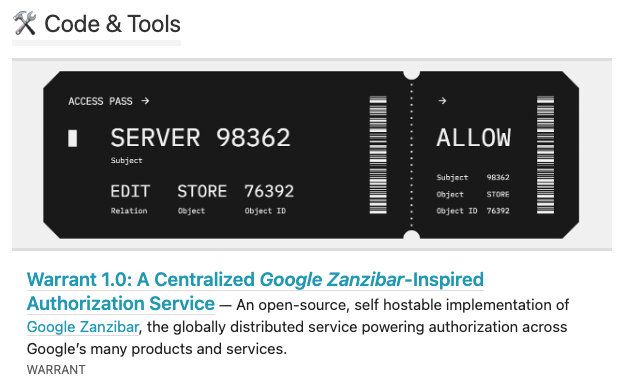
Great to see Warrant OSS featured in the 'Code & Tools' section of this week's @golangweekly newsletter 😁
We just released v1.0 which is stable and production-ready!
It's Day 2 of Launch Week! 🎉
Today, we're excited to launch the Warrant Query Language (WQL), a declarative, SQL-like language to query Warrant for lists of access controlled data from the context of an application.
#launch#devtools#authorization#accesscontrol#opensource
Let's say we're building Google Docs. To build the page that displays users who have access to a document, devs can query Warrant w/ WQL to get that list of users. The query will only return users with access to the document given all access rules for the document.