Fair play deserves real stakes.
Tired of “Web3 games” that talk about ownership but still run like Web2?
Where everything is on-chain, except trust.
That’s exactly where I see Symbiotic changing the rules.
Most games today build token economies, but not trust economies.
You can earn, stake, trade - but you can’t prove fairness, reputation, or real accountability.
And that’s a problem no amount of NFTs can fix.
Now imagine if restaking - the same architecture securing protocols and appchains -
could secure players and events too.
Symbiotic makes that possible.
Each game could create its own vault, with clear rules:
- players stake tokens before entering matches or tournaments;
- operators verify results via onchain proofs;
- if someone cheats, their stake gets slashed automatically;
- winners get verified rewards - instantly, without manual arbitration.
No “trust me bro” servers.
No disputes on Discord.
Just programmable fairness.
For games like Illuvium, Parallel, or Star Atlas, this isn’t theory - it’s architecture waiting to be plugged in.
Vaults define the rules, Relay distributes the tasks, and Resolvers enforce accountability.
Web3 gaming doesn’t need more graphics or new tokens.
It needs trust that scales.
And that’s exactly what Symbiotic was built for.
A lot of people think of Symbiotic as just “restaking infrastructure.”
But the real magic sits deeper - in how the system coordinates itself under load.
Imagine this:
A new appchain launches.
Traffic spikes. Users rush in. Transactions start queuing up, validators hit their limits - and suddenly the network feels the strain.
In most systems, this is where things slow down, or worse - break. But in Symbiotic, that’s exactly where the Relay kicks in.
Relay is the nervous system of Symbiotic. It doesn’t just move data - it coordinates everything: who executes which task, how load is balanced, how failures are absorbed without users even noticing.
Think of it like air traffic control for Web3. When one runway is overloaded, traffic reroutes - instantly, automatically. No manual intervention, no panic.
The Relay layer manages queues, monitors latency, and reassigns operations in real time. It turns what would normally be chaos into structured coordination.
That’s why Symbiotic can scale without breaking. Because the system isn’t just decentralized - it’s self-regulating.
And that’s what makes it different:
it’s not about avoiding overload, it’s about being ready for it.
Symbiotic is one of the few protocols whose architecture truly scales beyond Web3
It’s not about TVL - it’s about embedding trust where there was none before, and doing it without a central authority.
Right now, it solves shared security between chains.
But the same mechanism applies to other systems:
– AI models staking on output quality
– drones losing stake if they break flight rules
– DAO and govtech where code executes agreements, not just intentions
The key: Symbiotic makes consequences programmable.
Break the rules → lose your stake.
Deliver on your obligation → get rewarded.
No manual arbitration - just rules + capital enforcement
This applies across infrastructure, education, autonomous systems - even space.
Where no legal layer exists, it introduces programmable accountability.
In short:
Symbiotic could enable machines, agents, and institutions to trust each other - without platforms or intermediaries.
What TLS did for the internet, restaked trust can do for coordination
I broke it down in more detail - from AI and robotics to public infrastructure, digital law, and beyond
https://t.co/rhEjwcWIR6
gmbiotic fam 💚
I’ve been following Symbiotic for a while now - and seeing it cross $1B in staked assets with 8.1% growth this weekfeels like an important signal for the whole space.
It’s not just about the number. To me, it shows that restaked security is finally being recognized as a core piece of Web3 infrastructure.
Traditional staking secures one network. Restaking through Symbiotic lets the same capital secure multiple networks and applications - creating a shared, modular layer of trust that actually compounds over time.
That’s what makes this milestone meaningful. It’s not TVL for the sake of TVL - it’s the proof that scalable, decentralized security is starting to work in practice.
We’ve solved liquidity and scalability before. Now it’s about making security composable - something any protocol can plug into and build on safely.
Seeing Symbiotic grow this fast gives me the sense that programmable trust is no longer just a concept. It’s becoming the standard foundation for how Web3 protects itself.
If you believe in building the trust layer for Web3 - this is the moment to get involved. 👉 https://t.co/1J69k4U19D
Symbiotic with capX AI
Every cycle in Web3 brings a bridge - between code and meaning, value and purpose.
Now, it’s AI’s turn.
With Symbiotic securing the network and Capx opening the doors, we’re witnessing the birth of an AI economy that doesn’t belong to a single company, but to everyone who believes in open coordination.
Capx just launched mainnet - calling itself “The People’s Nasdaq for AI Apps” - and it’s secured by $221M in restaked security through Symbiotic.
It’s more than just another mainnet drop. Capx is building something that feels like the missing layer between AI and Web3 - a place where AI developers, users, and investors can finally share ownership in the tools they use and build.
With Symbiotic under the hood, Capx gains real cryptoeconomic security - not the usual “AI + blockchain” marketing fluff, but actual restaked value that backs the network. It’s a live example of how restaking turns abstract trust into something tangible and measurable.
If we think of Symbiotic as the infrastructure for programmable trust, Capx becomes its first large-scale expression - the “market” where decentralized intelligence and financial coordination meet.
Where AI apps aren’t just services - they’re assets that can be owned, governed, and improved collectively.
This feels like a glimpse into the next wave of the internet - one that belongs equally to builders, users, and protocols.
Buckle up!
The Symbiotic crew is speeding to Staking Summit
See you in Buenos Aires 😎
When:
November 15–16, 2025
Where:
Buenos Aires, Argentina (Staking Summit 2025)
🎥 Stream:
The opening panel “Insuring the Uninsurable: Can DeFi Really Cover Itself?” starts around 9:00 AM (UTC-3).
Watch live:
Check @StakingSummit and @symbioticfi for the livestream link - it’ll drop right before the event.
https://t.co/Agq5PrJxdT
@dhruvbodani@BraveDeFi@seb3point0
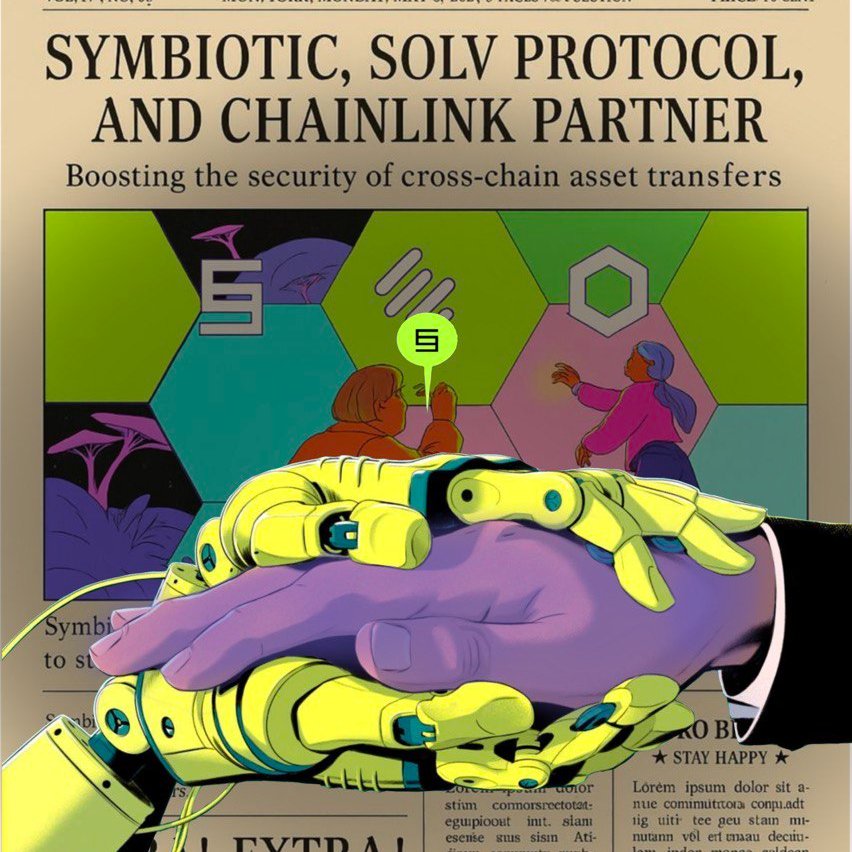
Symbiotic x Solv x Chainlink
Symbiotic joins forces with Solv Protocol and Chainlink to strengthen cryptoeconomic guarantees for cross-chain SolvBTC transfers.
Using Symbiotic’s restaking vaults (LINK & SOLV) and Chainlink CCIP’s modular security, users get an extra layer of trust and resilience when moving SolvBTC across networks.
Shared vaults, real monitoring, modular security -
a new standard for cross-chain Bitcoin.
“SolvBTC should serve users across networks without compromise.
Combining CCIP + Symbiotic gives stronger economic guarantees.” - Ryan Chow, Solv Protocol
Trust, connectivity, and BTC working together.
Top Layer - Users and Assets
Users hold or transfer SolvBTC across networks (e.g., Ethereum ↔ BNB ↔ Arbitrum).
SolvBTC is a tokenized version of Bitcoin that enables staking and yield generation.
Middle Layer - Chainlink CCIP (Cross-Chain Infrastructure)
CCIP is the foundational cross-chain protocol that handles the routing and verification of SolvBTC transactions between networks.
CCIP itself remains unchanged - its security is enhanced through additional layers provided by Symbiotic.
Lower Layer - Symbiotic Restaking Layer
Two vaults (LINK and SOLV) act as decentralized collateral pools, ensuring economic accountability.
The Monitoring Network tracks the correctness of cross-chain transactions executed through CCIP.
In case of discrepancies, the system raises alerts, protecting users from potential risks.
Base Layer - Cryptoeconomic Guarantees
The Symbiotic architecture creates a trust layer where every staker and operator bears stake-based responsibility.
As a result, SolvBTC gains an additional layer of security and reliability - without requiring any changes to CCIP itself.
Symbiotic is now featured on the Ethereum Foundation website - a great step for Web3.
Modular security, open architecture, universal staking.
Join the community on
Discord - https://t.co/ouKyOmyTUQ
X - https://t.co/JchMx3ZVHw
Symbiotic Community - https://t.co/s0a6xOqL2c
it’s just getting started 💚
Symbiotic × Manta AMA Recap
Just tuned into the Symbiotic × Manta AMA with Edgar Roth (the Symbiotic team) and Kenny Li (Manta Network).
It was calm, clear, and packed with real insights on modular security and shared trust.
Here’s the full recap 👇
- Celestia is central to Manta’s architecture.
John mentioned they were among the first to integrate it for data availability - that’s what helped the network stay stable during the inscription hype while other L2s struggled.
- The Symbiotic team explained that flexibility and a permissionless model were the key reasons for choosing them.
Manta could integrate shared security without rebuilding its entire stack.
“Symbiotic gave us security without the need to change our existing architecture.”
- Fast finality is now one of Manta’s biggest UX improvements.
Withdrawals on OP Stack dropped from 3 days → 12 hours,
and the team plans to push it down to 1 hour using ZK + Symbiotic.
- John confirmed that Atlantic (L1) is gradually being phased out,
while Pacific (L2) and Symbiotic become the foundation.
The focus now is on scalability and performance instead of privacy.
The Future of Symbiotic & Restaking
While writing these threads, I wanted to explain one simple thing:
Symbiotic isn’t just another restaking protocol. It’s an example of how Web3 is learning to build trust.
Here, trust isn’t a slogan - it’s architecture.
Not promises, but real mechanics: vaults, operators, resolvers, real incentives.
Symbiotic connects projects not through words, but through security. Tanssi, Symbiosis, Lombard, Chainlink, and many others- they all become parts of a single layer where security turns into shared foundation.
Symbiotic shows what restaking can become when trust stops being an idea - and becomes infrastructure.
yao fam !
Monad just dropped that Portal acquisition news not long ago - been putting off reading the blog but bruh, that’s pure alpha.
Monad’s got the future in the bag !!!
https://t.co/lrQzvmMjEG
@monad#monadtestnet#monadxyz
Season 2 of @kizzymobile is live It might be your new favorite social media betting game 😎
Use the code KIZZY2: https://t.co/meMzVrINDF
#monadtestnet#monadxyz@monad