𝗗𝗮𝘁𝗮 𝗶𝘀 𝘁𝗵𝗲 𝘁𝗵𝗶𝗿𝗱 𝘂𝘁𝗶𝗹𝗶𝘁𝘆. 𝗜𝗻𝘁𝗿𝗼𝗱𝘂𝗰𝗶𝗻𝗴 𝗪𝗮𝘁𝘁.
For seven months, we've been working on something we believe is foundational to the next era of AI.
AI agents are making consequential decisions (who to target, whether to approve, how to price). And they're doing it blind.
Not because the data doesn't exist. Because the infrastructure to make it available to agents never existed. Every data system ever built was designed for humans querying databases. Agents don't query. They reason. The entire data layer had to be rebuilt from the ground up.
So we built it.
Watt is the reasoning layer for people and company data, purpose-built for AI agents. 82,000+ real-world behavioral signals. 15 trillion data points. Time to agent: minutes.
Real-world behavioral signals synthesized into a graph your agents can actually traverse.
Our team has 50+ years of combined experience building infrastructure for the most complex data use cases in the world (think: hedge funds, NASA).
We're already in production with numerous customers who are building on Watt today. And we're scaling fast.
If you're building AI agents that need to understand the real world, please reach out. We'd love to show you what's possible.
And if you want to help build the data infrastructure layer for the agentic era: We're hiring.
Come find us. We're just getting started.
What is the Signal Graph?
An agent can't reason over petabytes of raw data. Not because it's too slow, but because there's nothing to grip.
Chief Architect John Zila on the substrate behind Watt:
→ A signal is a boolean clause. The graph stores, for every entity, whether that clause holds.
→ Signals are the asset. The graph holds about 162,000 signals; compositions over them generate more audiences than anyone could enumerate.
→ The answers are already on the shelf. For every signal, the exact set of entities is precomputed. Composition is an intersection of signals.
→ The graph traverses, not just filters. A single edge (eg, who employs whom) lets a composition cross from people to their companies and back.
A growing library of signals. An infinite space of questions. That's the substrate.
Signal Stack 01 is live.
A new series, breaking down cultural moments through behavioral data. First up: 𝗪𝗵𝗼 𝗮𝗿𝗲 𝗔𝗺𝗲𝗿𝗶𝗰𝗮'𝘀 𝘀𝗼𝗰𝗰𝗲𝗿 𝗳𝗮𝗻𝘀?
We built an audience of ~3.1M avid U.S. fans from 145,000+ behavioral signals. What stood out:
→ Italian ancestry over-indexes at 1.19×, Hispanic and Latino background at 1.11×. The rest of the demographic picture reads ordinary.
→ Fans concentrate in the Northeast and Florida. California sits well below its population share. The current USMNT roster maps the same corridor: Pulisic, Adams, and roughly half the squad have Northeast roots.
→ Interests cluster around upscale-leisure: tennis, hockey, international travel.
→ Credit and income signals lift slightly. Retail spending falls.
Signal Stack runs every two weeks. See you in two.
The @nyknicks just won their first title in 53 years. As a lifelong Knicks fan, I'm ecstatic!
So I ran a sample of ~1.4M Knicks fans using @wattdata via Claude to see what other local teams the typical Knicks fan supports.
A few things stood out (some surprising):
🧵
Signal Drop 01 is live.
Every two weeks we ship new signals into the Signal Graph and tell you exactly what landed. This one's a big drop.
→ Education signals on 118M+ people. "Alumni of X who are in-market right now" is a one-line query.
→ Geo as a composable signal. State, county, zip, MSA, CBSA, congressional district — mix them, stack them, reason across them like any other signal.
→ Company founding year, LinkedIn contacts, work-vs-personal flags on every email and phone, mobile ad IDs, and 1,700+ new intent topics.
More signals, all reasoned over the same way, all composable in plain language.
See you in two weeks. Link in comments.
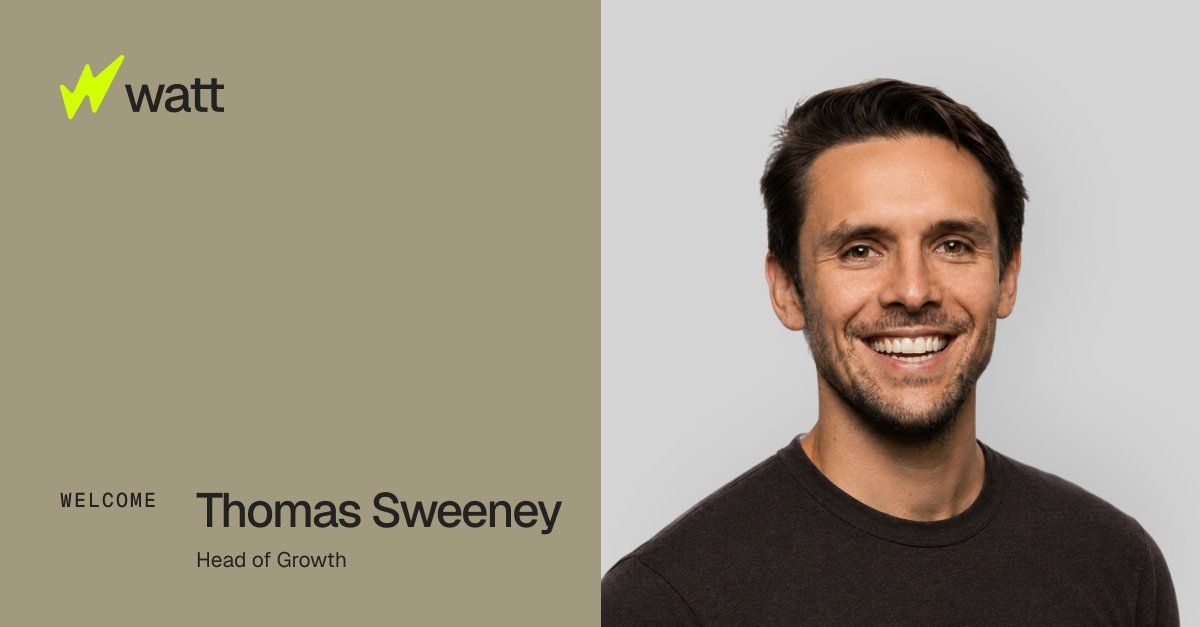
Welcome to the team, @tsweens!
Tom joins Watt as our first Head of Growth, leading brand, marketing, and the overall GTM motion as we scale from PMF to category creation to category leadership.
Tom comes most recently from CoinTracker, where he led growth through the company's hypergrowth years. Before that, GTM leadership at Meta, with experience spanning marketing, sales/partnerships, and corp dev at one of the most demanding environments in tech. He's the rare GTM leader who pairs first-principles strategy with world-class taste, (vibe)codes alongside engineers, and treats pipeline as a system rather than a set of plays.
Jared has been after him for months. We're glad he finally said “yes”!
A signal is a single fact about a person or company at a specific moment. Raw, uncompressed, and composable with others. Fields, traits, and segments are all downstream artifacts (somebody else's idea of what mattered, compressed before you saw it).
A few examples from the Signal Graph:
→ Searched buying a Peloton bike in the last 90 days
→ Renewed a commercial driver's license in 2025
→ Lives within 25 miles of a Tesla service center
→ Hired first VP of Sales in the last 60 days
If you've spent the last decade thinking in fields, the cognitive flip is to start thinking in signals. The artifact you ship gets bigger. The questions you can answer get more interesting.
New post on what a signal is, what isn't, and why one signal is almost never the answer. Link in comments.
If you're evaluating data infrastructure for your AI agent, you should know exactly where the data comes from.
@howdymaudi just published the rundown: two key vendors, thousands of upstream sources, all of it available on the open market.
The hard work isn't in the sourcing. It's in making raw signal reasoning-ready for an AI/LLM.
Most "audience targeting" on the major platforms hasn't worked in years.
Platforms push you toward broad interest categories and tell you to spend more. Whatever you can compose from "interested in fitness" and "households with kids" is what you get.
🧵
Excited to share that Watt has closed a $4.3M pre-seed from CEAS Investments, Companyon Ventures, 11 Tribes Ventures, Argon Ventures, and Bulletpitch, plus a number of top operator angels.
We're building the signal infrastructure for AI agents. Our graph contains 120,000 behavioral signals across 15 trillion relationships, 250M identities, 60M businesses, all accessible in plain language. What used to require a 200-person data team now requires one Signal Engineer.
For decades, the world's most valuable signals have been hoarded by a handful of big tech companies. That's over. We're putting them in the hands of builders.
Grateful to our investors, customers, and team. We're just getting started.
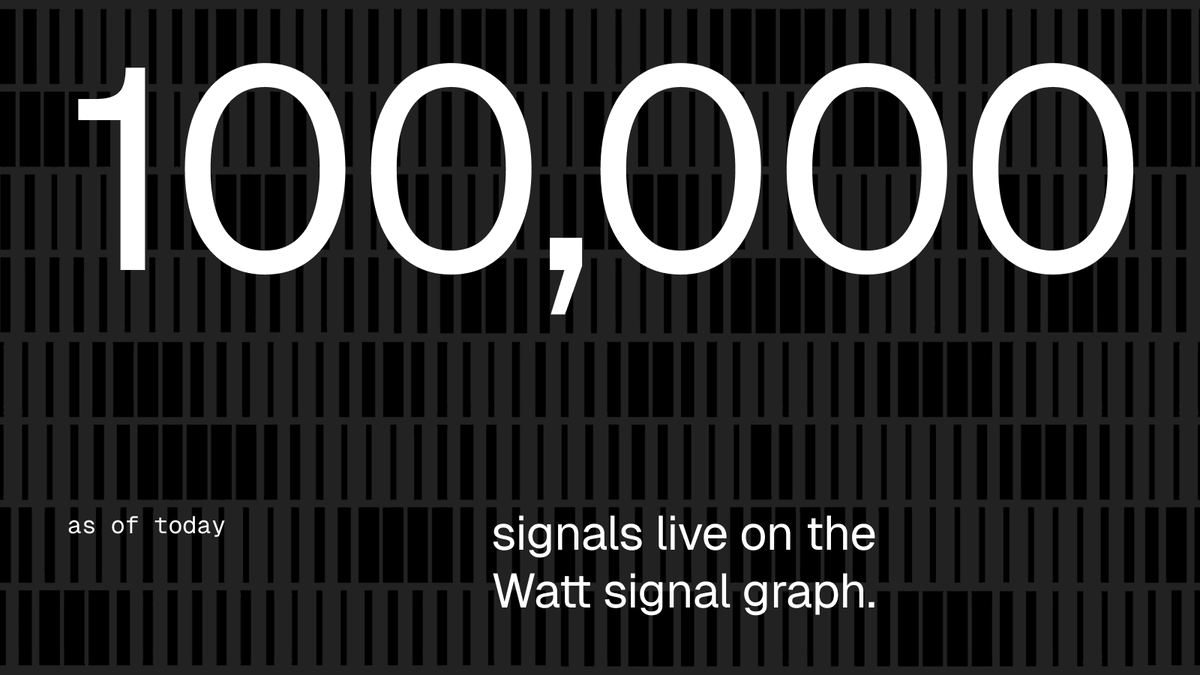
Today, we crossed 100,000 signals live on the Watt signal graph.
A signal is a measurement of an entity that changes over time. Headcount at a company. Foot traffic at a location. Spend in a category. The time dimension is what separates a signal from a static data point, and it's what lets an AI agent reason rather than just look something up.
It’s also what separates a data analysis from a data product. If you only have one-time data, it can only be used for historical analysis and immediately becomes stale.
If you have a signal you can build a product.
From those 100,000 signals, our search index computes more than 15 trillion relationships between them, recomputed daily. That's the substrate an agent actually traverses when it asks a question.
The legacy stack offers around 300 signals. We just crossed 100,000. Different scale. Different product. Different category entirely.
For the agents already building on top of us: this is what reasoning over raw signal actually looks like. For everyone else: come see what it makes possible.
For years before Watt, I built petabyte-scale knowledge graphs for adtech/martech & quant funds. Not because I wanted to. Because they were the only private-market buyers who could consume data at that scale.
🧵
Welcome to the team, @roshfm!
Rosh joins Watt as a founding engineer. He started by leading our MCP implementation and documentation, and is now embedded with customers as a forward-deployed engineer, building their first Watt agent alongside them.
Rosh spent time at Morning Brew, CBS Interactive, and shipped a long list of personal engineering projects along the way. He's the kind of engineer who treats a good idea as something to build by Friday, not something to add to a backlog. He's deep on software engineering fundamentals, fluent in agentic patterns, and translates vision into a tactical plan faster than almost anyone we've worked with.
He also happens to be a maestro on the pitch, and one of the most fun people to be around at Watt. We're lucky to have him.
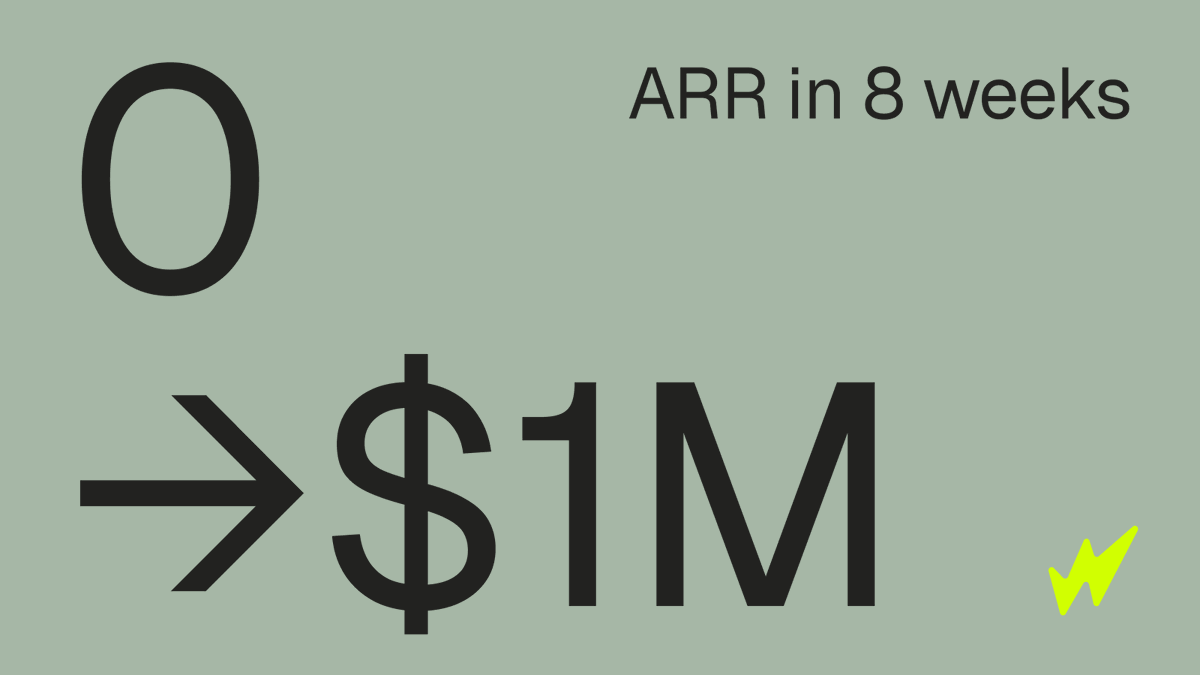
8 weeks ago, we launched Watt in beta. This week, we crossed $1M ARR.
We're proud of what our customers are building on Watt, and we're not going to slow down.
A few things we believe more strongly today than we did at launch:
1) Agents need a signal layer that is built for them. The legacy stack is not, and it shows.
2) When you give an agent 100,000+ real-world signals across 15 trillion data points and let it reason, the result isn't incrementally better. It's a different product entirely.
3) The craft is shifting. The people who used to wait in line for data are now composing against it directly. We call them “signal engineers” (more to come here).
This is the smallest Watt will ever be (we’re still in beta). The next layers of the platform are queued up, and a lot of what we're working on now will make today look quaint.
We're just getting started.