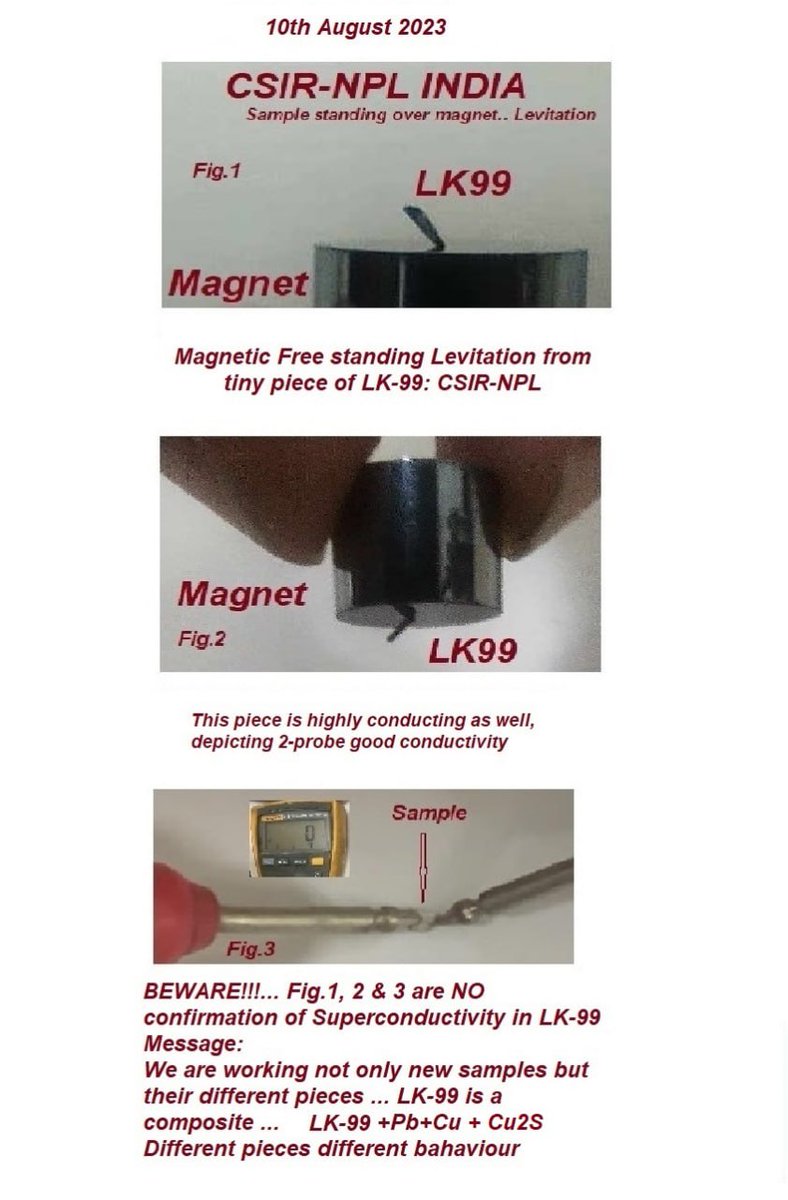
Indian researcher Dr. Awana VPS result!!!
@andrewmccalip Can you please measure your sample at room temperature, does it shows 0 ohm as well using multimeter - to show it is conductor or insulator. If your sample is not showing conductor, then something might be wrong?
#LK99
@andrewmccalip Can you check? Seems like very low resistance (0 ohm) shows by multimeter. Can you measure yours?
Below pic is legit, you can check the source of the Indian researcher.
@andrewmccalip Can you use a multimeter to measure the resistance? At least we will know it is conductor or insulator, it will take you 3s to do it, please let us know.
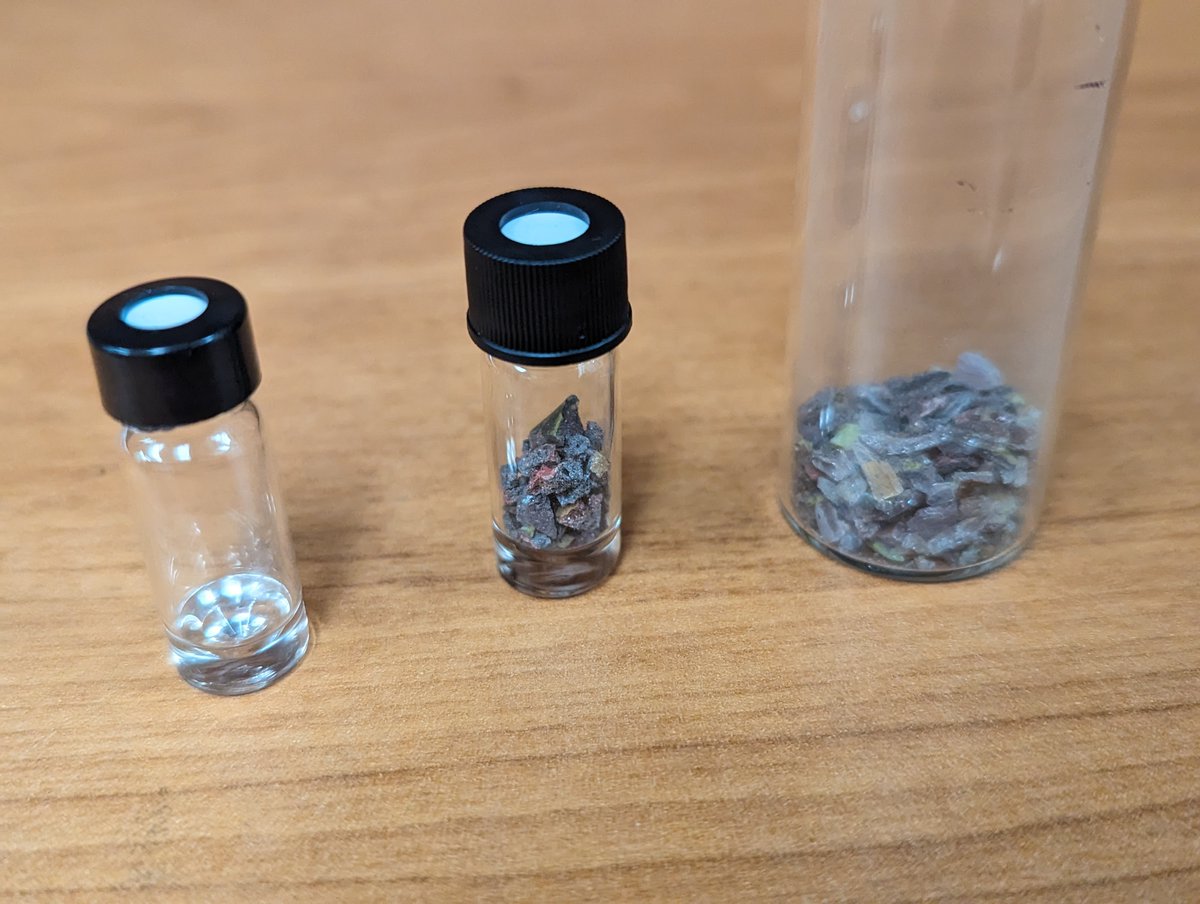
Big milestone happened today, which represents the original goal of the project! Today I delivered the rocks to @USCMatCon. Proper scientists will now perform MPMS, XRD, SEM to get to a quantitative measure of if we’re back, or it’s over. It’s more likely that we made novel (?) magnets, I'm not holding my breath for superconductors. It was always a long shot to hope for a true replication of room temp floating on the first try!
The sign-up spreadsheet was a big success, looks like tons of capability. I'll start reaching out tomorrow evening. Expect periodic updates now that we’re in this phase of the project.
Changing things up a little bit. I've relocated rock analysis to the living room now that things are ramping down and folks at Varda need some of the lab space back, shout out to @iris_IGB for the inspiration. While the equipment isn't as fancy, it's enough for what I need, and it’s nice to get a change of scenery after the work day. Videos will probably be a bit more casual, I feel like we may have hit a peak anyways with the @johncoogan video [https://t.co/GzG2xXbMbp]. I think the world as a whole is entering the slow grind part of this replication, and my guess is it's going to take many dozens of iterations to reach a conclusion on it. I’ve probably made my last batch, I don’t think I could do a better job on iteration 2 without more specialized equipment. There is still too much conflicting info to make a judgement call on LK99 yet, but I’m hopeful we get there in the next few weeks.
I did want to address the crude magnetic testing that has been occupying my (and a lot of folks’ mind):
I’ve made great progress in showing that there are indeed magnetic effects in the formulation as originally described, including some unreleased videos. That said, I think we're getting to the point where magnetic observations may be adding more noise than signal. Yesterday, I did perform the pole flip that was discussed in the last video. Very important to note, however, that ferromagnetism can exhibit pole agnostic behavior too. Check out the excellent video by @vangennepS. https://t.co/TR4UCzuZQ1. While the amateur magnetics method was fun to try for a screening method, it seems to have too many false positives to be entirely trustworthy.
Thank you all for the support thus far. Thousands of people have reached out, all with the most uplifting and supportive takes. It’s so cool that my nerdy hobbies resounded so strongly with the internet. Hopefully we can keep the narrative as wholesome science.
More to come, even if it’s a slower pace.
🔬Another #progressreport update: Our latest batch of Cu3P is out of the furnace! A quality check is underway before we move forward. We'll share an XRD spectrum tomorrow. Stay tuned as we gear up again for the final step: the baking of Cu3P and Lanarkite. 🧪 #LK99#OpenScience
First video of LK-99 Full Levitation, aka flux-pinning
This video was just posted to the Chinese video-sharing site BiliBili and claims to be a highly pure synthesized sample of LK-99.
What is the physical phenomenon behind this and what does it mean?
Levitation of superconducting materials is a phenomenon unique to what is called Type-II superconductors, and is an effect whereby magnetic field lines becomes 'trapped' as it passes through the material, providing the force needed to levitate. These are the popular images and videos of cryogenically-cooled discs floating above a magnet frequently seen online and in the pinned post on my profile.
You can think of this like strands of hair being caught in gum - the gum is suspended in mid-air by adhering strongly to the hair as the hair passes through it. The hair in this case is magnetic field lines and the gum is the Type-II superconductor. Just like hair comes in individual strands, or in other words hair is 'quantized' or 'discrete', so is the flux trapped at the 'pinning centers' quantized in what are called 'magnetic vortices' - the quantization of pinned flux lines is a key property and distinguishing characteristic of Type-II superconductors (although technically can occur in Type-I superconductors if the material thickness is smaller than the London penetration depth, which is indeed very small - specifics for the physics nerds out there).
Flux-pinning is entirely unique to superconductors and is also wholly distinct from the Meissner effect. It is not a property of diamagnets or diamagnetism.
At @TRIUMFLab I contributed to flux-pinning studies in Niobium crystal superconducting radio-frequency cavities used for particle acceleration. In that application, trapped flux poses an issue by increasing the remnant surface resistivity of the cavity, which has the effect of decreasing its effective quality factor or Q-factor, which is a measurement of a resonators efficiency. SRF cavities typically have Q-factors of 10E10 and trapped flux at pinning centers reduces the maximum effective accelerating electric field used to drive charged particle bunches close to the speed of light.
Flux pinning is thought to arise in some Type-II superconductors by small imperfections in the crystal, also called volume defects, that enable flux to penetrate the material. In SRF cavities an issue that arises is any magnetic field that is passing through the material, e.g. by the Earth's background field, can become pinned or trapped inside the cavity as it transitions into a superconducting state. See some attached plots in the comments from a study showing how the surface resistivity of SRF cavities increases the more there is a background field as the cavity transitions into superconducting state.
This is the first video I am aware of that claims to show the flux-pinned levitation of a LK-99 sample. If this is in fact what is happening, then it is a very unique and promising finding of this new materials properties and potential for future study.
If this is real then it is truly ground-breaking
Join me in experiencing the future of decentralization on the @Shardeum Sphinx betanet!
Get 15 #SHM now: https://t.co/g6ZKdp4Rc3
My address is: 0xfe369AAE0Dcf928CEa001f9b7BaB93ADF0536313