R.F. Kuang has written seven books, won the Nebula Award for Best Novel, and trained at some of the world's top universities: Cambridge, Oxford, and Yale.
Her wisdom-per-word ratio is also off the charts.
Some highlights from our conversation:
1) Emotions are like colors. Mix them! Emotions are never one-dimensional. Bring together fear and courage, love and revulsion, joy and panic. This collision of feelings is closer to how emotion actually works.
2) Practice literary shapeshifting. Become a new person, a new persona, and a new type of author with every project. Do not confuse your habitual voice with your authentic voice: there is no single way of constructing sentences that must define you. Treat language as a fluid and flexible tool.
3) There's no correlation between how good writing feels in the moment and the quality of the product. We mistake effortlessness for genius, flow, or divine inspiration. So don't evaluate a day’s work by the pleasure of producing it. Judge whether the sentences escaped your pre-existing patterns and helped you think something through.
4) Good writing comes from being attentive to what's happening around you and writing with specificity about those observations, rather than relying on the theoretical. Throughout the day, ask: “Where is this feeling sitting in my body? How am I physically responding to this?” Those questions force you beyond the abstract label and toward something more specific than the reader could easily imagine for themselves.
5) Use your zero draft to discover the beating heart of the story, not to prove that you can already write it. Research, brainstorm, follow your nose, and collect whatever feels surprising or “crunchy.” At this stage, coherence is less valuable than emotional resonance.
6) Draft in layers. Let the early draft remain “balls on sticks.” Add the setting, architecture, faces, furniture, and drape colors in later passes. A person’s visual appearance is often the least interesting thing about them.
7) Use the outsider’s perspective to make language strange again. Nabokov could play, stretch, and innovate with English because he was fascinated by the oddities and opportunities of particular word combinations.
8) Be suspicious of “volunteer words for volunteer thoughts.” Volunteer words are the phrases that offer themselves immediately because they are already floating around in your head. They repeat common discourse and carry ideas that are easy to digest; you are filling the page from your pre-existing dataset rather than articulating something you have actually observed or thought through.
9) If you're stuck, put the subconscious to work. Open a blank document, type a title, word, or phrase, then save and close it. Return after the problem has had time to work on you in the background.
10) Serious writing doesn't require solemnity. Soaring observations about history or human nature can sit beside potty jokes.
11) AI can offer readily available words for readily available thoughts, but readily available thoughts do not push boundaries. It may reproduce impressive human patterns, but “you won’t get your next Pale Fire from an LLM.”
12) Thinking about the audience as you write a first draft is a death sentence. The moment you start writing while looking over your shoulder, you stop taking the story where it needs to go.
Timestamps:
0:29 Writing your emotions
6:44 Observing people
15:20 Why easy writing doesn't work
23:09 Building unique voices for each book
30:47 What Kuang learned from debate
32:52 Why primary sources matter
35:33 AI & writing
40:54 How to start a book
45:16 Trust your subconscious
50:25 Copy the writers you love
52:57 Being goofy
57:34 Find a driving question
1:01:36 What every writer needs to learn
01:04:38 Book and movie recommendations
I've shared the full conversation with R.F. Kuang below. If you'd rather watch the full thing on YouTube, or listen to it all on Apple / Spotify, check out the reply tweets.
Enjoy!
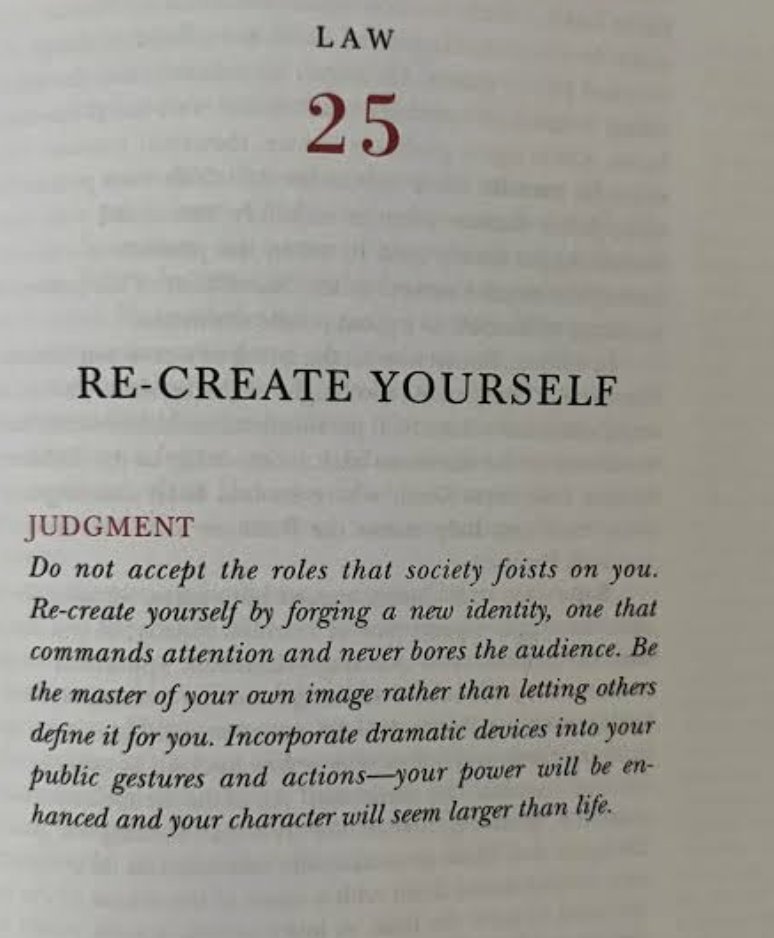
My take on law 25 is that you should actively shape your identity and public image, rather than allowing other people or circumstances to define you (which they will)
Greene argues that people who are powerful often treat themselves almost like a work of art. They reinvent themselves each time and control how they are perceived, and avoid being trapped by an old identity
they move on & fast
Une fille sur YouTube a fait une vidéo très vrai en parlant du fait que notre génération matcha influenceur de merde est incapable de sortir sans dépenser un sous alors que ça coûte 0€ d’aller se promener et se poser dans un parc ou à la plage et c’est vrai
Athletes like Erling Haaland and Alysa Liu hava captured our hearts because we live in a time of incompetent leaders and toxic masculinity. It is such a refreshing rebuke to see people performing at high levels while having fun and being their full selves.
A Japanese immunologist spent 20 years proving that the chemicals trees release into the air walk into your bloodstream, hunt down your stress hormones, and arm your immune system in ways no therapist or pharmaceutical has ever matched, and most of the data has been sitting in Japanese medical journals for two decades waiting to be translated.
His name is Qing Li.
He is a clinical professor at Nippon Medical School in Tokyo and the president of the Japanese Society of Forest Medicine. The Japanese government has been funding his research since 2004, and the body of work he has produced is the reason forest bathing is now an officially prescribed clinical therapy in Japan and Korea.
The story actually starts in 1982, when the Japanese Ministry of Agriculture, Forestry and Fisheries coined the term shinrin-yoku to describe the practice of slow, mindful walking in a forest. They did it for a practical reason.
Japan was urbanizing fast, stress-related illness was climbing, and the country had thousands of square kilometers of forest sitting unused. The idea was to give people a reason to walk into the trees... They had no idea what was actually happening to the human body during those walks until Qing Li ran the first proper experiment in 2005.
He took twelve healthy adult men on a three-day, two-night trip to a forest park. They walked for a few hours each day. Nothing strenuous. No prescribed routes or breathing exercises. They simply walked slowly through the trees, breathing the air, looking at the forest.
Li drew blood and urine samples before the trip, on the second day, on the third day, on day seven after returning home, and again on day thirty.
The numbers that came back from the lab were not what anyone expected.
The activity of a specific type of immune cell called the natural killer cell, which is the cell your body uses to hunt down cancer cells and virus-infected cells before they can spread, had jumped by roughly 50 percent during the forest trip. The actual number of natural killer cells circulating in the bloodstream had increased significantly.
Three different anti-cancer proteins that those cells produce, called perforin, granzymes, and granulysin, had all risen sharply. And the effect did not disappear when the men went home. The immune boost was still measurable on day seven and was still partially present on day thirty.
Two hours a day in a forest had upgraded the immune system for a full month.
Li ran the same experiment with women a year later and found nearly identical results. Then he ran it with a control group who took a three-day trip through an urban area with the same amount of walking, the same hotel quality, and the same diet.
The urban group showed no measurable change in natural killer cell activity at all. The forest was doing the work, not the vacation.
The mechanism turned out to be a class of airborne molecules called phytoncides. Trees produce these compounds to defend themselves against insects, bacteria, and fungi. Pine, cedar, oak, and cypress trees release them in particularly large amounts, especially in warmer weather and after rainfall.
When you walk through a forest, you are inhaling those molecules into your lungs and absorbing them through your skin, and once inside your body they appear to directly stimulate the production and activity of the very immune cells Li was measuring in his lab.
Roughly 50 percent of the health benefit of a forest walk, according to Li's data, comes from the chemistry of the air itself. The other half comes from what the forest is doing to your nervous system.
This is where it stops being only about the immune system and starts being about stress.
A separate Japanese research team measured cortisol, the body's main stress hormone, in 84 participants across 35 different forest sites. They drew samples before and after a 30-minute walk in each forest and compared them to control walks in matched urban environments. The cortisol levels of the people who walked in the forest were lower than the cortisol levels of the people who walked in the city by a significant margin. Their heart rates were lower. Their blood pressure was lower.
The activity of their parasympathetic nervous system, which is the part responsible for rest and recovery, had gone up. The activity of their sympathetic nervous system, which is the part that drives fight or flight, had gone down.
Then a researcher at the University of Michigan named MaryCarol Hunter ran the cleanest version of this experiment ever done. She recruited participants from a city and told them to take a nature pill three times a week for eight weeks.
They were free to choose the time, the place, and the duration of the nature experience, as long as it was outside, in daylight, and free of phones, conversations, and aerobic exercise. They sent her saliva samples before and after each session so she could measure cortisol changes accurately and rule out the normal daily drop in stress hormones that happens to everyone.
The result was that participants experienced a 21.3 percent drop in cortisol per hour spent in nature, with the biggest payoff happening between minutes 20 and 30 of the walk.
After that, the cortisol kept dropping, but more slowly. The threshold dose for measurable stress relief was just 20 minutes outside in something that looked and felt like nature.
What none of this means is that nature is a substitute for therapy or for medication when someone genuinely needs them. Therapy treats different things than a walk does, and Li himself has been careful in interviews to call forest bathing a complementary intervention rather than a replacement for clinical care.
But what the research has settled is that the human body has a physiological response to being among trees that operates on the same biological systems modern medicine is trying to reach with drugs and clinical protocols, and that response is fast, measurable, and free.
The strangest part of Li's work is the implication he keeps repeating in interviews. The average person now spends more than 90 percent of their life indoors. Their cortisol stays elevated. Their natural killer cells stay sluggish.
Their parasympathetic nervous system rarely gets a chance to take over. The system that was tuned by millions of years of life under a canopy of trees is being asked to run permanently inside a box made of drywall and screens.
Your body has not forgotten what it is supposed to do in a forest. It is waiting for you to walk into one.
Kobe Bryant once said:
“Everyone wants to be a beast. Everyone wants to be the best. But very few people are willing to do what it actually takes. Because what it takes is boring. It is waking up at 4:00 AM. It is shooting the same shot a thousand times. It is watching the film when you are tired. People fall in love with the result, but they hate the process. You have to fall in love with the boredom. You have to fall in love with the repetition.
If you can find joy in the mundane work that no one else sees, the lights will eventually shine on you.”
The quicker you act on realizing you have to attack life, not let it happen to you, the quicker you enjoy this journey versus wasting it on stress, anxiety, and worry
“It’s not an event to stay home and watch movies in your living room.”
Steven Spielberg says watching movies in a theater builds community as he explains why the movie theater experience is better than watching films at home.
(🎥 Michelle Obama/Youtube)
if korean netizens just know people are no longer interested in korean shows & are now into cdramas & western shows but it's because of #PerfectCrown that brought people back to kdrama.