Big up de vid to me new song Ali Ali Ali featurin fly local dancerz Amy Gardner and Michelina DeVeas showin dat me ain’t de only hot young talent in Staines right now. Respek
Album out now: https://t.co/r763iE7KLc
Watch the music video: https://t.co/AO8VXgDeMg
There’s more to social proof than a “bestseller” badge or a “loved by 1 million customers” message.
In this episode of Behavioral Science for Brands, I sit down with MichaelAaron Flicker to discuss how some lesser-known nuances of social proof can be used for better marketing.
We cover how the impact of social proof varies by context, culture and demographics, and how these findings can be harnessed.
Spotify: https://t.co/GRQmL4nekE
Apple: https://t.co/WP07KUXVGw
YouTube: https://t.co/Zy9aFzi99p
Pou chèf gang yo ak manm gang yo k ap kenbe kat konpatriyòt nou yo an otaj ann Ayiti:
Mesye nou kidnape yo pa konbatan. Yo se teknisyen nan domèn avyasyon ki fè pati misyon nou ann Ayiti, nan kad yon misyon entènasyonal. Misyon nou an gen sèlman pilòt ak pèsonèl teknik, ki gen kòm travay prensipal fè evakyasyon medikal epi sove lavi moun, pa fè lagè.
Men, nou te kidnape yo yon fason lach pandan yo t ap retounen apre yo te fin achte manje nan yon makèt nan zòn nan.
Se poutèt sa, jodi a nou te lanse yon operasyon militè pou pote yo sekou. Nou gen yon sèl objektif: fè kat konpatriyòt nou yo retounen lakay yo vivan, san okenn mal.
Men, mwen vle pou nou menm, chèf gang yo, konprann yon bagay byen klè: atak jodi a pa anyen devan sa k ap vini si nou pa remèt toule kat otaj yo vivan.
Epi pa pran pawòl nou yo pou menas san fondman. Nou deja fini ak gang yo nan El Salvador, e nou kapab fini ak nou tou.
Nou toujou gen tan pou evite sa.
Remèt nou kat konpatriyòt nou yo vivan, san okenn mal, epi tout bagay ap retounen jan sa te ye anvan kidnaping lan.
Desizyon an nan men nou.
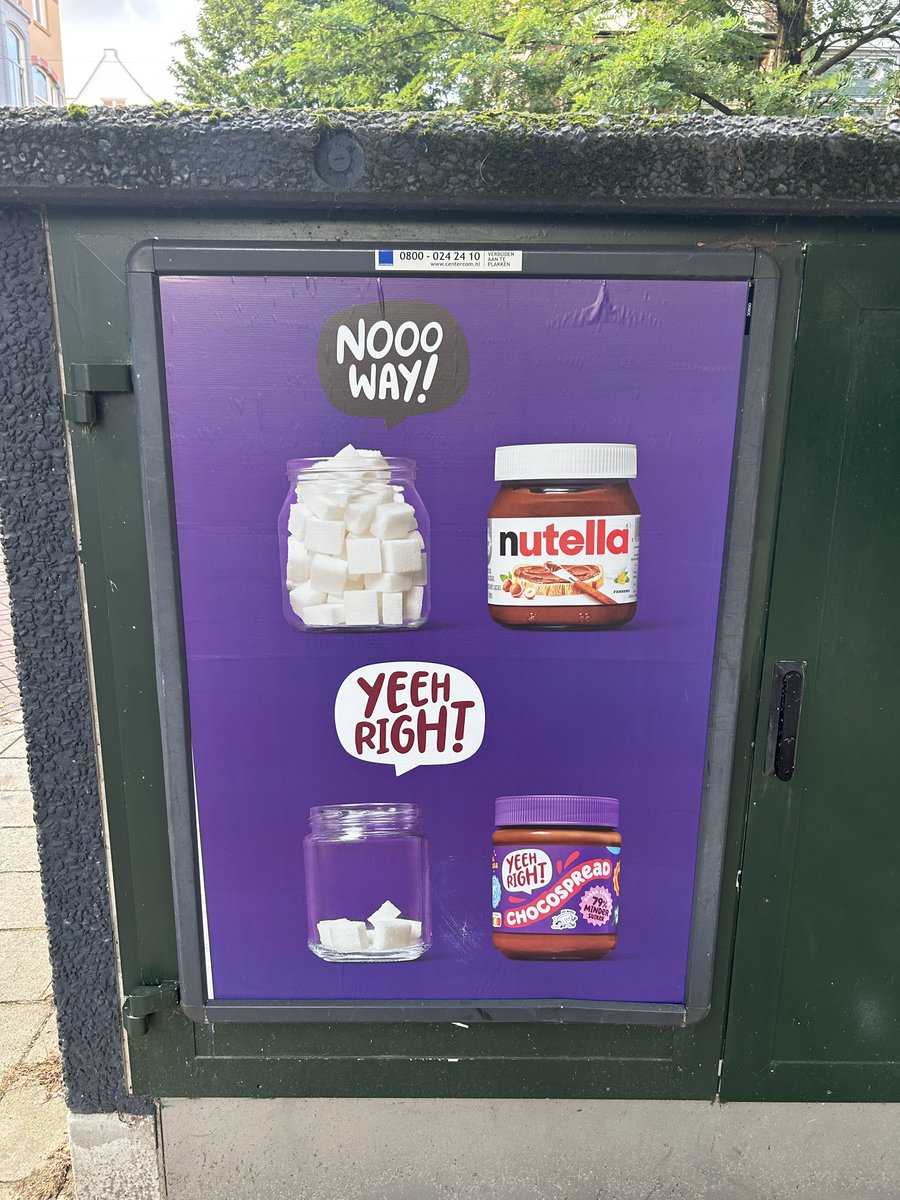
This Dutch ad brilliantly applies the principle of concreteness. Lower-sugar products often talk about sugar in terms of grams or percentages. But those terms are abstract (i.e. hard to visualise) so they're quickly forgotten.
By showing actual sugar cubes, Yeehright! is a lot more memorable. That's because of the principle of concreteness - the repeated finding that messages people can visualise are far stickier than abstract ones.
In 2021, I ran my own experiment into concreteness with Mike Treharne, based on a 1972 study by the academic Ian Begg.
We gave 425 nationally representative participants a list of 10 two-word phrases, some abstract and some concrete. For example:
-Cashew nut (concrete)
-Central purpose (abstract)
After 5 minutes, we asked people to recall as many phrases as they could.
Participants remembered 0.7% of the abstract phrases, but 6.7% of the concrete ones.
The massive x9 difference in memorability occurs because concrete words are easier to picture than the abstract phrases.
Think of a cashew nut - you can see the image in your head... But 'central purpose'…it's much harder to visualise.
So anytime you’re dealing with abstract terms or stats, think of how you can convert them into visualisable messages, either through language (e.g. "that's 20 sugar cubes less") or through a clear image (like the one below). It’s a criminally underused tactic!
***
If you'd like to learn more, I'm running a training session on behavioural science for better marketing on December 10th.
More details here: https://t.co/85AoYvSAm4
Prices aren't judged entirely logically. People focus more on the headline number, than the unit of time. It's known as the pennies-a-day effect and it means that if you communicate your prices across smaller time units, you'll reduce your customer's price sensitivity.
That’s what hims did. Rather than leading with £16.50 a month, they advertise 55 pence a day. The same treatment now feels like a few loose coins from your back pocket, making it seem much more affordable.
I tested the pennies-a-day effect in 2017 with 500 participants.
I split them into 4 groups and showed the same car financing deal. However, each group saw the price displayed as either a daily, weekly, monthly or annual amount.
Here’s how many people thought the deal was good value in each group:
Annual price: 11%
Monthly price: 40%
Weekly price: 43%
Daily price: 51%
People who were shown the daily price were almost 5x more likely to rate it as good value than people who saw the annual price.
So if you’re looking to tackle customers’ price sensitivity, cutting prices or offering discounts isn’t the only option. If possible, keep the price as is, but reframe it across the smallest possible time frame (e.g. a day). The same offering will feel better value.
This is just one tactic for making the same price more appealing. If you’d like to learn others, I‘m running a training session on behavioural science for better marketing on Thursday 10th December.
More details here: https://t.co/85AoYvSAm4
Robbie Williams revealed that a RANDOM WOMAN gave him a HANDJOB in his castle bedroom - and he had NO IDEA who she was.
He woke up to a strange woman standing by his bed and assumed she was the cleaner.
She offered him a handjob. He agreed.
Later, he told the woman running the castle:
“Your cleaner's weird.”
“We don't have cleaners on a Wednesday.”
But it gets even crazier.
THREE YEARS LATER, his guitarist heard the story and immediately recognized her.
“That's Maureen from the pub!”
“She said she did that but nobody believed her!”
Anna Kendrick's reaction is PRICELESS. 💀
As a young teenager, I wish I'd known about the spotlight effect. It's the idea that we radically overestimate how much our mistakes are noticed. It's easy to think others are paying attention to our cock-ups but most people are far more fixated on their own concerns.
The original study was run by Thomas Gilovich (Cornell University) in 2000.
He requested that participants arrive at his lab at a set time. Then he put them in a small room to fill out a questionnaire.
But Gilovich intentionally gave one participant the wrong start time.
When that participant arrived 10 minutes after the others, Gilovich chided him for his tardiness and said he needed to wear a Barry Manilow T-shirt for the experiment (a singer specifically chosen to be deeply embarrassing).
Then Gilovich brought the "late" participant into the room where the others were completing the questionnaire. Just as he was sitting down, in another twist, Gilovich asked the participant to step back out...
"I'm sorry", Gilovich said, "on second thoughts I think you're too late to take part".
After these bizarre meanderings, Gilovich asked the participant to estimate how many people in the room had noticed his Manilow T-shirt.
The average estimate was 46%.
Then Gilovich questioned everyone in the room as to whether they could remember what the "late" student was wearing. Only 23% had noticed it.
The "late" participant thought they were the centre of attention, "in the spotlight". But most people are focused on themselves, rather than on others.
This means that if you make a faux pas, there's less reason to worry than we suspect - most people won't even notice it. To me, that's a pretty cheering lesson for teenagers and beyond.
But there's a less happy implication for marketers. After all, the main point of the study is that even bizarre incidents playing out right in front of people are barely noticed. Too many marketers assume customers will pay attention to their latest campaign. But that's not the case. We need to go to remarkable lengths simply to be noticed.
Luckily, behavioural science offers many simple ways to do this. If you’d like to learn these, I‘m running a training session on behavioural science for better marketing on Thursday 10th December. More details here: https://t.co/85AoYvSAm4
(The drawing, by the way, is by the wonderful @sketchplanator).
Borat almost got made as a normal scripted comedy. Matt and Trey from South Park had come up with a brilliant scripted version.
Sacha Baron Cohen just told 60 Minutes what changed his mind. He spent four days with Jim Brooks, the man behind The Simpsons and Taxi, working out the story. Then at dinner, The Exorcist director William Friedkin told him "you've got to make it in the real world."
So he pitched Fox a movie where real people move the plot without knowing they're in a movie. He didn't think they'd go for it. They handed him $14 million.
The first scene was Borat trying to buy a car. The guy pointed him to an ice cream truck instead. "Oh wow, the theory works." Borat went on to make $260 million. 20 years later he's back with Ali G: Who Iz I?, his first movie as a director, out this Friday.
A$AP, Drake and Kendrick better check demselves before me wreck demselves coz dere iz a new rap king in town, Ali G. Me rhymes is tighter dan me Julie’s batty crease and sicker dan someone wiv a terrible cold or flu like symptoms. Check out me movie sountrack produced by Hit-Boy and Andrew Watt, wiv @questlove as Music Superviror. Between dem, dese 3 geezers has won 14 Grannies. Respek.
Listen to “Richer Than Elon”: https://t.co/gBlBCrkRcH
Pre-save the Album, Ali G: Who Iz I? https://t.co/GPKsaLUfbQ
@UMG@defjam
Sacha Baron Cohen says the idea behind Ali G was simple: Put “the world expert” in a room with “the biggest idiot in the world.” https://t.co/BvnUVXIcTy