GPT-2: Language Models are Unsupervised Multitask Learners
1/ This research paper was released in Feb 2019 by OpenAI and it's become one of the most controversial papers because it's the first time OpenAI decided to close source their model
In this paper, they said
We've trained a large scale unsupervised language model which generates coherent paragraphs of text, achieves state-of-the-art performance on many language modeling benchmarks and performs rudimentary reading comprehension, machine translation, question answering and summarization, all without task specific training
How does Linear regression works?
What does it mean to fit a line to the data? The line with the best fit is one that minimizes the sum of squared residuals/errors from each data point to the true line
The squared error is referred to as a loss function and is typically mean squared error (MSE) or equivalents. To fit a good line to data points, we tweak the two parameters that make a line y = mx + b. By changing m and b, we can shift the line up and change the steepness
By using an optimization technique like gradient descent, we are able to slowly and iteratively shift the line closer and closer to the data and the true underlying line
CC: Algoneural
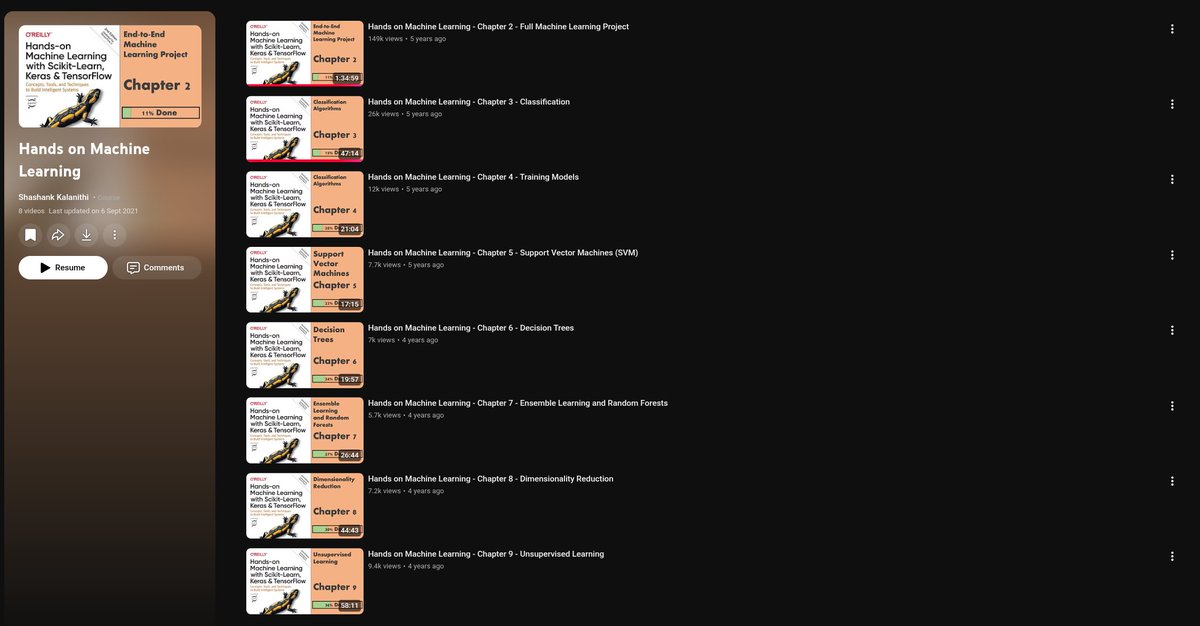
Starting my Machine Learning journey tomorrow
This book is considered one of the best for learning classical ML algorithms. I'll read the whole book, implement every algorithm and post whatever I learn from it. I'll try to finish it asap so I can go deeper into concepts and build something useful around it
How does Linear regression works?
What does it mean to fit a line to the data? The line with the best fit is one that minimizes the sum of squared residuals/errors from each data point to the true line
The squared error is referred to as a loss function and is typically mean squared error (MSE) or equivalents. To fit a good line to data points, we tweak the two parameters that make a line y = mx + b. By changing m and b, we can shift the line up and change the steepness
By using an optimization technique like gradient descent, we are able to slowly and iteratively shift the line closer and closer to the data and the true underlying line
CC: Algoneural
What is Linear regression?
It is the simplest form of machine learning, using just two parameters to find patterns in data. The algorithm learns by adjusting a slope and an intercept, the slope determines how steep the line is, while the intercept sets where it crosses the y-axis
Through training, the model continuously tweaks these two values until it finds the line of best fit that minimizes the distance between predicted and actual data points. This straightforward approach of fitting a straight line through data demonstrates the core principle of machine learning, automatically adjusting parameters to make better predictions
CC: 3blue1brown
Starting my Machine Learning journey tomorrow
This book is considered one of the best for learning classical ML algorithms. I'll read the whole book, implement every algorithm and post whatever I learn from it. I'll try to finish it asap so I can go deeper into concepts and build something useful around it
What is Linear regression?
It is the simplest form of machine learning, using just two parameters to find patterns in data. The algorithm learns by adjusting a slope and an intercept, the slope determines how steep the line is, while the intercept sets where it crosses the y-axis
Through training, the model continuously tweaks these two values until it finds the line of best fit that minimizes the distance between predicted and actual data points. This straightforward approach of fitting a straight line through data demonstrates the core principle of machine learning, automatically adjusting parameters to make better predictions
CC: 3blue1brown