Five years of Infinite Giving! 🎉 Karen Houghton built it to help nonprofits grow. Today: 500+ nonprofits, 0% fees on stock gifts, a Fast Company World Changing Software honor, and Karen named an Atlanta Business Chronicle Woman of Influence. Proud backers since day one! 🙌
Minister, you left out the tribunal.
Pompey did not lose his head on a battlefield. Seven weeks after Pharsalus he lay at anchor off Egypt, waiting on the verdict of a council he had never answered to: a eunuch, a hired rhetorician and a general, sitting for a boy king. Plutarch calls it a tribunal.
Its ruling, in the rhetorician’s words: “A dead man does not bite.”
He was run through from behind as he rose to step ashore.
Then came the men with swords. Caesar turned away from the head and wept over the ring. The eunuch and the general were dead within the year, and the king vanished in a battle on the Nile. The rhetorician ran for years. They caught him too. Egypt was a Roman province eighteen years on.
Remember the past, by all means. All of it.
My grandfather owns a school notebook from 1946 with 312 American soldiers in it.
He was 13. His father had not come home from the war. His mother had three little ones and no money. So every morning, he carried a wooden box to a corner near the American headquarters in Tokyo and shined boots.
He spoke no English. So he did what a Japanese boy does with something he doesn't understand.
He kept records.
Every soldier. Name. Hometown. Payment. One line each, in pencil.
He's 93 now. Last month, he finally let me hold it. A few lines:
"Pvt. Wojcik. Chicago. 10 yen. Says Chicago is the greatest city in America. Said this four times. Then a soldier from New York walked by. They argued. Neither paid."
"Cpl. Haskins. Texas. 1 chocolate bar. Says everything in Texas is bigger. I looked at his feet. He said, 'Size 13, partner. Charge me double.'"
"Pfc. Tutt. Alabama. 5 yen. Sang the whole time. Very bad. I would have paid HIM 10 to stop."
"Lt. Garrity. Boston. Asked me to teach him how to bow. Bowed to a general. The general bowed back. Both in trouble."
"Pfc. Sorensen. Iowa. Asked where my father was. I pointed at the sky. He pointed up too. 'My brother,' he said. He stayed beside me in the street until I finished. Paid 50 yen. Five times the price."
"Sgt. Abramowitz. Brooklyn, New York. Took the brush from me and did his own boots. 'This is how the Army taught me, kid. Watch.' Then he saw my feet. I had no shoes."
"Sgt. Abramowitz. Brooklyn. Came back. Brought shoes. My size. Would not let me touch his boots. Said, 'Tomorrow.'"
"Sgt. Abramowitz. Brooklyn. 10 yen."
"Sgt. Abramowitz. Brooklyn. 10 yen."
"Sgt. Abramowitz. Brooklyn. 10 yen."
Page after page. Abramowitz. Abramowitz. Abramowitz. Every day for eleven months. Same corner. Same 10 yen. In 1946, that was real money.
My grandfather didn't understand it until he was in his thirties.
The boots were already clean. They were always clean.
It was never about the boots.
The last line about him is from the day his unit shipped home.
"Sgt. Abramowitz. Brooklyn. He sat me on my own box and shined my shoes. Paid: nothing. Owed: everything."
My grandfather became a shoemaker. He ran his own shop in Tokyo for 51 years. No child ever paid.
Above his counter hung a small wooden sign, in English. Nobody in the neighborhood could read it. He never explained it.
"TOMORROW."
He is 93. Every morning, he still does his shoes the Brooklyn way. Small circles. Spit. Patience.
He never went to America. Not once.
I asked whether he wishes he had.
He tapped the notebook.
"I didn't need to," he said. "America came to my corner. And one of them kept coming back."
Building code / Legal work:
"When you have so much more trust in [Claude's] ability to write good [legal docs], I've gotten to a point where I essentially have [Claude draft the docs without needing my review]"
Garry Tan puts the share of engineers already building features this way at maybe 1 percent and says it should grow by 100x, while Lauren explains she now lets agents merge their own pull requests
“This is the gold standard for how to do it. I would say maybe 5 or 10 percent of engineers, or maybe 1 percent of engineers, period, in the world are doing this right now. So this is literally something that should grow by 100x.”
“It took us quite a while to get to that point. It's quite hard to get to that point overnight. It involves investment into making sure you have the right skills. Your code base has good guardrails and constraints so that the time that you would otherwise have to spend on human code review is encoded into your code base and your static analysis and your tooling.”
“When you have so much more trust in your agent's ability to write good code because you've set up those systems, I've gotten to a point where I essentially have my agents merge their own pull requests.”
w/ @garrytan, @poteto
Four possible reasons why NO media will cover new exculpatory evidence in the Brian Cole Jr. case:
1 - They are using the ‘alternative suspect theory’ as a legal excuse to not report, to avoid a potential defamation lawsuit. (Total BS excuse. They can report the “news” of any such litigation and cover the case as it's presented in the courtroom. But … they aren’t.)
2 - For “right-wing” media, anything that contradicts the current FBI/DOJ narrative jeopardizes their seats in the White House press room and on Air Force One.
3 - For MSM or “left-wing” media, anything that reveals the pipe bomb story to be a multi-agency conspiracy destroys the official narrative established by Pelosi’s original J6 Select Committee.
4 - They have received “the call” from DOJ/FBI/CIA and were told to stay away. (We have absolutely, 100%, confirmed that this has happened with certain media orgs.)
Why won’t any other media sources commit their investigative journalistic resources to even fact-check what we are revealing on a weekly basis? Now … ask why we weren’t even invited to the big OMG 2026 Citizen Journalist Gala at Mar-A-Lago. What are they afraid of?
#FreeBrianColeJr
Why landing a Starship was 100x as difficult as landing a Super Heavy.
Engineering meets science fiction.
@elonmusk is the Thomas Edison of this century.
Have you ever wondered why catching Starship is so much harder than catching Super Heavy, even though they both return to the same launch tower? 🔥
💡 The answer comes down to four major engineering challenges that make Starship’s recovery fundamentally different 👇
⚡ The first problem is shedding an enormous amount of energy
At hot staging, Super Heavy was traveling at roughly 5,800 km/h (3,600 mph). Starship, meanwhile, had to return from orbital speeds of roughly 27,500 km/h (17,100 mph).
That’s nearly five times faster. Because kinetic energy increases with the square of velocity, each kilogram of Starship at orbital speed carries roughly 22 times the kinetic energy of a kilogram of Super Heavy at separation.
That works out to nearly 30 million joules per kilogram.
Almost all of that energy has to be dissipated before Starship can safely reach the tower.
One option would be to use rocket propulsion to cancel out its orbital velocity. However, scrubbing off roughly 7.7 km/s of speed using Raptor engines alone would require a massive amount of propellant.
The rocket equation makes this approach especially punishing. Every extra kilogram of landing propellant has to be hauled into orbit first, dramatically increasing the fuel needed at liftoff.
Instead, SpaceX uses Earth’s atmosphere to bleed off almost all of Starship’s orbital velocity.
That saves an extraordinary amount of propellant, though it introduces another major hurdle.
🔥 Surviving extreme atmospheric heating comes next
As Starship plunges into the atmosphere at hypersonic speeds, powerful shock waves compress and heat the surrounding air to blistering temperatures.
Thousands of ceramic heat-shield tiles protect its stainless-steel structure from the intense heat.
Simply keeping those tiles attached isn’t enough, though. Superheated gas can seep into the gaps between them, risking damage to the underlying structure.
For Flight 15, SpaceX carried forward upgrades from Flight 14, including extra tile-retention hardware in vulnerable areas and redesigned curved tiles that reduce heating between adjacent tiles.
Because Super Heavy never reaches orbital velocity, its return doesn’t expose it to anything close to the same thermal stress.
And there’s another complication.
A heat shield that survives one reentry isn’t necessarily ready to fly again. Starship’s thermal protection system must eventually withstand repeated missions without major repairs or refurbishment.
That’s critical, since rapid reusability is one of the core reasons SpaceX designed Starship to be caught rather than discarded.
Yet surviving reentry still isn’t enough. Starship also has to arrive at the exact right spot.
🎯 Hitting a precise target from orbit raises the stakes even further
About 56 minutes before the catch, a single Raptor engine fired for just 10 seconds to initiate Starship’s return.
That brief deorbit burn wasn’t meant to eliminate orbital velocity. Instead, it nudged the spacecraft’s trajectory so atmospheric drag could take over the much larger job of slowing it down.
Starship then entered the upper atmosphere thousands of kilometers away over the Pacific Ocean.
From there, its four aerodynamic flaps controlled its orientation and fine-tuned the forces acting on the vehicle.
Super Heavy uses grid fins to steer during its return, but Starship’s flaps have to handle a far wider range of flight conditions.
As Starship decelerates from hypersonic through supersonic and down to subsonic speeds, its guidance system continuously adjusts its attitude and flight path.
The challenge is maintaining the right balance of altitude, speed, and trajectory while aerodynamic forces shift dramatically throughout reentry.
For Flight 15, the return corridor crossed sparsely populated parts of northern Mexico and South Texas.
Starship maneuvered around major population centers in the Rio Grande Valley, passed north of South Padre Island, headed offshore over the Gulf of Mexico, and made its final turn toward Pad 2 at Starbase.
Think about the guidance precision required.
A spacecraft returning from orbit must dissipate nearly all of its immense kinetic energy while threading a carefully controlled trajectory straight back to a single launch tower.
It also has to arrive at a low enough speed, in the proper orientation, and with enough propellant remaining to pull off the final maneuver.
That brings us to the most visually spectacular part of the entire recovery.
🚀 Executing the landing flip with pinpoint precision is the final test
Super Heavy approaches the launch tower already vertical, using its grid fins and Raptor engines to guide its final descent.
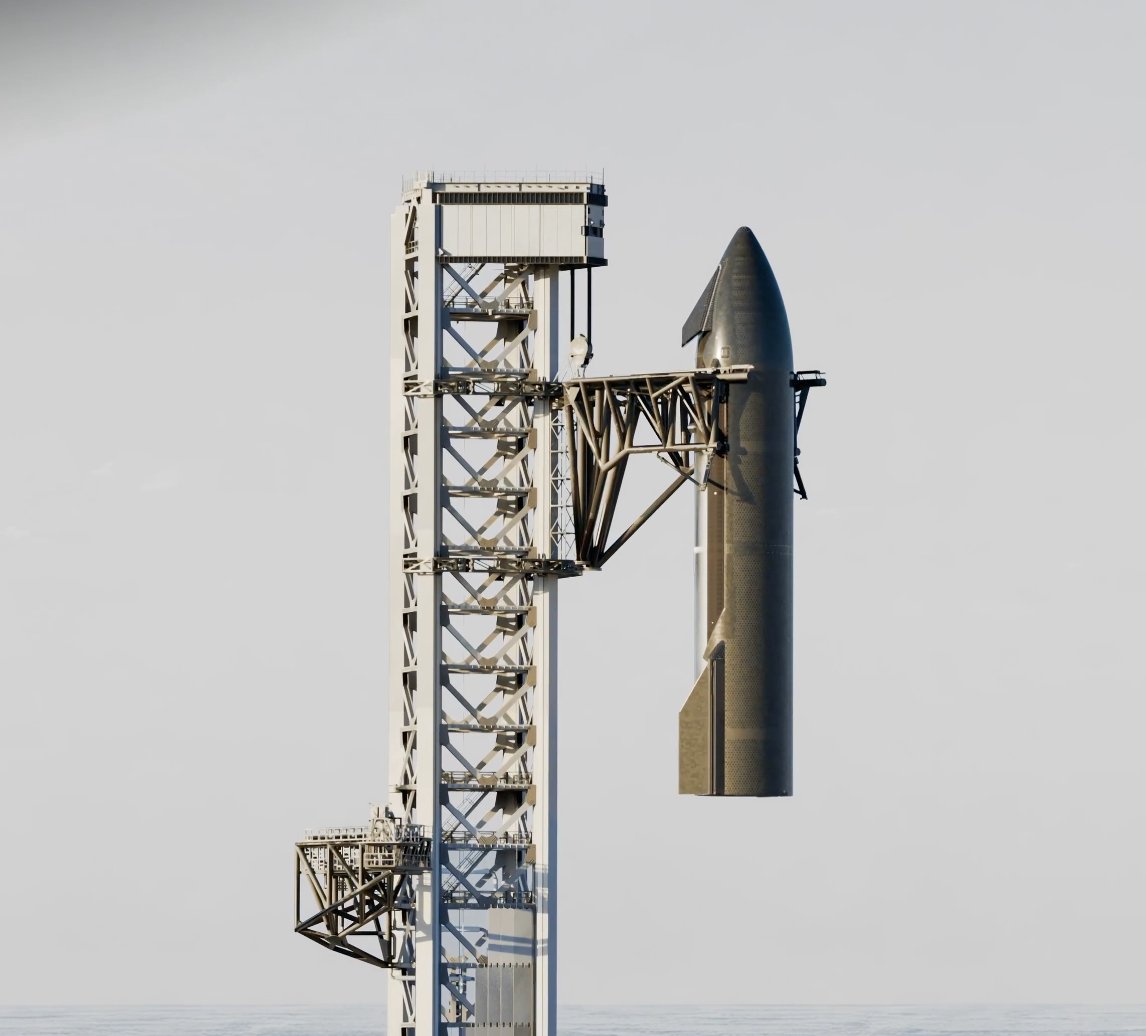
Starship comes in belly-first.
It has to rapidly swing its massive frame upright, stabilize its attitude, and align itself precisely between the tower’s mechanical arms.
SpaceX’s official Flight 15 timeline allotted just 18 seconds between the start of Starship’s landing burn and the catch.
During those 18 seconds, three sea-level Raptor engines ignite to kick off the maneuver.
The spacecraft rotates upright while its flight computers constantly regulate engine thrust and vehicle attitude.
The engines then step down from three to two, giving the vehicle finer control as it nears the chopsticks.
Finally, it transitions to a single engine for the last moments of descent before shutting down as the tower takes its weight.
Consider the coordination involved.
The guidance system must balance translation, rotation, thrust, and descent rate while positioning a massive spacecraft within a narrow capture envelope.
Unlike a conventional vertical rocket landing, Starship must first transition from an aerodynamically controlled, belly-first glide to an engine-powered vertical approach.
All of this unfolds within seconds, right after the vehicle has completed one of the most punishing atmospheric reentries ever attempted by a reusable spacecraft.
🧠 What makes SpaceX’s approach so ingenious is how seamlessly the entire recovery system works together
Trying to solve every phase of the return with rocket propulsion would carry a crushing propellant penalty.
Instead, SpaceX delegates the toughest parts of the recovery to systems purpose-built to handle them.
The atmosphere dissipates most of the orbital kinetic energy without consuming onboard propellant.
The heat shield protects Starship from the intense thermal loads of that deceleration.
The four aerodynamic flaps provide the control authority needed to manage its attitude, energy, and trajectory throughout atmospheric flight.
And the Raptor engines take over once aerodynamic control alone can no longer deliver the precision needed for the final catch.
That division of labor allows SpaceX to recover an orbital spacecraft without carrying enough fuel for an all-propulsive return.
Yet the engineering trade-off goes deeper than saving propellant.
SpaceX is shifting much of the cost of returning from orbit away from expendable propellant and toward reusable hardware built to endure extreme thermal and mechanical stress.
The potential economic payoff is enormous.
Cutting back on the propellant reserved for recovery frees up more of Starship’s mass capacity for useful payload. However, that advantage only becomes truly meaningful if the heat shield, flaps, engines, and other systems can survive repeated flights without extensive refurbishment.
That’s why catching Ship 42 is such a landmark milestone.
SpaceX has proven that its thermal protection, aerodynamic controls, propulsion, and guidance systems can work in concert to recover an orbital upper stage right at the launch site.
The next engineering hurdle is proving that the same spacecraft can do it repeatedly.
If SpaceX can bring Starship home, inspect it, refuel it, and launch it again without rebuilding major systems, the economics of getting payload to orbit could change dramatically.
That first catch proves the recovery architecture works. Repeated reflights will determine just how much of its economic potential SpaceX can unlock.
Recovering the entire launch vehicle is considered the holy grail of rocketry. On this mission, we will attempt to recover both stages of Starship for the first time
I don't think it's an exaggeration to say that, if @SpaceX achieves every mission objective on Starship flight 15, this will be one of the most important moments in human history.
Recovering an entire orbital launch system will be such a huge unlock for our civilization.
Heres a thought: Dell and Super Micro both sold server racks w/sanctioned Nvidia chips to Chinese fronts. But only Super Micro, a quasi Taiwanese firm, has been prosecuted. Dell is American, probably lawyered/lobbied for more sophisticated CYA to engage in the same alleged crime.