@hdorodev Ah didn’t know that was required for dms. You can also try discord (link in footer on the site). Otherwise we’ll start sending out invites to the early access list in a few weeks
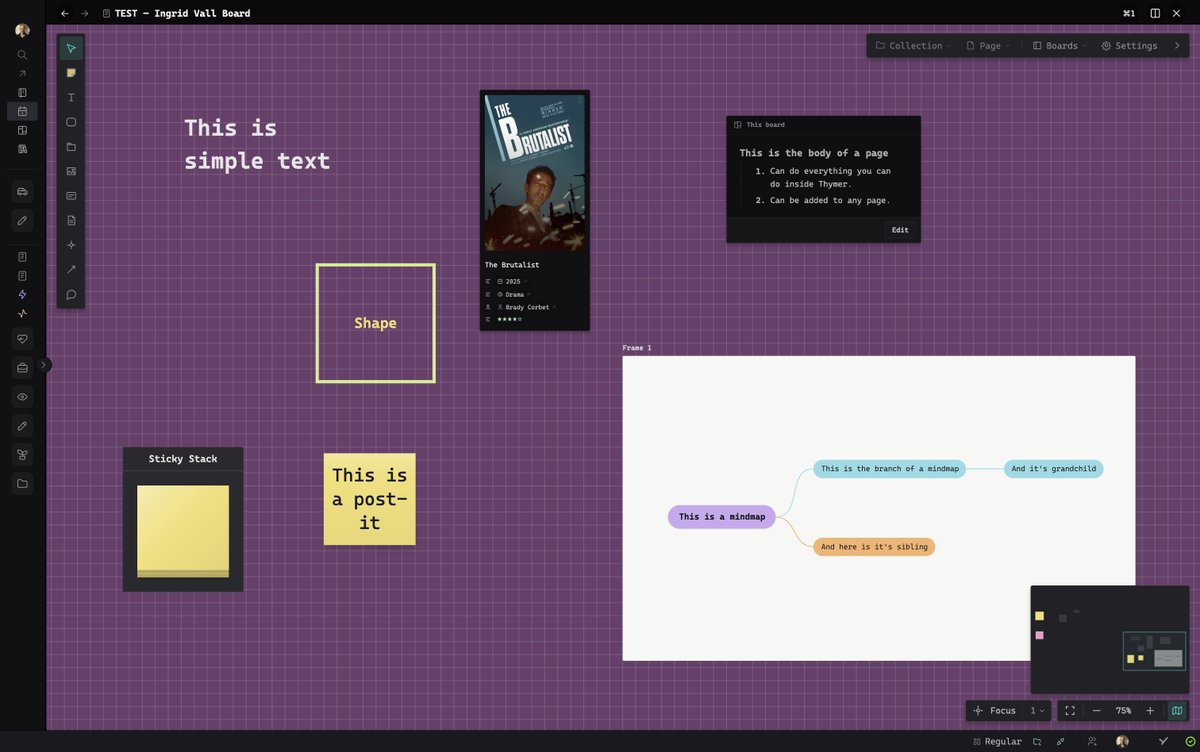
Someone built a whole infinite canvas whiteboard plugin for Thymer because why not!
This is one of the most fun parts of building malleable software (especially in the agentic age): there seems to be no limit to the cool things people come up with. So many fun plugins already, can't imagine going back to "static" software now!
@yomaru_1999 Not to worry, we didn't remove any roadmap or anything like that, we're running a small closed alpha now, beta very soon. Will dm you next week when we add more invites.
Okay a very-high level (raw!) braindump of some architecture/stack decisions. We'd love to write some blog posts about it later but gotta ship first :)
- app written completely from scratch in vanilla ES6
- no frameworks, no dependencies
- (.. except libsodium for encryption and one for grapheme parsing if i'm not forgetting sth)
- entire dev env is simply editing source file and reloading
- CSS rules and design also done by hand
- editor also completely from scratch. no contenteditable.
- .. this was needed to seamlessly blend outlining (structured/networked) features with long form editing, so it both works without losing the illusion of simply editing text
- that includes logic for scrolling, dragging, selections, (multiplayer) cursors, formatting, dataviews, ...
- app UI plugins can be written in JS to create dynamic views or add features. isolated by subdomain.
- we try to batch, defer and delta-render whenever possible. virtual scrolling in some places, lots more low hanging fruit there if needed.
- main thread is for UI updates
- custom-made sync engine, which runs in a separate shared worker thread
- multiple tabs communicate async with shared worker (kind of offline multiplayer)
- data cached locally in indexeddb ("sharded" into buckets for performance)
- worker thread also takes care of other work like encryption. e.g. attachments are decrypted on first request off the main thread then cached in separate indexeddb.
- because all data is local, things like dynamic queries, views and global fuzzy sort are pretty quick!
- real-time updates over websocket, fallback over POST if needed
- syncing backend server written in Go.
- data updates synced as encrypted deltas, server occasionally creates new snapshots of entire encrypted state
- both client and server consolidate deltas and resolve conflicts (like tree cycles) in same global order to ensure eventual consistency allowing for concurrent offline edits
- server can be self-hosted on mac, windows or linux. deployment is running a single binary.
- encrypted data on server is stored in a SQLite per workspace
- encrypted files on server stored on FS or R2
- lowest part of the stack for cloud version: just simple metal, dedicated servers. commodity hardware super cheap and powerful these days
There's plenty more for an actual write up but yeah those have to wait for now ;). If you're interested in more you can always ask @jdvhouten or me
And to think our very first prototype actually started by writing a custom GPU-based rendering engine 😅 (this was before gpui). We decided using web tech instead was the better trade off (browser compat, customization, plugins, theming etc), still happy with that decision. It's definitely been a big project (UI is just a part of it) but happy to soon release what we have now