@truckdriverpleb "No hate! No fear! Fat shaming is hurtful here!" Bro I been called alot of shit...but never a "fat fuck". Hope you are holding up okay. LOL!
Wayne Gretzky is no more Canadian than Tim Hortons.
He might have started as a Canadian, but he is a conservative American now.
He drops into Canada occasionally to remind us to gamble.
It’s okay to be Mexican!
It’s okay to be White!
It’s okay to be Asian!
It’s okay to be Black!
Only one of these statements is classified as hate speech #BanTheADL
Each day, I am looking at landmarks and natural formations and their history with the Indigenous Peoples.
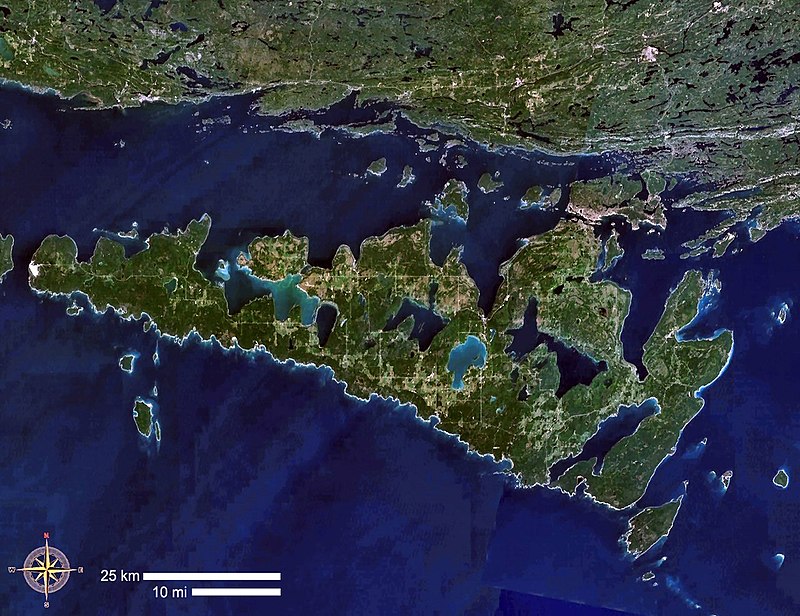
Today, I am looking at Manitoulin Island, the largest lake island in the world.
The Indigenous Peoples have occupied the island for upwards of 12,000 years.
The Ojibwe called the island Manidoowaaling (ᒪᓂᑝᐙᓕᓐᒃ), meaning "cave of the spirit". This name comes from a story that there is an underwater cave on the island where a powerful spirit is said to live.
The Odawa call the island Mnidoo Mnis, meaning "island of the Great Spirit".
It was said that Manitoulin Island was the home of Gitchi Manitou, the Great Spirit. Among the Ojibwe and Odawa, manitous are forces in the spirit world. Gitchi Manitou was the greatest of the spirits, and lived separate from the rest on the island.
Oral histories of the Indigenous Peoples who occupied the island stated that the Creator picked the most beautiful places in the world when creating the island.
The Cup and Saucer Trail on the island has been a significant place for thousands of years for the Indigenous Peoples. The Ojibwe call it Michigiwadinong, meaning "bluff in the shape of a spearhead".
According to legend, Nenabozhoo, a cultural hero and trickster, put down his spearhead on the trail while fleeing Haudenosaunee warriors that he has been tormenting as a trickster for generations.
The island is within the traditional territory of the Three Fires Confederacy, a confederacy made up of the Ojibwe, Odawa and Potawatomi.
If you enjoy my Canadian history content, please consider a donation to Canadian History Ehx at https://t.co/u12Dmz7XUX
Sources:
https://t.co/7uS1ekLoiu
https://t.co/LUi95A86hL
https://t.co/dQdCzUQpPL
ChatGPT:
In today's digital age, money exists primarily as electronic records in banking systems. Whether it's physical cash or digital transactions, the fundamental concept behind money is the transfer and communication of information. Money carries with it data about its value, ownership, and the transactions it has been involved in. This information is crucial for conducting economic activities and maintaining the functioning of financial systems.
Moreover, money itself can be seen as a representation of information. The value of money is derived from the trust and belief that it holds, which is based on the information about its scarcity, stability, and acceptance within a given economic system. This trust is built upon shared knowledge and information about the currency, the issuing authority, and the underlying economy.
When we consider time as a currency, we are acknowledging its inherent value in our lives. Time is a finite resource that we all possess, and once it is spent, it cannot be regained. In this sense, time can be considered the most valuable currency, as it is irreplaceable and limited.
Just like money, time can be seen as a form of information. It carries with it information about our experiences, our actions, and the choices we make. The way we allocate our time reflects our priorities and values. Time spent on various activities provides us with information about our personal preferences, commitments, and aspirations.
Furthermore, time plays a crucial role in economic transactions and decision-making. Time is a factor in interest rates, investments, and the calculation of returns. It affects the value of money over time through inflation and interest, and it influences the allocation of resources in the economy. The concept of time value of money recognizes that money has different worth at different points in time.