Principal CEO | Experienced Public Safety, Corrections Management Consultant providing Expertise in the Rule of Law § that improves Public Safety & Trust. 🇺🇲
William D. Colón | Professional Summary
Seasoned correctional executive with 26 years of progressive leadership within the New York City Department of Correction (NYCDOC)—the nation’s second-largest correctional system—where, as Commanding Officer, I provided direct oversight for 8,321 uniformed officers and more than 900 supervisory personnel across multiple ranks. Throughout my NYCDOC career and for the past seven years as Founder and President of Analytical Solutions Consulting Inc., I continue to deliver strategic consulting services to public-safety and criminal-justice agencies, correctional labor unions, advocacy organizations, and legal counsel. My work addresses complex systemic challenges, identifies organizational dysfunction, and provides proven methods to sustain operational efficiency, public safety, and constitutional compliance by preeminently addressing high-stakes policies and procedures, and legal matters affecting carceral systems nationwide.
I am the architect of the Constitutional Public Safety Staff Management System (CPSSMS), an AI-enhanced platform that integrates "human-in-the-loop" oversight, multivariable calculus, backpropagation neural networks, and "machine-learning" algorithms to ensure constitutional compliance, operational efficiency, and fiscal accountability. Documented results from my leadership include: cost-function analyses that reduced costs by hundreds of thousands of overtime hours across multiple commands and fiscal years. Department-wide policy revisions to the rank of correction officer within vacation smoothing call-outs, eliminating unbudgeted backfill deviations as high as 20% bringing them to a well-regulated 10%. And many other policies related to workforce governance and administration. An Operations & Policy Management professional with a proven track record of delivering sustained multi-million-dollar cost savings and safety through policy reconstruction, workforce optimization, and governance. Additionally, I authored the New York City Department of Corrections’ first comprehensive Administrative Operations Manual and successfully launched major initiatives, including the Centralized Intake and the Bronx Hall of Justice.
My leadership has been recognized by the Congressional Hispanic Caucus, the Assistant Deputy Wardens and Deputy Wardens Association, the Correction Officers’ Benevolent Association, the NYC Department of Correction Hispanic Society, and several former Commissioners. In December 2020, Congressman Joaquin Castro, Chair of the Congressional Hispanic Caucus, formally submitted a letter to the presidential transition team recommending me for a senior federal position, emphasizing my expertise and readiness to lead at the national level. Additional honors include multiple “Deputy Warden of the Year” awards, the ADW Dominick Schiano Award, and commendations from elected officials and commissioners.
I am immediately available for senior executive roles within federal, state, or municipal government, where my proven capabilities position me to:
Lead large-scale correctional or public-safety agencies by driving systemic reform, aligning operations with constitutional standards, and achieving measurable improvements in efficiency, transparency, and public trust.
Optimize resource allocation, implement data-driven correctional workforce management systems, and deliver substantial cost savings through innovative policy and technology solutions in deputy or chief operating capacities.
Guide criminal justice reform initiatives, federal consent-decree compliance, and oversight investigations with principled, evidence-based recommendations as a senior policy advisor.
Strengthen workforce stability in correctional systems by reducing deviations in staffing protocols and fostering collaborative relationships between administration and unions in labor relations leadership.
Support legislative hearings, federal monitorships, and high-stakes investigations through expert testimony and recommendations that drive informed decision-making and sustainable operational improvements within our nation's criminal justice system.
I stand ready to assist newly elected or appointed administrations in rapidly adapting to the complexities of correctional and public-safety systems. My expertise enables leadership teams to make informed, data-driven decisions, align agency missions with new priorities, optimize resource allocation, and implement constitutionally sound policy reform from day one.
My mission remains to strengthen American governance by aligning public safety and criminal justice systems with constitutional principles while delivering measurable advances in performance, transparency, equity, and public trust.
I welcome confidential inquiries from governors, attorneys general, legislative leaders, transition teams, federal courts, and oversight bodies seeking proven, principled leadership to drive systemic reform.
References and recommendation letters available upon request.
https://t.co/aos6CuJ9OI
Eliminate the black box in public safety and corrections administration by presenting budget solutions supported by factual data and detailed implementation plans that challenge and clarify false narratives in today's political landscape. By resolving ambiguities, emerging leaders can identify new opportunities where current leadership fails in their duty to uphold fair and impartial laws.
Correctional Staffing Oversight - A National Imperative for Evidence-Based, Risk-Informed Correctional Staffing Oversight
A national call for evidence-based, institution-specific workforce standards that protect safety, uphold the Constitution, and align with GAO internal control principles — replacing oversimplified solutions with approaches that reflect the complex realities of correctional systems across America.
Empirical research dating to a 1984 NIJ-funded multi-facility study demonstrated that staff-inmate ratios are not the primary driver of prison safety, internal order, or institutional climate. No single “ideal” staffing pattern exists; effective staffing must instead be assessed according to the unique design, population, classification levels, and operational realities of each facility.
Decades of federal oversight have reinforced this conclusion. Government Accountability Office reviews and National Institute of Corrections guidance caution that reliance on simplistic ratios or rigid minimum standards fails to capture real-world risks — including officer fatigue from chronic overtime, gaps in supervision, and resulting increases in violence, self-harm, and service deficiencies.
Across every jurisdiction in the United States, this pattern reveals a common vulnerability: when correctional systems operate under oversimplified staffing assumptions rather than rigorous, institution-specific analysis, they invite precisely the conditions the Eighth Amendment and the rule of law prohibit.
A national conversation is therefore essential—one that moves beyond reactive minimums toward proactive, evidence-based safeguards tailored to the distinct needs of individual facilities. Only through deliberate, data-driven oversight can we fulfill our constitutional obligations to protect both incarcerated individuals and the professionals charged with their custody.
By embedding these principles into correctional workforce planning—through regular post audits, relief-factor calculations, institution-specific staffing models, and ongoing sensitivity/risk analysis—jurisdictions can replace reactive, one-size-fits-all regulations with preventive, constitutionally sound systems of oversight.
This is not merely a management best practice; it is the disciplined framework required to uphold public safety, staff well-being, and the rule of law in every carceral system across the nation.
Reference List Entry: Coates, B. R. (1984). The impact of differing staffing ratios on prison environments (NCJ No. 99833)—National Institute of Justice, Office of Justice Programs, U.S. Department of Justice.
https://t.co/EG3DhTvntT
https://t.co/Dc973Ft6Jy
Executive Summary
This page compiles the primary legal authorities, official government records, court documents, and operational data that form the foundation for the analyses and recommendations presented across https://t.co/iSkTycsCw5. It prioritizes rigorous, evidence-based evaluation and emphasizes the importance of addressing actual operational conditions in correctional systems.
https://t.co/na5RIqy57A
Rule of Law & Constitutional Governance in Public Safety & Justice
Legitimate Power Derives from the Governed and Is Bound by the Rule of Law
https://t.co/nwLUdtGhMC
Quantum computing is entering a realm where data orchestration architectures will surpass current paradigms in coding and analyzing multidimensional data, as superficial similarities and ambiguities are redefined by established rules. The integration of quantum computing will also drive a major shift in the legal frameworks governing the executive, judicial, and legislative branches, as these entities develop a deeper understanding of the processes needed to protect all parties and oversee workforce practices amid complex governance. As systems and data architectures evolve, the legal and technical structures used to manage multidimensional data will undergo fundamental changes.
Waste, Fraud & Abuse: Technical Realities
Information Silos as a Systemic Governance Vulnerability
Data silos in government systems represent a significant operational challenge. Vast amounts of critical information remain locked within isolated, incompatible, or outdated legacy platforms. This fragmentation prevents departments from accurately accounting for and sharing data, causing agencies to operate as separate entities rather than as a unified organization amid the inherent complexities of government administration and public safety.
The scale of these technical failures is documented and substantial. In fiscal year 2025, federal agencies reported an estimated $186 billion in improper payments across 64 programs — an increase of $24 billion from the prior year. The Government Accountability Office estimates that annual federal fraud losses range from $233 billion to $521 billion, and that cumulative improper payments since fiscal year 2003 exceed $2.8 trillion. In public safety and corrections, the Bureau of Prisons remains on the GAO’s High-Risk List due to chronic understaffing that threatens inmate and staff safety. Its staffing assessment methods — including full-time equivalent (FTE) forecasting — rely on inconsistent, unvalidated data that create blind spots, conceal inefficiency, and drive hundreds of millions of dollars in excess overtime each year.
These outcomes are predictable technical results of governance systems lacking transparent data orchestration. Information silos block cross-agency sharing, permitting undetected overpayments and duplication. Opaque staffing algorithms function as black boxes without human validation, masking chronic understaffing as efficiency. Unvalidated data inputs produce garbage-in/garbage-out calculations that leave safety-critical posts vacant. Without real-time, auditable analytics, violence spikes and systemic risks remain obscured.
https://t.co/yFWXvt4UQ4
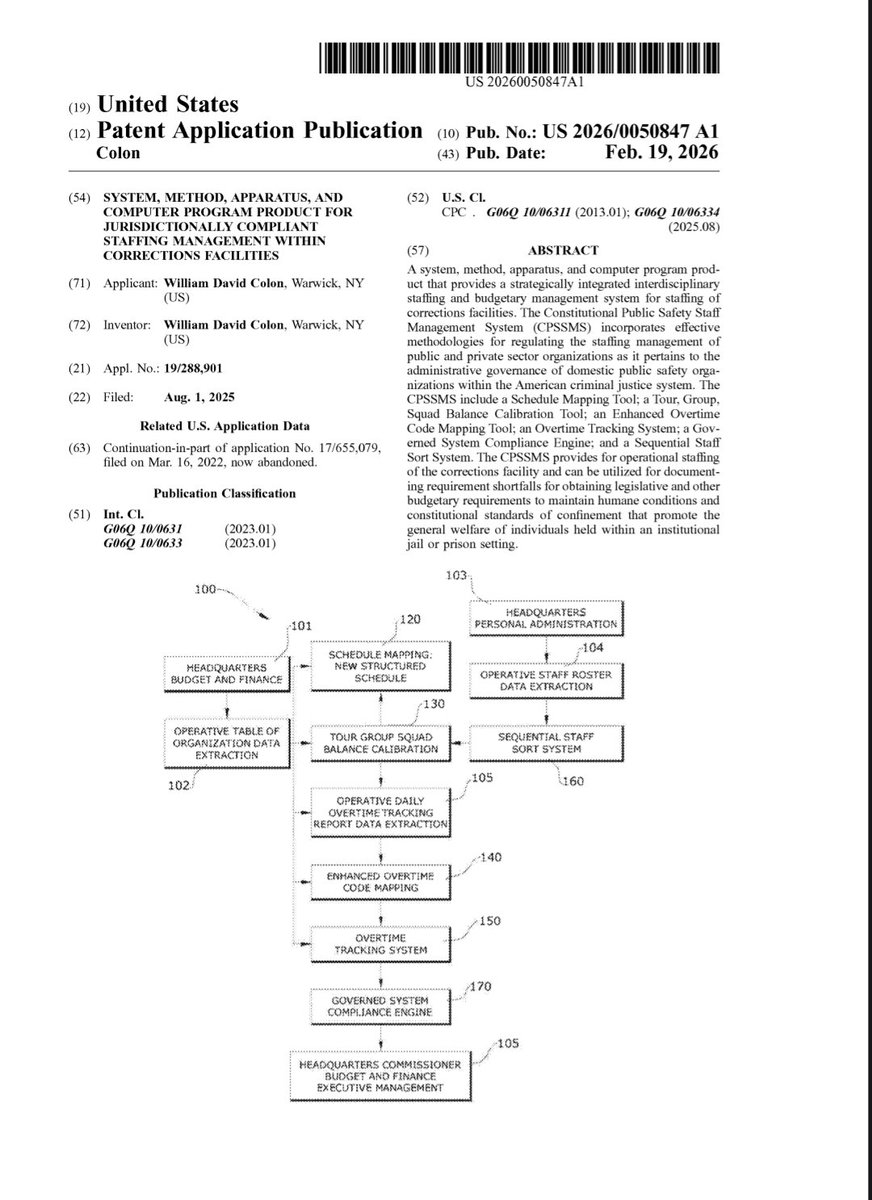
United States Patent and Trademark Office Publication
Title: System, Method, Apparatus, and Computer Program Product for Jurisdictionally Compliant Staffing Management Within Corrections Facilities
Publication No.: US-2026-0050847-A1
Publication Date: February 19, 2026
Application No.: 19/288,901
Applicant: William David Colón
Status: Published Patent Application
(Patent Pending)
This published patent application constitutes the technical foundation of the Constitutional Public Safety Staff Management System (CPSSMS).
Patent Technology Characterization
The Constitutional Public Safety Staff Management System (CPSSMS) is an Adaptive Self-Optimizing AI System.
It continuously learns from real-world operational data, adapts dynamically to changing correctional environments (staffing levels, overtime patterns, population shifts, and regulatory requirements), and self-optimizes its internal models through backpropagation neural networks, empirical machine learning, and multivariable optimization.
Orchestrated by a central governing engine with Human-in-the-Loop (HITL) oversight, CPSSMS iteratively refines staffing forecasts, schedule balancing, compliance monitoring, and resource allocation — thereby delivering a self-evolving platform that sustains exceptional accuracy and effectiveness over time while upholding the highest standards of jurisdictional and constitutional compliance.
The CPSSMS is classified by the USPTO under G06Q 10/06311 (Scheduling, planning, or task assignment for a person or group) and G06Q 10/0633 (Workflow analysis or management) — the precise category for advanced resource-allocation and compliance platforms. This underscores its novelty as a uniquely integrated, jurisdictionally compliant staffing engine purpose-built for 24/7 correctional operations.
Powered by an interdependent multivariable ML pipeline (RNN/LSTM forecasting, reinforcement learning optimization, PCA clustering, and backpropagation refinement), the system treats staffing as a higher-dimensional adaptive function. Delivering auditable force plots that turn every decision into a defensible, explainable output.
I advance accountable, transparent, and constitutionally sound governance in America’s criminal justice system. With 26 years of leadership experience at the New York City Department of Correction and the development of the Constitutional Public Safety Staff Management System (CPSSMS), I deliver measurable improvements in operational efficiency, due process, equal protection, and public trust. I look forward to strengthening the rule of law through responsible, effective public service practices.
The government’s mandate to protect individual rights—specifically the right to safety and humane conditions—requires more than just policy; it requires precision.
William D Colón
https://t.co/ICVDrrEJUd
Analytical Solutions Consulting Inc. integrates established expertise in public administration and governance, computational mathematics and computer science, performance optimization, and investigative analysis to engineer integrated, results-oriented solutions for complex public-sector challenges. This multidisciplinary foundation delivers precise, scalable frameworks that strengthen operational integrity, accountability, and strategic effectiveness across administrative and governance environments.
https://t.co/ICVDrrEJUd
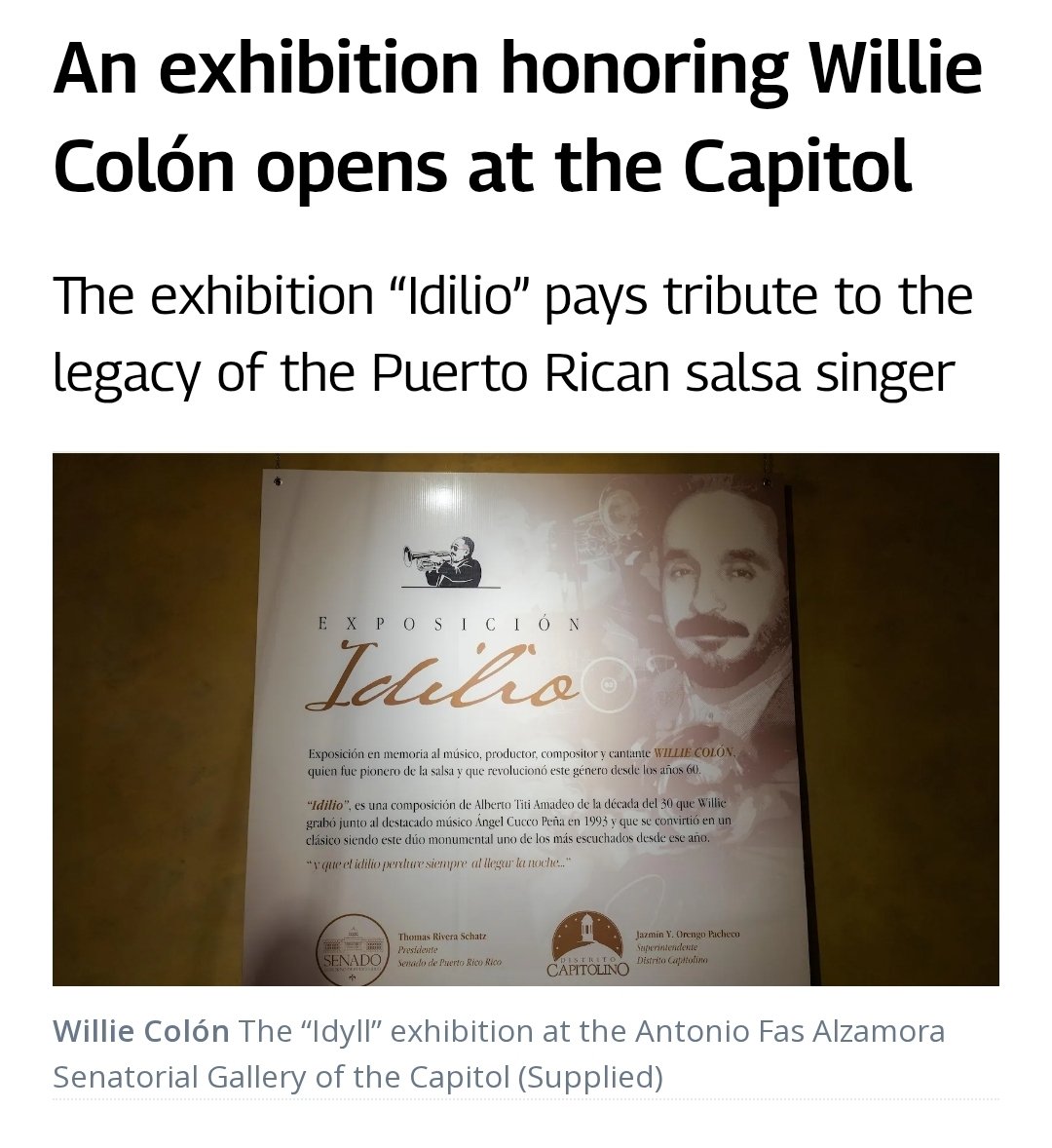
I'm deeply moved and grateful for the beautiful tribute the Senate of Puerto Rico has paid to my father’s legacy.
On March 18, 2026, the Senate inaugurated the exhibition **“Idilio”** at the Galería Senatorial Antonio J. Fas Alzamora in El Capitolio, San Juan. This exhibition honors the life and monumental contributions of Willie Colón (William Anthony Colón Román) — a pioneering salsa musician, composer, arranger, and producer who revolutionized the genre since the 1960s.
Named after the classic song “Idilio,” which my father recorded in 1993 with the legendary Ángel “Cucco” Peña (turning it into one of salsa’s most beloved hits), the display features striking photographs, artwork, and instruments celebrating his career and the salsa tradition he helped globalize.
During the emotional ceremony, Senate President Thomas Rivera Schatz presented **Moción 0819**, which was unanimously approved, recognizing my father’s indelible impact on Puerto Rican and Caribbean culture. Cucco Peña accepted the recognition on behalf of our family and shared touching memories of their collaboration.
My sincere thanks to Senate President Thomas Rivera Schatz, Capitol District Superintendent Jazmín Y. Orengo Pacheco, Senator Migdalia Padilla Alvelo, José Nieves of the PR Music Hall of Fame, and everyone involved in making this happen.
The exhibition is open to the public until March 31, 2026. If you’re in Puerto Rico, I highly encourage you to visit and experience this tribute.
**Official Links:**
• Senate of Puerto Rico Press Release: https://t.co/w49EEtZOaj
• Metro Puerto Rico Coverage: https://t.co/OOUa1lGOaO
#WillieColon #SalsaLegend #PuertoRico #LatinMusic #Idilio #CulturalLegacy #Family
🇵🇷🎺
State prison staffing shortages remain a severe nationwide crisis in 2026, with correctional officer vacancy rates often 30–50% or higher in hard-hit systems. North Carolina faces a nearly 49% overall shortfall (needing ~9,682 officers but short ~4,703, with one in four facilities at 50%+ vacant), New Jersey over 13% for custody staff (amid decades-high levels and rising assaults), New York thousands short post-strike fallout, and others like New Hampshire (~47% in recent reports), Maryland, and various states showing persistent high vacancies despite declining prison populations.
Core drivers include non-competitive pay (e.g., North Carolina's second-lowest starting salaries nationally), mandatory overtime, extreme stress, safety hazards, burnout, high turnover (often 20–30%+ annually), and post-pandemic workforce shifts—aggravated by outdated static staffing models that fail to adapt to real-time variables like morale erosion, training delays, hiring barriers, and retention challenges.
Impacts are dire: state prisons ~50% deadlier over recent years (per 2026 DOJ-funded Safe Inside report), surging violence and staff assaults, frequent lockdowns, canceled rehabilitative programs, unsupervised units, overuse of non-custody staff in security roles, delayed medical/mental health care, and elevated risks to inmates and employees.
Reactive measures—pay raises, bonuses, recruitment drives—persist but are often inconsistent or constrained by budgets.
Lasting solutions demand proactive reforms: dynamic real-time workforce planning with predictive analytics, forensic resource audits, modernized policies with ethical oversight tools, and stronger governance accountability to dismantle the entrenched cycle of understaffing, inefficiency, and heightened danger across state systems.
https://t.co/evAW5QfTbZ
https://t.co/ICVDrrEJUd