Great pleasure to be on the “The Visible Hand Podcast” with Jordi Blanes i Vidal, discussing my (empirical!) work on the relation between delegation and the volatility of a firm’s environment (with Desmond Lo and Chieko Minami).
Economist and @StanfordGSB Professor Donald John Roberts passed away last Thursday 2026/01/22. He was 80 years old. I considered him a mentor and a friend. He was always interesting and funny and had a really positive disposition. It was a pleasure to chat with him.
Together with his long term coauthor Paul Milgrom, John was a key person in changing how economists think about firms as organizations. He always remembered fondly the years he spent at Northwestern's Kellogg School from 1971 to 1980, where he joined a fantastic group that included Roger Myerson, Bengt Holmström, Nancy Stokey, Robert Weber, Mark Satterthwaite and Paul Milgrom. They all used used game theory and information economics to study of many problems across economics: he mainly in industrial organization (notably his work on limit pricing with Milgrom and his work with Milgrom Kreps and Roberts on repeated Prisoner's dilemma with incomplete information), but the group made path breathtaking work in auctions, financial markets, mechanism design.
He later worked on complementarities and organizations, with key papers on supermodular games and monotone comparative statics. He showed firm performance resulted from the interplay of information, incentives, and complementarities. This work is crucial to understand technology adoption and strategy.
He also studied, with @I_Am_NickBloom management practices empirically in India, by running an experiment where consulting advice was randomized, and in China on WFH also with Nick.
He wrote with Milgrom a book for MBAs that bombed for MBAs (too dense, too many ideas) but that Econ profs and PhDs (me at the time!) loved: Economics, Organization and Management (1992). It had a massive impact (15K cites, astonishing for an MBA textbook), and it is still a book I read. It was the first textbook to apply modern contract theory and incentive economics to management problems. He extended this work in his 2004 book The Modern Firm, which was named best business book of the year by The Economist, and which analyzed how organizational design, competitive strategy, and business environment must fit together for firms to perform well. I always think of firms in terms of his frameworks. (He summarized the way he thought about Firm capabilities by PARC- People, Architecture, Routines, Culture-he liked to say his Stanford students teased him by reading his acronym backwards).
In all his work he asked how economic reasoning could illuminate the organization of productive activity. He believed that economic theory should connect to real decisions, and that the study of organizations deserved the same rigor applied to markets.
I loved John and learned a lot from him. R.I.P.
Why would a university ever prefer less information about its applicants?
That question lies at the heart of two new papers coauthored by @Yale economist Navin Kartik with @wdessein (@Columbia_Biz) & Alex Frankel (@ChicagoBooth): https://t.co/8XRN7KgU6z
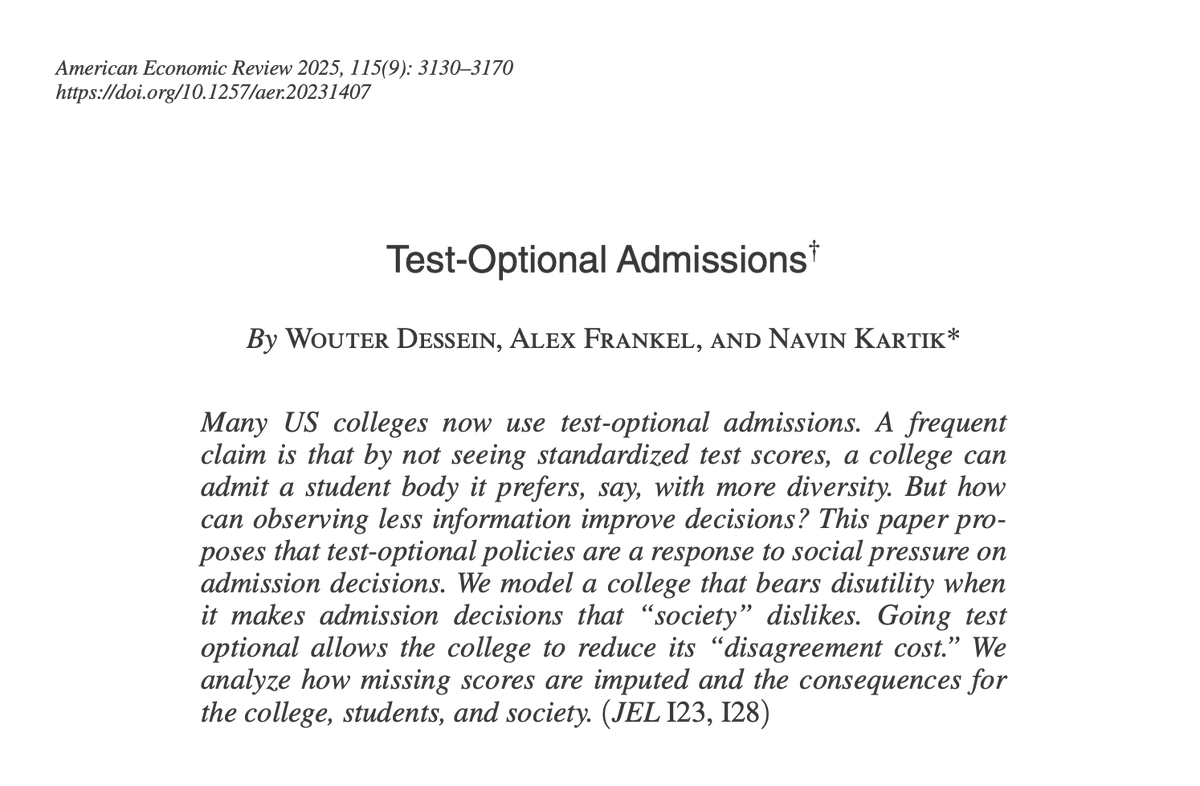
"This paper proposes that test-optional policies are a response to social pressure on admission decisions."
NEW in the American Economic Review by Wouter Dessein, Alex Frankel, and Navin Kartik: https://t.co/WIoIqdWB9x
Are standardized tests still an important part of college admissions?
@ChicagoBooth’s Alexander P. Frankel and @Columbia_Biz's @wdessein and Navin Kartik examined whether ignoring test scores could help colleges make better choices. https://t.co/xep79ONgpF
My Alma mater, KULeuven, now has two co-editors at top 5 journals: Jan De Loecker, at Restud, and Frank Verboven, at AER! It was great to visit this 500 year old university (and beautiful medieval town) last fall on sabbatical.
Congratulations to Frank Verboven (@frankverboven) for being appointed as AER coeditor, handling papers in empirical IO and related fields. His term starts on July 1. I’m delighted to have him on our team. @AEAjournals
@ElliotLip Very cool paper, @ElliotLip! Could one interpretation be that you show what happens when you introduce dynamics in Rotemberg/Saloner “narrow business strategies” theory (AER 1994) and their “ visionaries, managers and strategic direction” (Rand 2000). You wrote a strategy paper!
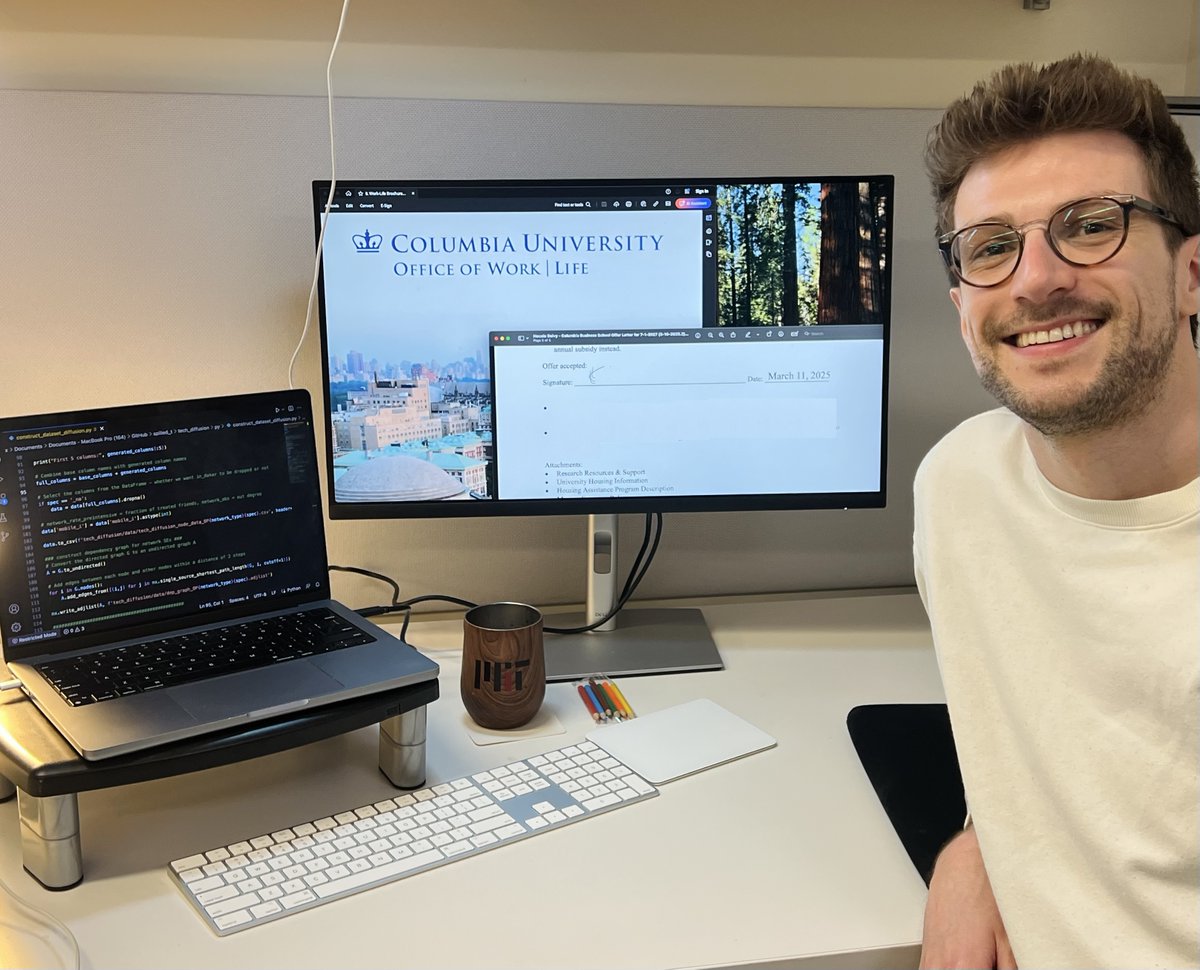
This is the end of my job market journey. Beyond excited to share that I will join Columbia Business School @Columbia_Biz@Columbia as an Assistant Professor of Economics in 2027—in my dream city, New York—after the Prize Fellowship at Harvard! @HistoryEcon @Harvard
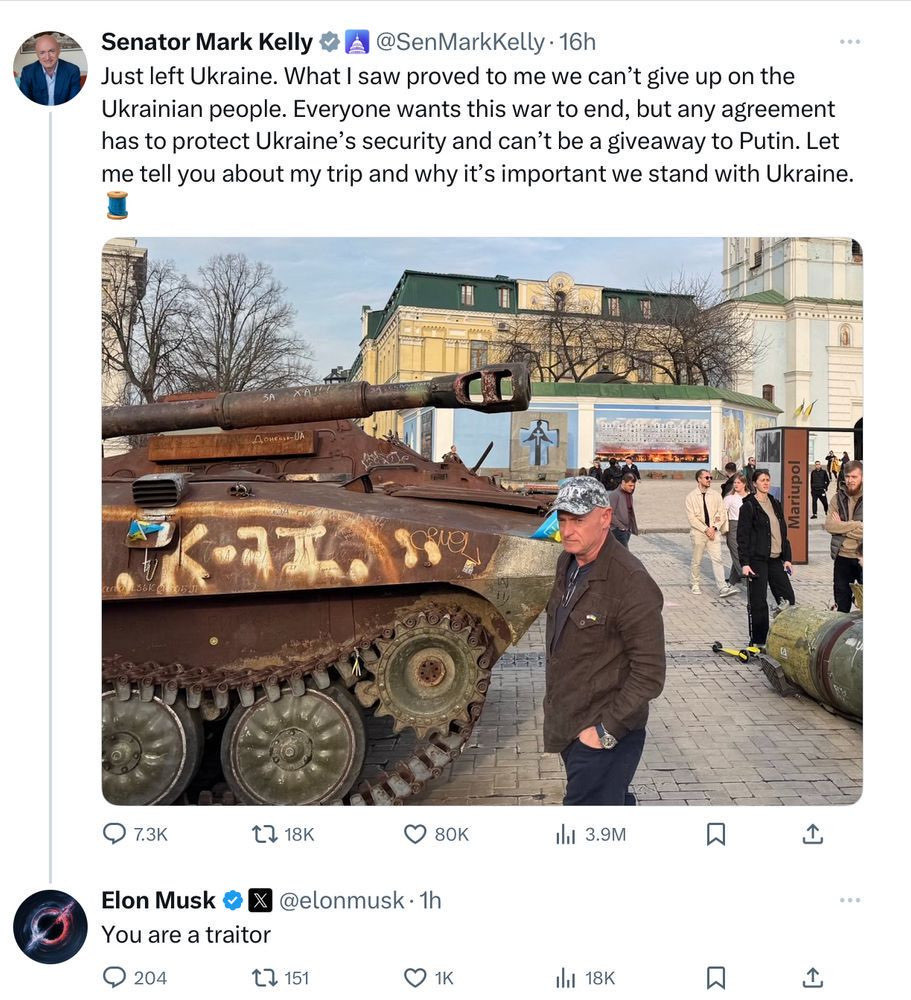
Traitor?
Elon, if you don’t understand that defending freedom is a basic tenet of what makes America great and keeps us safe, maybe you should leave it to those of us who do.
This week started with administration officials refusing to acknowledge that Russia started the war in Ukraine. It ends with a tense, shocking conversation in the Oval Office and whispers from the White House that they may try to end all U.S. support for Ukraine. I know foreign policy is not for the faint of heart, but right now, I am sick to my stomach as the administration appears to be walking away from our allies and embracing Putin, a threat to democracy and U.S. values around the world.
The call for papers for the NBER Organizational Economics Working group (April 10-11 2025) is out!
If you have a paper you would like considered for presentation, please upload it to this link by 11:59 pm ET on February 14, 2025: https://t.co/oqQLTpXUC9
Pls retweet
After 15 years, I finally separated from my Amex Platinum Card today. Had to pay $50 to bring a guest into the Amex Centurion Lounge - a “new policy” this year. Why pay $800 per year for a flashy credit card whose benefits and points keep losing value? @AskAmex@AmericanExpress
Dark post by @rajivatbarnard on what a Trump administration may bring for academia, and how universities can get ready (such as getting rid of test-optional policies): The Storm Ahead, by @rajivatbarnard https://t.co/bccaC43DKm
Great pleasure to be on the “The Visible Hand Podcast” with Jordi Blanes i Vidal, discussing my (empirical!) work on the relation between delegation and the volatility of a firm’s environment (with Desmond Lo and Chieko Minami).
In the next episode, Wouter Dessein will discuss how to (empirically!) allocate decision-making power to subordinates when both adaptation and coordination are important #EconTwitter
Costas Arkolakis and @Conor_A_Walsh have an exciting new paper on the macro effects of clean power. They predict dramatically lower electricity prices by 2040 and that this will raise wages by 2-3%. Energy transition will be a boon not a drag!
https://t.co/ABD9ZXkcBs