J'ai vu une Tesla décoller. Et j'ai entendu beaucoup de bêtises.
« Ça ne sert à rien. » « Gadget de milliardaire. » « Qui a besoin d'une voiture qui vole ? »
Personne. Et c'est exactement pour ça que c'est important.
En 1978, Brabham a aligné en Formule 1 une voiture équipée d'un ventilateur géant à l'arrière. Il aspirait l'air sous le châssis et plaquait la voiture au sol. Elle a gagné sa première course avec une avance insolente. Elle a été interdite immédiatement.
Quarante-huit ans plus tard, on y revient. Un système de succion qui colle la voiture à la route et lui permet de passer sous la seconde au 0 à 100.
Personne n'a « besoin » de faire le 0 à 100 en moins d'une seconde. Comme personne n'a besoin d'une Formule 1. Et pourtant : les freins carbone de votre berline, l'hybridation de votre moteur, l'aérodynamique de votre SUV, les palettes au volant — tout ça vient de voitures de course que personne n'utilisera jamais pour aller au travail.
La Formule 1 ne sert à rien. Pourtant elle sert à tout.
En 1973, quand la France a lancé Ariane, l'Europe sortait de onze échecs consécutifs du programme Europa. La presse parlait d'argent jeté dans l'espace. Vingt ans plus tard, Ariane détenait la moitié du marché mondial des lancements commerciaux, et chaque satellite de télévision, de météo ou de GPS que vous utilisez a bénéficié de cette obstination.
Le progrès a toujours la même tête au début : un truc inutile, cher, ridicule, construit par des gens qu'on prend pour des fous.
Ce que j'ai vu à Dallas, ce n'est pas une voiture volante. C'est un châssis, une gestion de l'énergie et une maîtrise des flux d'air que l'industrie automobile mettra dix ans à digérer.
Les applications viendront : sécurité, freinage, stabilité, consommation. Elles finiront dans des voitures ordinaires conduites par des gens qui expliqueront, en 2036, que tout ça était évident.
La question n'est jamais « à quoi ça sert ».
La question est : qui ose encore construire des choses qui ne servent à rien ?
Il y a cinquante ans, c'était nous. La fusée, le TGV, le Concorde, le Minitel.
L'Europe construisait des choses absurdes et magnifiques.
Aujourd'hui, on commente depuis le siège arrière car nous sommes hors course.
Merci @elonmusk de nous faire rêver
ELON MUSK: “It's going to be pretty wild that you can have a rocket car. The car has attitude control thrusters and main thrusters in the rear, so it can basically fly like a rocket. It could do rolls. It could do crazy gymnastics. Whatever you want, really.
This is not necessarily a safety-optimized car, but it takes the fun meter to 11 out of 10.
This will be an actual car that’s on the roads. I’m not sure it’s necessarily legal in all jurisdictions.
The car can recharge its air tank, so it’s not like you need special propellant or anything like that. It literally is just going to pop itself up and be able to do these maneuvers whenever you’d like.”
Constance Fisher drowned her three children in a bathtub in 1954.
Mental hospital. Declared better. Released.
Husband stayed. They had three more kids.
She drowned those three too.
Same house. Same bathtub. Same excuse. Six dead children because a system treated a child killer like a patient who just needed time.
That is the whole argument. Not “was she sad.” Not “did she hear voices.” What happens after you let them out, and who pays for it the second time.
Lindsay Clancy strangled her three kids. People are already writing her a sympathy card and calling prison cruel. Cruel is three little bodies. Cruel is doing it once and getting a path back to freedom. Cruel is pretending history didn’t already run this experiment and lose six kids.
Mental illness can explain how someone gets there. It does not give you a free murder. It does not entitle you to more children. And it does not require the rest of us to wait around and see if the next round dies too.
If you kill your kids, you don’t get to be a mother again. You don’t get a soft landing and a second family. Life without parole. Lock the door. Stop experimenting on other people’s children and making excuses.
Convict her. Convict those who harm children. Period.
🔥 LET'S GO! Elon Musk is RE-LAUNCHING his America PAC, investing over $100 MILLION into the 2026 midterms funding voter turnout efforts for conservatives
Elon is COUNTERING George Soros, and has a LOT more firepower than the leftist megadonor.
Elon's America PAC is expected to fund door-knocking, digital advertising, and direct mail targeting conservative voters.
A true patriot.
🇺🇸 BREAKING: The largest fireworks show in the history of the WORLD has just kicked off in Washington, DC
850,000 MUNITIONS — last year's was 20,000
Trump PROMISED to make it happen, and he MADE IT HAPPEN! 🔥
"There is no challenge Americans cannot overcome, there is no place we cannot go, there is no goal we cannot reach, and there is NOTHING Americans cannot do." - President Donald J. Trump 🇺🇸
In September of 1814, America was once again in trouble.
The young republic was only thirty-eight years old. The War of 1812 had gone badly. British troops had marched into Washington, burned the Capitol, set the White House ablaze, and now turned their sights toward Baltimore. If Fort McHenry fell, the harbor would be open, the city would likely follow, and another devastating blow would be dealt to the fragile nation.
Amid this uncertainty, a young American lawyer named Francis Scott Key sailed under a flag of truce to the British fleet. He had come to negotiate the release of a friend, a physician the British had captured.
He succeeded.
The British agreed to free the doctor.
But there was a catch.
Because Key and his companions had seen too much of the British fleet and learned too much about its plans, they were not allowed to return to shore. Instead, they were detained aboard a ship in the harbor and forced to watch the coming battle from behind enemy lines.
On the morning of September 13, the bombardment began.
For the next twenty-five hours, British warships unleashed somewhere between 1,500 and 1,800 bombs and rockets upon Fort McHenry. These were the “bombs bursting in air” and the “rockets’ red glare” of the song—not poetic embellishments, but terrible realities.
Key stood on the deck through the endless day and the long, terrifying night. Every explosion lit the darkness for a fleeting instant before the smoke swallowed everything again. Somewhere beyond that wall of fire stood the fort. Somewhere beyond it flew an American flag if it still flew at all.
He could not see.
He could only listen.
As long as the guns continued firing, there was reason to hope. The British would not waste ammunition on a fort that had already surrendered.
Then, just before dawn…
The guns fell silent.
For the first time all night, there was only stillness.
It was the most frightening sound of all.
Had the fort finally fallen? Had the defenders surrendered? Had the flag been torn down in the darkness while no one could see?
There was nothing to do but wait.
As the first light of September 14 slowly pushed back the smoke, Francis Scott Key strained his eyes toward the distant fort.
Then he saw it. Not a British flag.
The American flag. Still there. Still flying.
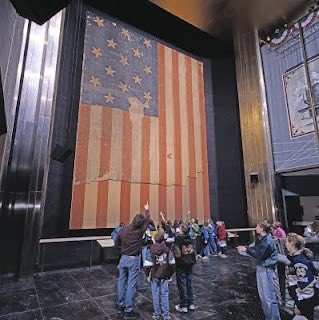
That flag was no ordinary banner. Months earlier, the fort’s commander had commissioned a Baltimore flagmaker, Mary Pickersgill, to sew a flag so enormous “that the British would have no difficulty seeing it from a distance.” It measured roughly thirty by forty-two feet, carried fifteen stars and fifteen stripes, and was so large it had to be assembled on the floor of a brewery because no ordinary room could contain it.
That was the Star-Spangled Banner.
The very flag Key saw through the morning mist.
The very flag that still survives today in the Smithsonian.
Overcome by what he had witnessed, Key reached into his pocket, pulled out an envelope, and began writing. The words came from a heart that had spent an entire night fearing his country might disappear with the dawn.
He first titled the poem Defence of Fort M’Henry.
Within days it was printed and circulating throughout the country. Before long, people began singing it to a melody they already knew—an old British tune called “To Anacreon in Heaven,” originally written for a London social club. There is something beautifully ironic in that: America’s most beloved patriotic song borrowed the melody of the very nation it had just survived. It also explains why the anthem is so notoriously difficult to sing. It was never written for ordinary voices gathered in stadiums or school assemblies.
The song spread quickly and became one of America’s favorite patriotic hymns, but it would wait more than a century before receiving official recognition. Not until 1931 did Congress declare “The Star-Spangled Banner” the national anthem of the United States.
Happy Independence Day!
There’s a story from the end of the Revolutionary War I want to tell as we celebrate America’s 250th Birthday, and it’s one everyone in the world can learn from.
George Washington, at that moment, after commanding the American forces to victory, was the most powerful man in the new country. Many people talked about making him King of America.
Across the ocean, King George was sitting with an American painter, and asked what he thought Washington would do now that the war was ending. The painter said he believed he would go back to his farm.
The King said, “If he does that, he will be the greatest man in the world.”
As the war officially ended, Washington came to speak to Congress and said, “Having now finished the work assigned me, I retire from the great theater of Action.” He returned his commission they’d given him in 1775 - after more than 8 years of leading the Americans to victory without pay, and he was home at Mount Vernon for Christmas.
Of course, he was elected as our first President a few years later, and after two terms, showed the same selflessness again when he willingly gave up his power and went back to Mount Vernon again.
That’s true greatness. He had all the power in the world. But power, alone, does not make you great.
Washington’s greatness came from being a true servant - to a cause much bigger than himself. His greatness was his complete lack of selfishness.
The whole story of American Independence is a story of selflessness. It’s a story of people who set their self-interest aside and worked for each other.
We’ve all heard the line about “We must all hang together, or, most assuredly, we shall all hang separately.”
Apparently, Ben Franklin might have actually never said that.
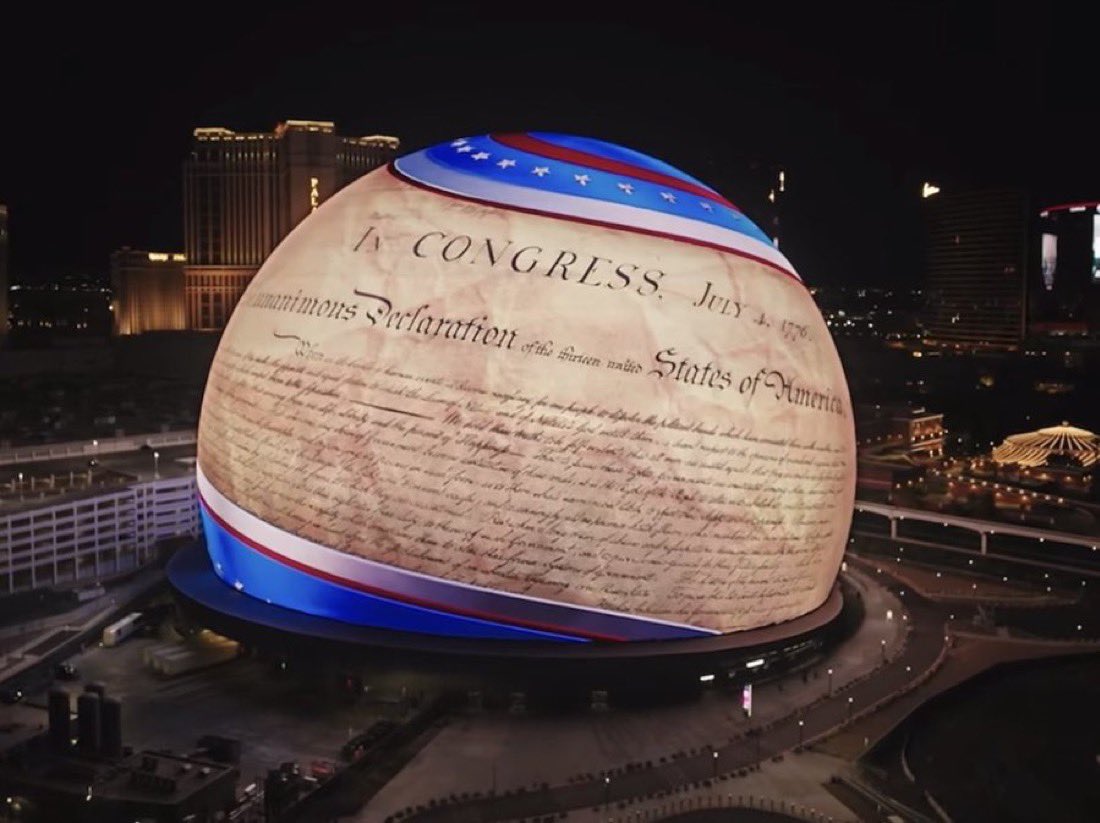
But that’s fine, because the same mentality is right there in the last line of the Declaration of Independence, published on this day 250 years ago:
“And for the support of this Declaration, with a firm reliance on the protection of divine Providence, we mutually pledge to each other our Lives, our Fortunes and our sacred Honor.”
We mutually pledge to each other.
No one was in this alone. No one was in it for themselves. This was a group of people with different backgrounds who were in it for each other.
Today is a reminder: greatness comes from what we do for each other, never what we do for ourselves.
That’s a lesson that applies no matter what country you call home.
It’s a lesson that doesn’t require any law passed by a politician, because, let’s be honest, if you’re waiting for selfless politicians, I really hope you are not holding your breath.
All of us have the power to be there for the people around us. For our families and friends. For our neighbors. For everyone.
All of us can reach for greatness.
It’s as simple as looking beyond yourself, seeing past the mirror, picking your eyes up from your phone, and pledging to be there for each other.
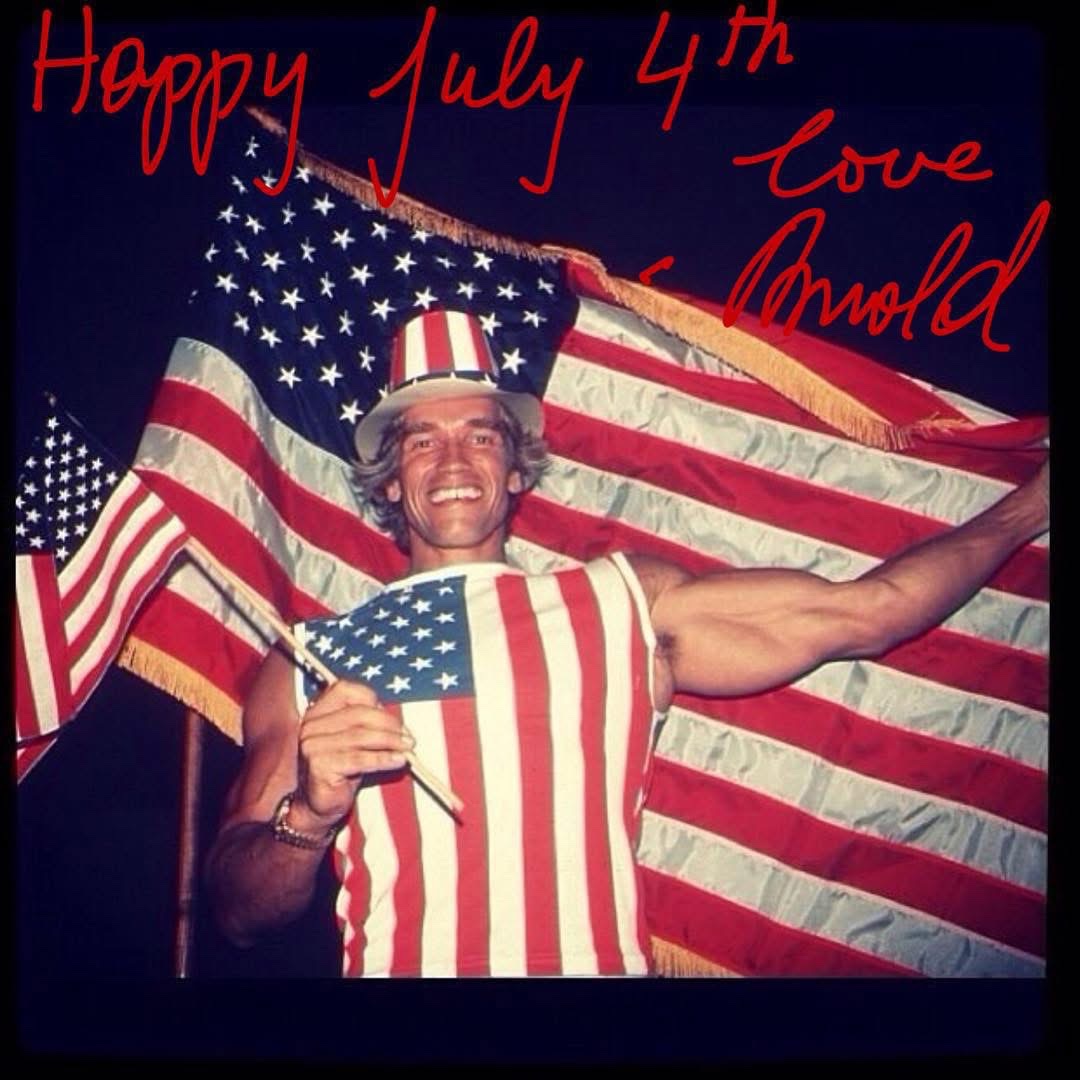
Happy Fourth. May you all find your own version of greatness today by lifting each other up.
Lift up your neighborhood. Lift up America. Lift up the World.