Got some ADA to put to work?
The ADA/ASCEND pool on Surf @surfcardano currently pays ~9.5% APY for supplying cardano:native
Almost 5x higher yield than staking.
Another successful BankFi Rewards Day.
November's distributions reflect the continued performance of our revenue-generating infrastructure across Bitcoin mining and World Mobile.
With thousands of eligible Units participating, rewards continue to flow through the BankFi ecosystem, supporting Unit holders, $BANK stakers, and Holder Pass owners.
Real infrastructure. Measurable performance. Consistent execution.
It pays to $BANK with us
The increased liquidity into the strike vault this week already showing up big time in the numbers
New weekly volume ATH: $80M
New weekly revenue ATH: $15,000
Amidst global markets getting nuked Strike is stronger than ever
Additional 300,000 ADA in TVL overnight 🔥
And another day of opportunities
COCK and ASCEND pools are each paying ~9-11% on supplied ADA 🤯
Plus over 4M ADA available to make your next leveraged position 🏝️
Link: 🏝️ https://t.co/zZk3lITK7q
Now that $STRIKE will soon be available on Ethereum, it’s our turn for some listings.
We’re excited to announce Aave, Ethena, and Uniswap are now live with 20x leverage.
Link: 🕹️ https://t.co/nIvqsblk2g
Cardano is working towards something that could fundamentally improve how quickly value moves across its ecosystem. Peras is now 75% of the way through its tracked roadmap to mainnet.
For anyone unfamiliar with Peras, it is an enhancement to Cardano's Ouroboros consensus protocol, specifically designed to accelerate transaction settlement.
Under current Ouroboros Praos, transaction confidence increases with every subsequent block, but achieving the protocol's strongest immutability guarantees can take many hours, with a conservative stability window of up to 36 hours. Peras aims to dramatically accelerate this, allowing participants to establish whether a transaction has settled or been rolled back within approximately two minutes under its proposed parameters.
Peras introduces a voting layer in which participating stake pools endorse blocks. When sufficient voting power supports a block, a certificate is produced that effectively cements that block and its predecessors into the preferred chain.
This dramatically reduces the probability of a rollback, allowing participants to establish whether a transaction has settled or been rolled back within a much shorter window.
Why does this matter?
Because settlement is fundamental to how financial infrastructure operates.
Consider liquidity. When an exchange, financial application or bridge has to wait for settlement before releasing or reusing funds, capital is effectively tied up during that period. Reducing that waiting time improves capital efficiency and allows funds to become available for subsequent transactions sooner.
Then also lets consider interoperability.
Cross chain bridges and partner chains need strong assurances about events occurring on another network. If a transaction is reversed after the receiving chain has already acted upon it, the consequences can be significant.
Peras reduces this uncertainty window considerably. It gives interoperability infrastructure a much stronger foundation for coordinating transfers, releasing escrowed assets and managing cross chain transactions.
There are also implications for decentralised finance, lending, collateral management, exchanges and eventually autonomous agents that need reliable settlement before executing their next action.
This is where I think the combination of Cardano's upcoming improvements becomes particularly interesting.
Leios is addressing transaction throughput and network capacity. Peras is addressing how quickly transactions can be treated as settled with extremely high confidence.
Increasing the capacity to process transactions and reducing the time required to establish settlement are complementary improvements.
There is still considerable testing and validation to complete, but this is tangible engineering progress towards a major protocol upgrade.
Faster settlement improves the economics of moving capital, reduces uncertainty for interconnected financial systems and makes it easier to build applications that depend on reliable transaction outcomes.
Cardano is developing the foundations for a network that can support increasingly sophisticated financial activity.
I also really appreciate the transparency here. The live tracker and regular development updates give the community a clear view of progress towards mainnet.
I've personally advocated for this level of reporting across many treasury funded proposals. If we're funding development with community funds, we should be able to see how that work is progressing, and I haven't been asked to post this, I just find it really easy to research and cover projects that show transparent progress.
Nice work @tweagio
https://t.co/l1yR0KnSDF
Here's a look at BankFi's World Mobile portfolio.
With over 6,200+ Spark Air Nodes, 60+ Ember Nodes, 6 Frontier Nodes, and 1 Titan Air Node, we are proud to be one of @WorldMobileTeam's global distribution partners.
This infrastructure helps generate rewards for our community and partners through real-world activity.
Backed by our compounding growth model our portfolio continues to grow, delivering real rewards to real people.
That's why it pays to $Bank with us
Our BTC mining portfolio continues to grow.
What started with our existing mining infrastructure is expanding through reinvestment and new partnerships across Cardano and Robinhood Chain.
Every addition helps grow the productive asset base behind BankFi.
And we'll continue sharing the numbers.
It pays to $Bank with us
Our integrations and cross chain connections have built the foundation to access billions of dollars in liquidity.
We’ve now done over $200M in volume in back to back months and eying down our first $500M month.
Built on Cardano.
Expanded to Robinhood Chain.
Powered by the same mission:
Making real-world revenue-generating assets accessible to more communities.
Stay tuned, it will be an exciting week
1000x leverage, prop trading, ios app release, ada as margin to open positions, vault share as margin to open positions
100m usd daily end of year
do you see what i see
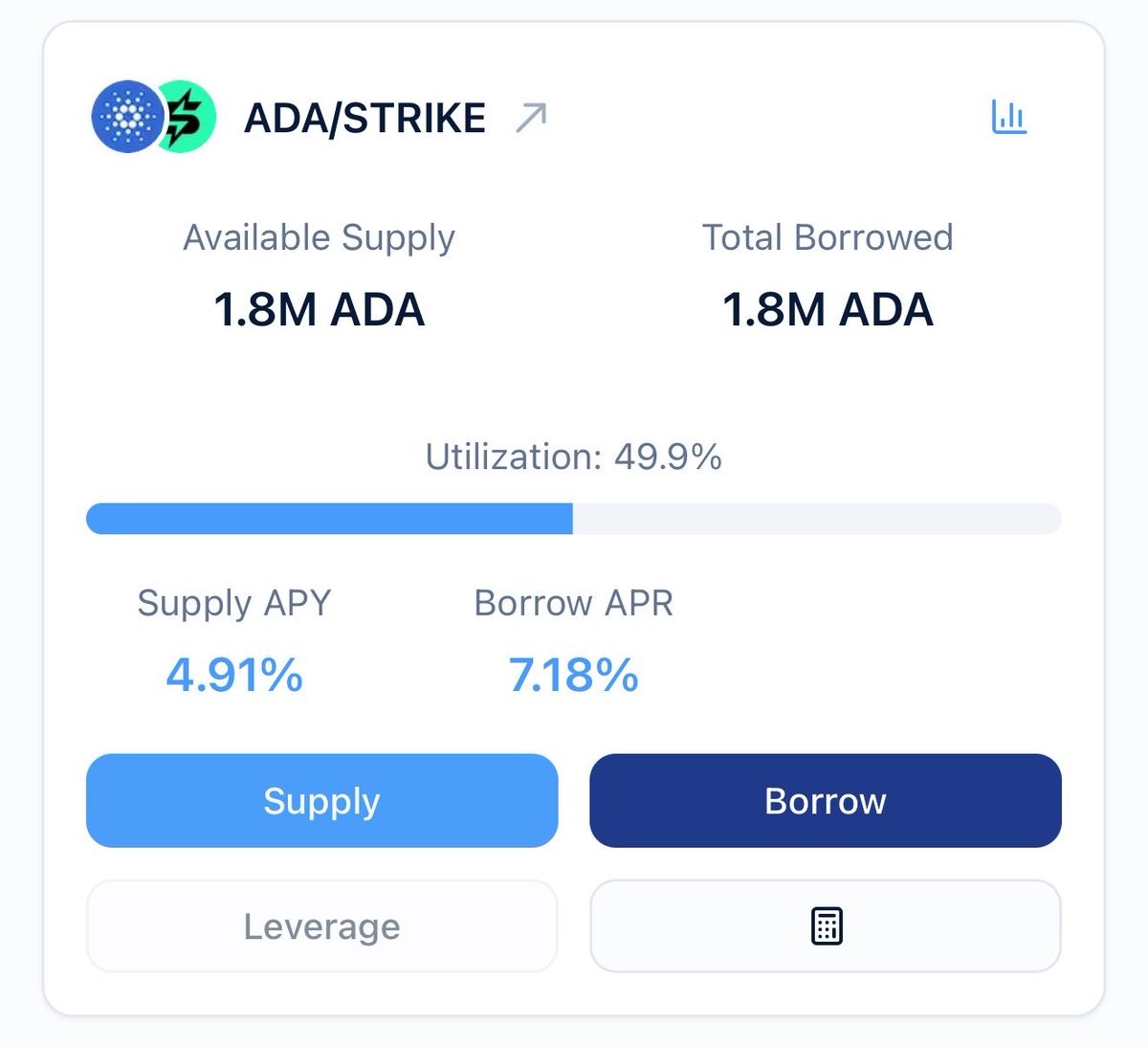
Borrow STRIKE at 7% 🔥
If strike goes higher than 7% over the next YEAR then you’re a profit
Current STRIKE price: 2.20 ADA
Profit price: 2.35 ADA
Making money has never been easier
Just keep surfing… 🏝️
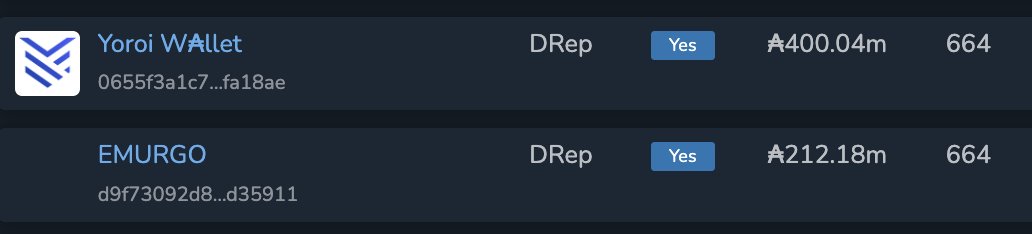
Both @emurgo_io and @YoroiWallet voted Yes on PFMS right before deregistering. I went through their rationale, and it was basically copy-pasted from the proposal itself. I couldn't find any real reasoning in it.
They did serious damage to our ecosystem with the wallet hack, and they built up much of their voting power through wallet UX. I think they voted irresponsibly right up to the end.
One thing I'm sure of: at foundations like Solana or Sui, which push hard on ecosystem growth and take a practical approach, this proposal wouldn't even make it to review.
As someone who works in this industry, I find it hard to accept putting this much treasury money into this proposal.
If you're not convinced, show me a foundation or VC that's funded a record-keeping project at anywhere near this amount in the last few years.
We keep shipping
Atomic swaps are now live on Midnight 🔥
This means users can now trade assets directly even if it doesn’t have that specific trading pair
For example on Pulse we have NIGHT/ADA and NIGHT/USDCx, which means you can also now trade ADA/USDCx even though there isn’t an existing pair for that
Midnight DeFi… 🕕
Link: 🌕 https://t.co/w7q0IusPqc
Proud to share that Autopilot by Bolt won 2nd place in the @strikeperps Hackathon!
It's incredible to have our work validated and we're looking forward to continuing to contribute to expanding the Strike ecosystem.
Congrats to all of the other participants and winners as well 🔥
The overwhelming support for @VaultlingsNFT has been incredible!
We're excited to bring BankFi's compounding yield services to Robinhood Chain and beyond, creating new opportunities for the ecosystem as we continue to grow.
And this is just the beginning.
It does not matter which blockchain you support, or which asset you hold.
The uncomfortable reality is that offensive capability is advancing faster than defensive capability across almost every digital system.
Blockchain makes this unusually visible because communication is public, adversarial behaviour is observable, and failures propagate through open networks. That can create the impression that the problem belongs to blockchain.
In reality though, It does not.
The same pressure exists across banks, governments, cloud infrastructure, identity systems, communications networks and almost every institution built on digital trust.
AI increases that pressure. It lowers the cost of reconnaissance, phishing, impersonation, vulnerability discovery, code generation and automated exploitation. The marginal cost of attempting an attack continues to fall.
This changes the economics of security. Where Centralized systems concentrate authority. They create privileged credentials, administrators, databases, signing infrastructure and institutions whose compromise can affect millions of people at once.
Distributed systems attempt something different. They distribute authority, replicate state, constrain unilateral control and allow participants to verify rather than simply trust. A sufficiently decentralized network can continue operating even when individual operators, companies, jurisdictions or infrastructure providers fail.
That does not make blockchains invulnerable though. It just changes the cost of attacking them.
An adversary may need to acquire economic resources, compromise many independent actors, overcome cryptographic assumptions, defeat consensus rules, sustain network influence and do so while the system remains observable to everyone else.
Distribution increases the number of independent failures required for systemic failure.
There is a cost to decentralization. Redundancy is expensive. Consensus introduces complexity. Formal verification takes time. Security margins reduce efficiency. Independent infrastructure is harder to coordinate than a central database.
But there is also a cost to centralization.
There is a cost to privileged access.
A cost to informal assumptions.
A cost to software that depends on trusted intermediaries behaving correctly forever.
And increasingly, there is a cost to trust itself.
Banks require trust. Governments require trust. Custodians require trust. Administrators require trust. Every trusted actor becomes part of the security model, and every part of the security model becomes something an attacker can target.
AI increases the scale at which that trust can be exploited. The logical response is to reduce unnecessary trust wherever verification can replace it.
This is where blockchain remains important.
Its value is deeper than transferring tokens. It is the ability to construct systems where ownership, execution, settlement and consensus can continue without requiring every participant to trust the same institution.
AI will accelerate this transition, while simultaneously making the environment far more hostile. That creates an obligation for blockchain systems themselves.
We must use the same acceleration offensively against our own assumptions. Attack our protocols. Attack implementations. Model failures. Formalize critical components. Automate verification. Search relentlessly for the weakness before an adversary finds it.
Blockchain will continue to advance through cryptography, distributed systems, formal methods, economic design and better engineering. AI will increasingly amplify every one of those disciplines.
The next era of security will be defined by machines attacking machines at a scale humans cannot manually supervise.
The systems most likely to survive that environment will be those that minimize trust, distribute failure, verify their assumptions and make successful attack increasingly expensive.
That is the purpose of decentralization, and this is where good blockchains sit.