Tellor’s voting power is split equally across 3 groups:
33.3% users (tips)
33.3% reporters
33.3% team
This design carefully balances influence across different network roles instead of pure token weight, raising the cost and complexity of control.
Read more:
https://t.co/xSWywTVE72
Agents are starting to execute on-chain decisions without a human checking the inputs first. That raises the stakes on where those inputs come from.
An agent can't apply judgment about whether a data source is trustworthy the way a person might glance at a chart and sanity-check it.
This is the exact problem verification over reputation is meant to solve. Tellor's data can be checked against its reporting and dispute history rather than taken on faith in whichever party supplied it.
Systems making decisions without a human in the loop need infrastructure built to be checked, not just trusted.
Learn how Tellor works here:
https://t.co/xSWywTVE72
A growing share of DeFi infrastructure now routes through a small number of oracle providers, which works fine...until it doesn't. A useful test for any piece of infrastructure is what happens if every team behind it disappeared tomorrow.
Tellor is built so requesting, reporting, validating, disputing, and relaying data never depends on a centralized party.
Infrastructure that only works because a specific team keeps showing up is decentralization theater, not decentralization.
👨🏫 Tellor supplies Ampleforth with the AMPL/USD exchange rate and US Personal Consumption Expenditures (PCE) metrics for its CPI oracle.
Track it here:
https://t.co/EqU399CKNj
Bitcoin freezes supply and lets price go wild. Stablecoins peg price by trusting custodians.
$AMPL refuses both. When demand shifts, supply absorbs the shock, not price. Every wallet adjusts proportionally, so your share of the network never changes.
Over 120 self-corrections since 2022.
Zero custodians, zero collateral, zero permission.
Fixed supply can't adapt. Pegged supply can't be trusted. AMPL is the third option.
Running a node to sync with Tellor doesn't require permission from the team, specialized hardware, or a hosting agreement.
Infrastructure that only a few permitted parties can run isn't actually decentralized, no matter what it's called.
Get started here:
https://t.co/FZUwKYkHnH
Most oracle conversations start and end with price feeds, so it's easy to assume that's all Tellor does.
The actual scope is broader. If the data is publicly available and independently verifiable, Tellor can bring it on-chain the same way it brings ETH/USD on-chain.
Every data type gets its own query ID, generated through a public tool rather than an approval process.
Build your query here: https://t.co/DwpqmdRPxN
Consensus is not a button. It's a process.
Reporters put values on-chain, the values are aggregated to find the signal, validators attest to the aggregated data, and open disputes keep everyone honest.
This is how Tellor forges permissionless, censorship-resistant oracle data.
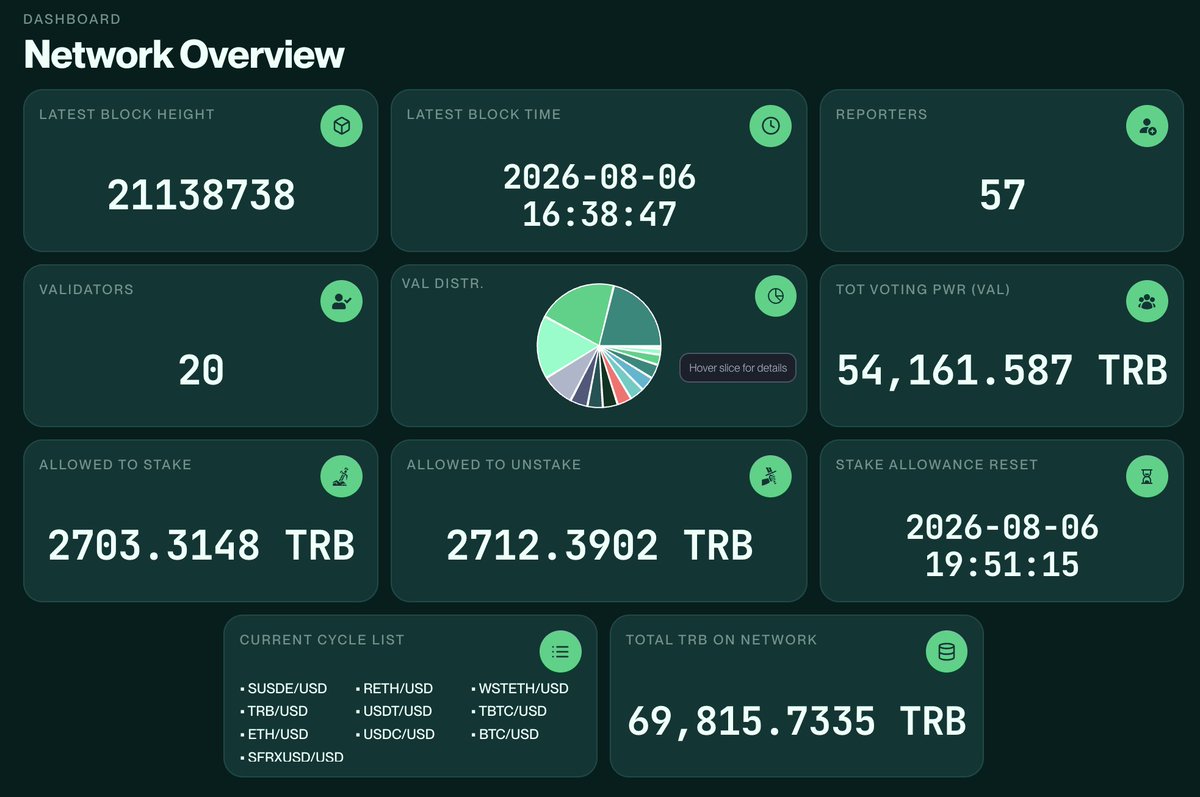
Tellor’s cycle list delivers fresh consensus on core queries in order to maintain a base level of liveness.
Governance steers the list while reporters are incentivized with time-based rewards, giving builders steady data where it counts most.
Keep track of the cycle list here:
https://t.co/fIxZxc5VmX
Pure crypto-economic truth from subjective reports.
Any staked reporter can submit a value for a query (i.e. data request, e.g. BTC/USD price).
For a given time period, reporters can add their value to the array of submissions. At the end of the time period, the official value is determined by a weighted aggregation of all the values submitted.
The cypherpunk dream is infrastructure no gatekeeper can shut off, and that's the standard Tellor is built toward.
Anyone can request data, report it, dispute it, validate it, or relay it on-chain without asking permission first. Even AI agents can tip for new data on their own.
Tellor. The oracle built to outlive its creators.
Need an oracle where the team cannot decide which data is allowed to exist?
On Tellor, anyone can tip a query, stake to report it, raise a dispute on-chain, or relay attestations to another chain. None of those roles require approval, and none can be blocked by a trusted intermediary.
This is how censorship resistance works in practice.
Tellor's 'Operator Dashboard' pulls Tellor’s chain-state and layers it with role specific tooling so you can evaluate your position clearly.
Learn More here:
https://t.co/iDmvXYIzHH
Start modelling here:
https://t.co/lU7XdFtIzM