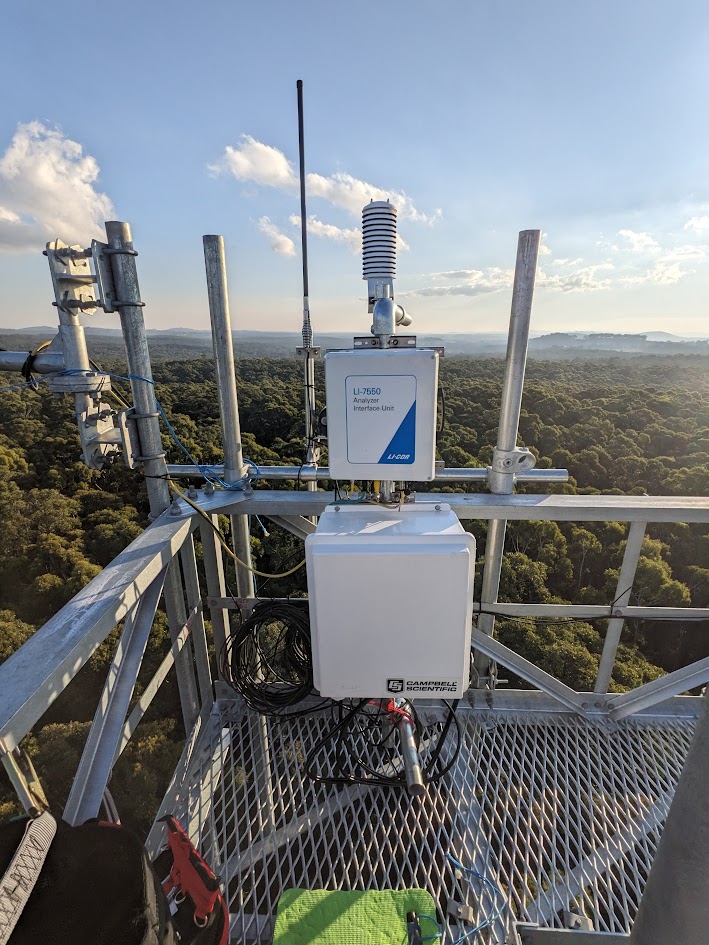
📡 The installation of the new #fluxtower at our Wombat Stringybark Eucalypt SuperSite has officially been completed! Located in the Wombat State Forest near Ballarat, the original 35m tall flux tower installed in 2010, blew down during heavy storms in 2021.
(Pic: Dr Markus Loew)
Artificial light at night (ALAN) is bad for animals but… what about trees? Do they photosynthesize at night? Lose water? Grow more? Change shape? New paper from the @urbanlightlab has the answers! 🧵1/
https://t.co/iibIyswmwk
Registrations are now open for the OzFlux 2021 conference on 1-2 November 2021:
https://t.co/OhWBBiEupn
The preliminary program is also available!
Registration is free and easy!
Hope you can join us! 😊
#NCRISimpact#climate#water@weArndtalab@moore_science_ @jamie_cleverly
OzFlux 2021
Abstracts DUE 10 October 2021 - in three days
The ecosystem processes conference in Australia and New Zealand - 1-3 November 2021
Online & free
https://t.co/xBCMnskLpc
Keynotes by
@b_medlyn, @pepcanadell, @trevorkeenan, @BennettRen, @nifiju
🚨OzFlux 2021 Conference🚨
THE 🇦🇺🇳🇿 ecosystem processes conference!
1-3 Nov 2021
All online & free
Abstract submissions now open: https://t.co/OhWBBiEupn
Hope to see you online!
#NCRISimpact
OzFlux 2021
The ecosystem processes conference in Australia and New Zealand - 1-3 November 2021
Online & free
https://t.co/OSdhedPUIO
Submit your abstracts until 10 October 2021
Keynotes by @b_medlyn, @pepcanadell, @trevorkeenan, @BennettRen, @nifiju
1/n) #Methane emissions from tree stems: a new (research) frontier in the global #carbon cycle indeed! This year has seen a rapid increase in #Treethane research publications - expanding our current knowledge with new observations, insights, biomes, drivers + sampling techniques
The temperature optimum of ecosystem photosynthesis in Australian forests has adjusted to the local temperatures - but all ecosystems have a little bit of room to move. Read about it in our new paper in GCB:
https://t.co/hFpCAXUBl6
Our new paper in @PNASNews reveals a new invertebrate-microbe interaction! Termites control microbial communities in their mounds by emitting hydrogen gas. This hydrogen in turn fuels growth of potentially defensive Actinobacteria in the mounds.
https://t.co/3VIyGNnLzy
Surprising: increased internal water storage in non-succulent plants does not per se lead to greater survival in extreme conditions on green roofs. We tested this with 11 Mediterranean herbs and shrubs that differed in succulence:
https://t.co/E93mmqVu7Y
Can we "teach" trees to become more drought tolerant? Yes, sort of..., but no, not really...
Confused? Find out more in @C_Pritzkow new paper, out now in Tree Physiology
https://t.co/lfvafDbf9V
Farewell Wombat Flux!
Our OzFlux tower at the Wombat forest survived 11.5 years of wind and weather, but the Victorian storms on 9 June were too much. A falling eucalypt hit the guy wires, the tower buckled and had to be taken down...
How many sediment samples do you need in a mangrove forest to accurately determine sediment carbon? More than you think...
Read about it in our new paper in ECSS
https://t.co/4UaYeMrCoG