Introducing The Web3 Brief 🚀 your essential monthly digest for Web3 innovation & policy in Canada
Stay informed about the latest Canadian policy developments, Web3 commentary, and key updates from the Canadian Web3 Council!
Link to subscribe in the replies 👇
We’re hosting a workshop on the future of stablecoins and tokenized capital markets in Canada. Morva Rohani will join industry experts what we really know about new digital asset regulations.
📅When: Wednesday, June 10, 9:00 - 11:00 am
📍Where: Brainstation, Toronto, ON
If you’re a head of product, payments, partnerships, or the operators around them, across Canadian banking, fintech, treasury, and financial infrastructure, then this event is for you.
Register here: https://t.co/KgyKZLPGFj
CW3 recently submitted its recommendations for the pre-budget consultations ahead of Budget 2026. We outlined how Canada can foster a competitive and innovative stablecoin ecosystem while maintaining strong consumer protections, calling for clear licensing pathways, a level playing field for issuers, and regulatory alignment with emerging international standards.
You can read our recommendations in more detail in our latest blog post.
https://t.co/fAhPIHxVML
Paxos has become the first blockchain-native company authorized by the U.S. Securities and Exchange Commission (SEC) to provide clearing and settlement services for securities transactions. The approval allows Paxos to operate as a registered clearing agency and central securities depository through its subsidiary, Paxos Securities Settlement Company (PSSC).
The milestone is significant for the future of tokenized capital markets. By using blockchain as the settlement rail, Paxos says eligible securities can be settled the same day or nearly instantly, rather than through traditional multi-day settlement cycles. The approval follows years of engagement with regulators and highlights how blockchain infrastructure is increasingly being integrated into regulated financial markets.
https://t.co/nNdvMOA90a
The Bank of Canada has announced it is joining the Bank for International Settlements (BIS)-led “Project Agorá,” a major international initiative exploring tokenization and cross-border payments. The project brings together central banks and private financial institutions to test how tokenized commercial bank deposits and central bank settlement assets could make international payments faster, cheaper, and more efficient.
This is a major sign that Canadian financial authorities are moving beyond theoretical discussions around digital assets and into practical experimentation with tokenized financial infrastructure. Cross-border payments remain one of the clearest real-world use cases for blockchain-based innovation, and Canada’s participation ensures it remains part of the conversation shaping the next generation of global financial rails.
https://t.co/Nz4hxdmQi7
Executive Director Morva Rohani addressed the Standing Committee on Finance study on Pre-Budget Consultations in Advance of the 2026 Budget yesterday, speaking on the importance of regulatory clarity around stablecoins.
Morva highlighted how stablecoins lower costs, create stronger demand for Canadian government bonds, and enable easier trade with Europe and Asia. She urged lawmakers to consider our recommendations, namely:
- Defining stablecoins as payment instruments clearly and consistently across all Canadian laws
- Allow providers to offer rewards programs
- Work with other countries to recognize each other’s rules
She concluded with a warning that if Canada’s inaction could lead to our entrepreneurs building elsewhere and Canadians continuing to use USD-backed stablecoins.
We appreciate everyone on the committee for taking the time to share their views. You can see her full comments in the video below.
Robinhood’s acquisition of WonderFi, the parent company of Canadian crypto platforms Coinsquare and Bitbuy, has officially received approval from CIRO. The decision clears a major regulatory hurdle for one of the most closely watched digital asset deals in Canada over the past year.
The approval is another sign of how quickly digital asset infrastructure is becoming integrated into mainstream financial services. Canada has spent the past several years building a regulated crypto market framework, and transactions like this highlight how those regulated platforms are increasingly being viewed as strategic assets by global financial firms.
https://t.co/ANXjUfTjFo
The SEC is reportedly preparing a new framework that could allow the trading of tokenized versions of public stocks on crypto platforms in the U.S. The proposal would reportedly create an “innovation exemption” for tokenized equities, potentially enabling these assets to trade outside traditional exchanges and on decentralized infrastructure.
This development highlights how quickly the conversation around tokenization is evolving not just in Canada, but globally. While questions remain around investor protections, shareholder rights, and market oversight, the direction of travel is increasingly clear: regulators and institutions are actively exploring how blockchain infrastructure can modernize financial markets.
https://t.co/bfsmcwKudo
The CLARITY Act is past the Senate Banking Committee markup hearing, and it’s on to the floor for a full vote with the White House targeting passage on July 4th. While the bill is now past a major hurdle, it has many steps to clear in both the House and Senate before then.
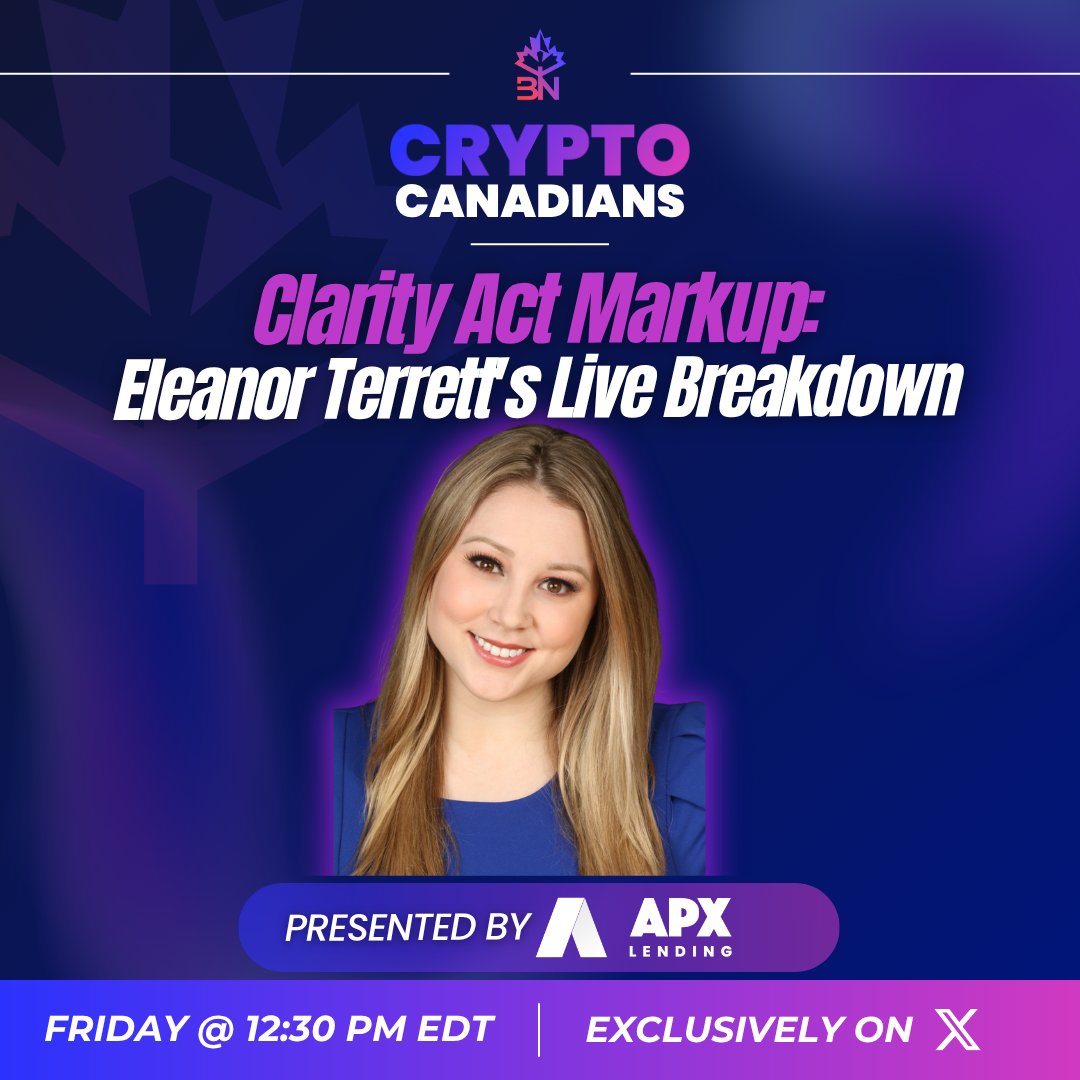
Still, it has a real path to becoming law. Crypto reporter Eleanor Terrett explored the state of the vote and nuances of the situation on Blockchain North’s Crypto Canadians, expressing cautious optimism about the votes to come.
We are live today at 12:30 PM EDT.
Clarity Act Markup: Eleanor Terrett's Live Breakdown.
The ink is barely dry. @EleanorTerrett has been closer to this story than anyone. Let's break down what happened in the room & what this means for digital assets.
Ep sponsored by @APXLending 🙌
This Thursday’s Senate markup of the revised CLARITY Act is shaping up to be one of the most important digital asset policy events of the year. The markup comes after earlier negotiations stalled, and the latest version appears designed to address concerns around market structure, consumer and developer protections, and stablecoins.
The bill has undergone several changes since January, with notable implications for digital assets in Canada, including:
- New compromise on stablecoin yield, with passive yield banned but rewards still allowed for bone fide activity, including on-chain transactions and sending
- Stronger provisions around stablecoin reserve requirements and oversight
- Expanded focus on tokenization and blockchain-based financial infrastructure, notably RWAs
- Provisions addressing DeFi, intermediary responsibilities, and compliance obligations and newly defined expectations for decentralized activities
The outcome of Thursday’s markup could help define not only the future of U.S. crypto regulation, but also the broader direction of North American digital asset policy coordination.
https://t.co/t9ekhXk4Bn
Payments Canada says access to the country’s long-awaited Real-Time Rail (RTR) instant payments system will roll out in phases beginning in late 2026, with broader access expected through 2027. The phased rollout underscores both the opportunity and the challenge of modernizing Canada’s payments infrastructure, as some banks may benefit from uneven access early on.
Once fully operational, the RTR will enable near-instant payments and settlement 24/7, while supporting richer payment data and new financial products across Canada’s economy. Instant payment systems have already been implemented in more than 100 countries, and stakeholders continue to stress that broad participation from both banks and fintechs will be critical to ensuring competition, innovation, and consumer benefit.
https://t.co/uwyMTBoc8X
Speaking at @CoinDesk's Consensus event in Miami, media and investment figure Kevin O’Leary argued that Wall Street’s current “tokenization boom” is still ahead of regulatory reality. In his view, without clear and enforceable crypto regulations in the United States, tokenization will stay largely exploratory, with interested institutions unable to confidently scale beyond pilots and proofs of concept.
More broadly, O’Leary frames regulation as the missing infrastructure layer still needed for tokenization to move to mainstream financial markets. His comments come as the debate is becoming increasingly relevant in Canada, where policymakers are actively advancing work on tokenization frameworks and broader digital asset rules.
https://t.co/Tkd011Pi6v
Another big win for Canada’s digital asset ecosystem from CW3 Member @Wealthsimple!
We’re excited to see Wealthsimple become the first Canadian financial institution to pilot stablecoin settlement with Visa Canada and Tetra Digital Group. Their successful experiment shows how stablecoins can integrate with existing payment rails, enabling faster, more flexible settlement (including seven-day cycles) while maintaining institutional-grade infrastructure.
This is exactly the kind of innovation that moves the conversation forward in Canada. It demonstrates how trusted institutions can bridge traditional finance and blockchain-based systems in a way that is practical, compliant, and scalable.
Canada’s top banking regulator, the Office of the Superintendent of Financial Institutions (OSFI), is launching a pilot program aimed at significantly speeding up the process of becoming a federally regulated bank. The initiative, expected to roll out in June, is designed to reduce approval timelines that have historically stretched across several years, with the goal of bringing more competition into a market long dominated by the country’s largest institutions.
This signals a potentially meaningful shift for Fintechs. If successful, the pilot could lower barriers to entry and create new pathways for emerging financial institutions to scale within a regulated framework.
https://t.co/xd3ahI8uCu
Congratulations to CW3 member Tetra Trust Company on the launch of CADD, now fully approved and live on multiple chains.
As Canada’s first regulated stablecoin structured as a payment instrument and issued under a provincial trust framework, this represents a meaningful step toward integrating blockchain-based settlement into the regulated financial system.
Their achievement underscores not only their hard work, but also the growing maturity of Canada’s digital asset ecosystem.
CADD has received regulatory approval from the Alberta Treasury Board and Finance and is now live on @base , @ethereum and @tempo
The Canadian dollar is now a global digital currency 🍁
Read more 👇
https://t.co/0beScS3vut