@Thominhogoals retarded fools like you make me doubt whether all humans actually have a brain, wtf do you mean? someone has be performing poorly for the past 4 seasons your concern isn't how he can get back to his best form and help his club. you're here spilling rubbish. fcking bastard
@adebisidejoke Let me give you an advice, quit this content stuff. you're one of the reasons why people don't take women seriously in this football space, i know you're doing it for the engagements and money but come on. Do you even understand football?
@BackroadGee_ you thinking yamal deserves the ballon d'or after seeing the voting criteria in order of importance makes you nothing but a f00l, people like you deserves no opinion in football
@enkhay_9@jayzinprospecs@MadridXtra stfu, bastard your mom is a wh0ŕè i hàťè the way that she smell, i hate the fact that she confuse her self with real women 🤡
@enkhay_9@jayzinprospecs@MadridXtra You fcking bastard son of a whore, you dad pulled out in time but your infected bastard of a mother still decided to bring a natural disaster like you into the world, why can't you just d!e and let this world be a better place? fck you and your mom, bastard fcking prat
For a long time, I’ve thought the biggest gap between AI and crypto wasn’t intelligence.
It was trust.
A smart contract can verify exactly what code executed. But when that same application needs an AI answer, we often end up trusting an API and whatever happens behind it.
Reading through the @BaranosAI whitepaper, the approach really stood out to me.
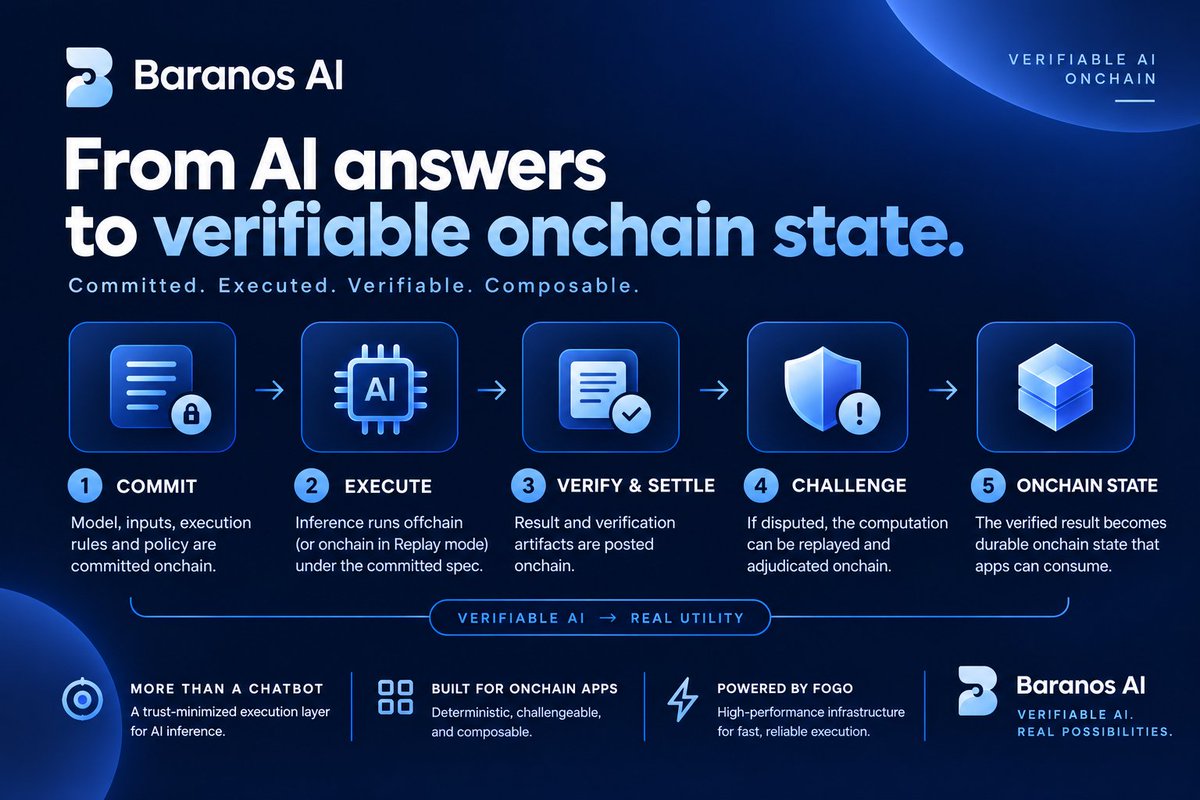
Instead of treating AI as a black box service, Baranos commits the model, inputs and execution rules, then makes the result challengeable and replayable onchain.
That changes what AI can actually do inside onchain applications.
Prediction markets are the obvious starting point, but the same primitive could eventually extend to insurance, governance, risk systems and autonomous agents.
The interesting part isn't simply putting ai onchain.
It's making an AI result something other software can verify, settle and rely on.
That feels like the bigger idea behind Baranos.
Yeah, I’m paying attention to this one.
@BaranosAI@fogo
One idea from the @BaranosAI white paper keeps standing out to me:
Insurance claims are still largely a trust problem.
You submit a claim, provide your evidence, and someone at the insurer interprets the policy and decides whether you qualify.
If the answer is “Claim denied”, there usually isn't a way for both sides to independently verify exactly how that decision was reached.
That’s where I think @BaranosAI on @fogo gets interesting.
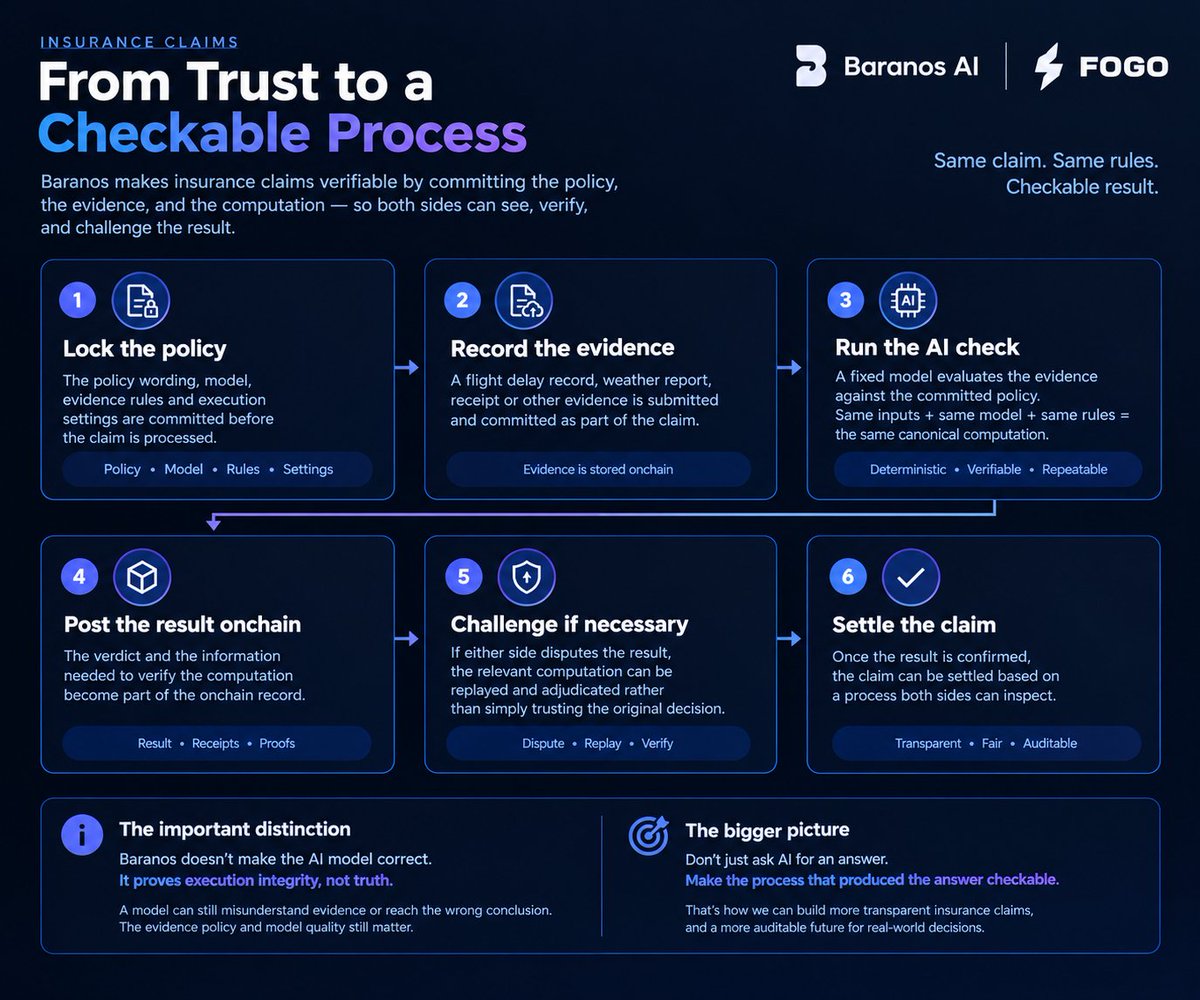
Imagine an insurance claim working like this:
→ Lock the policy
The policy wording, model, evidence rules, and execution settings are committed before the claim is processed.
→ Record the evidence
A flight delay record, weather report, receipt, or other evidence is submitted and committed as part of the claim.
→ Run the AI check
A fixed model evaluates the evidence against the committed policy. Same inputs + same model + same rules = the same canonical computation.
→ Post the result onchain
The verdict and the information needed to verify the computation become part of the onchain record.
→ Challenge if necessary
If either side disputes the result, the relevant computation can be replayed and adjudicated rather than simply trusting the original decision.
→ Settle
Once the result is confirmed, the claim can be settled based on a process both sides can inspect.
That changes the conversation from:
“Why should I trust your decision?”
to:
“Show me that the decision was produced according to the rules we committed to.”
And that's an important distinction.
Baranos doesn't magically make an ai model correct. verification proves execution integrity, not truth.
A model can still misunderstand difficult evidence or reach the wrong conclusion. The evidence policy and model quality still matter.
But if the disagreement is about what actually happened during the computation, you now have something much stronger than an opaque API response.
You have a committed policy, committed inputs, a reproducible computation, and a mechanism to challenge the result.
To me, that’s the bigger idea behind verifiable AI:
Don’t just ask ai for an answer.
Make the process that produced the answer checkable.
That could make insurance claims, prediction markets, lending, and other real world decisions far more auditable.