The past few months have taught traders the same lesson, again and again.
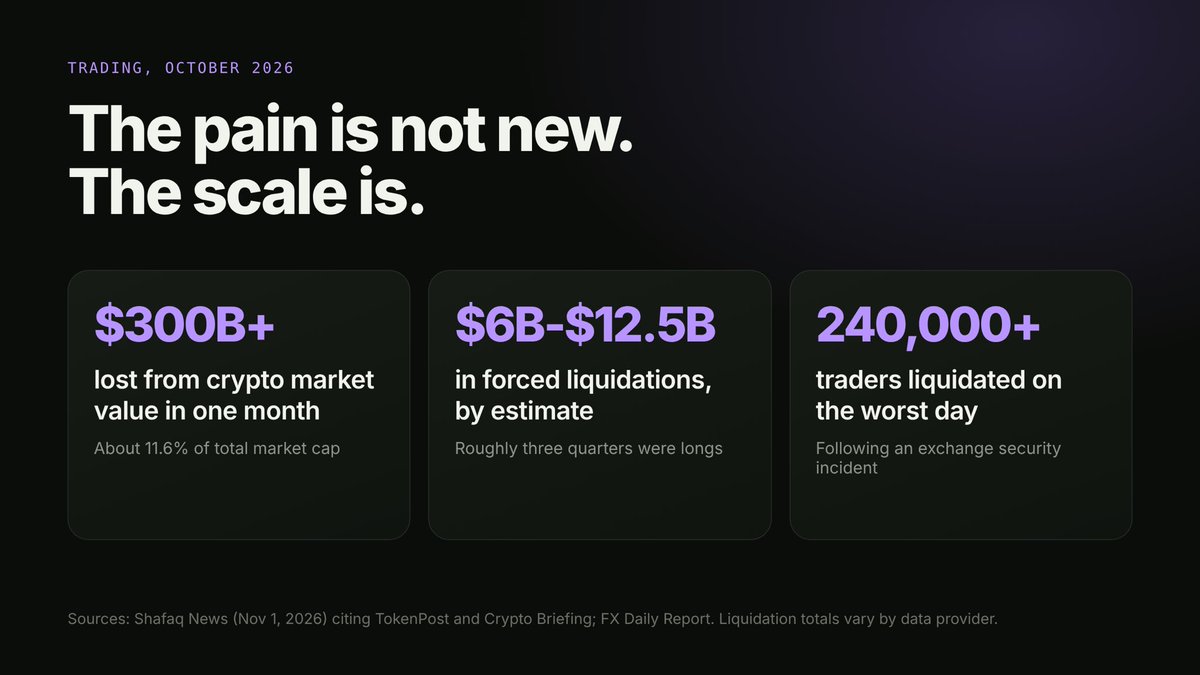
October alone wiped more than $300B off crypto's market value. Estimates of forced liquidations for the month range from about $6B to $12.5B, and roughly three quarters of the higher figure were longs. On the worst day, more than 240,000 traders were liquidated. A major exchange security incident at the end of the month then put custody back in the spotlight.
Look at what actually hurt people:
1. Leverage with thin guardrails. When margin runs short, positions close automatically, often at a poor price.
2. Custody risk. When your funds sit on one platform, you inherit its worst day.
3. Tools that promise intelligence but deliver scripts. One estimate says about 95% of retail bots marketed as AI are rule-based scripts built on basic indicators. They need constant watching, which is exactly what traders wanted to stop doing.
None of this is new. What is new is that better tools are now possible.
The next trading product worth using should do three things. Act on its own, around the clock, instead of waiting for a click. Show its reasoning, so you know why it moved. Keep the user in control of their funds and their risk limits.
Traders do not need another dashboard. They need something that does the work and stays accountable.
That is the direction I am watching most closely.
Four shutdown headlines, most of them from Nov 9.
Galxe is closing Quest, ID and Passport. Campaigns end Dec 5 and reward claims close Dec 15. It has served 36 million users, per https://t.co/bAVowB0ENR.
Veil’s founder shut the protocol down and halted deposits immediately. The frontend and relays stay up until Dec 21.
Lisk closed its bridge on Nov 2. Manual claims are planned for January 2027, but eligibility and steps aren’t spelled out yet.
XXYY, a memecoin terminal, announced its shutdown too. Cryptopolitan puts it down to falling memecoin activity.
Different projects, different reasons. But each one has people on the other side, reading the announcement and working out what happens next.
In my experience, the chat goes quiet before the headline.
Bitcoin fell about 5% in a day this week and was one of the calmer charts on the screen.
Here is what the same day did to everything else:
Semiconductor index, down 12%. Nasdaq, down 5.5%. S&P 500, down 4.3%. Dow, down 3.4%. Crypto miners, down 15% to 20%. Over $1B in leveraged crypto positions got liquidated.
People gave mixed reasons. After the midterms, there were fears a Democratic-controlled Congress could slow data-center construction. Add doubts about returns on AI spending and weak chipmaker earnings, and AI stocks got sold all at once.
Bitcoin ended just under $76K, which erased its post-election rally. Still, major cryptos fell less than a lot of AI stocks. Two trades everyone calls the future had their worst day together, and the one people call risky held up better.
A Wintermute trader said not to overreact to one day, and that it could be a chance to look for bargains. Fair. One day proves nothing.
But it does show how tightly wound the AI trade is, and how fast it unwinds when the story wobbles.
When the story wobbles, what is underneath is all that is left. We have been heads down on that at Moss.
Follow along → @MossAI_Official
I mean, who would want a dead token after a merely 24 hours, let alone a few days after launch?
Come check us out @MossAI_Official , you will like what we are building
Two holder groups. Same launch day.
In one, the questions stop getting answers by week two. In the other, every question gets an action, with a reason and a record you can check.
Most tokens go quiet. This one didn’t.
Stay tuned.
Launching a token takes minutes. Keeping one alive takes months.
Of about 9 million Pumpfun tokens tracked in 11 months, only 0.2% had 10 or more trades by week five.
Who is still running it on day 35?
This has to change.
A token launch gets all the attention. I keep asking what happens after it.
105 of 113 large token launches since 2024 now trade below their TGE price. The median is down 95.7%.
Launching was never the hard part. Staying alive after day one is.
My take: launch and audit are one-time events. Running the token is every day.
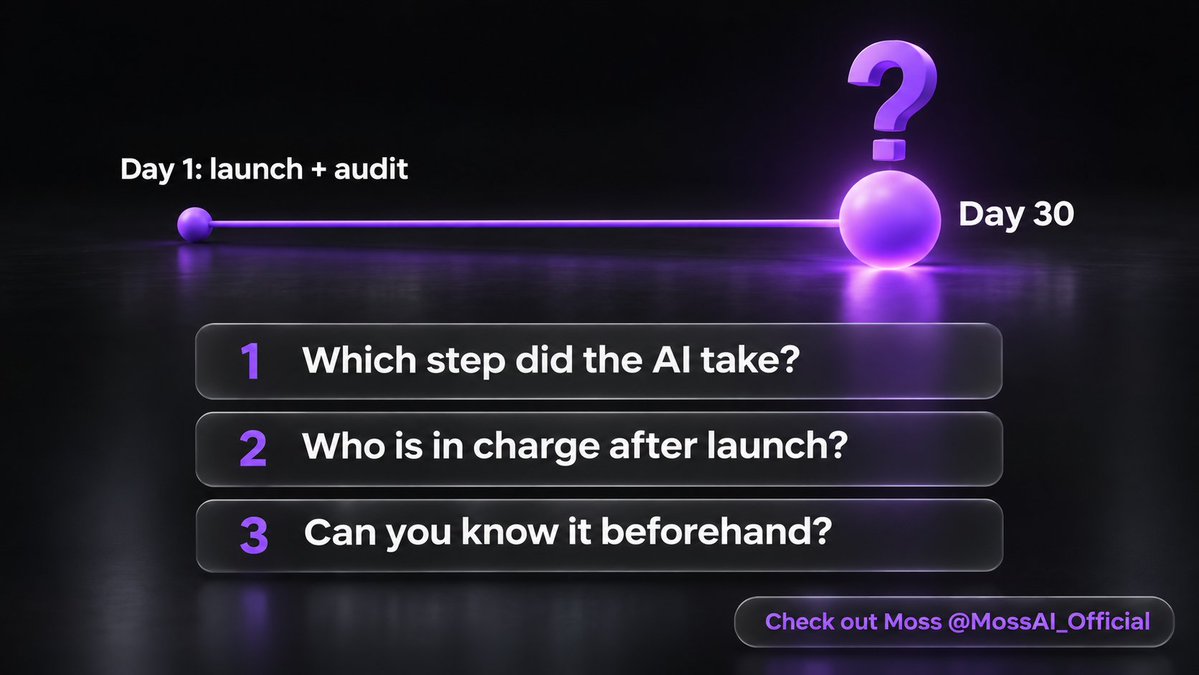
With AI in the loop, I ask three things: which step did it take, who is in charge after launch, and can I know that beforehand?
Check out Moss, perhaps the answer be here soon → @MossAI_Official
The rules usually arrive after the damage.
Hackers took about $940M in the first half of 2026. Audits checked the code, but not the keys, bridges and infrastructure around it.
Each new safeguard patches the last failure, not the cause.
Imagine hundreds of meme coins, each launched and run by an AI agent that never sleeps, 24/7.
That's what the Moss launchpad is built for, and it's coming to BNB Chain.
Join our community and be the first to know once its out:
https://t.co/9P9npJxYZM
Excited to reveal what we’ve been building: a launchpad for 100% agent-run tokens.
AI agents hold the private keys, launch their own tokens, and manage them 24/7.
The Real Agent Coin Launchpad. Coming soon.