@Blaqkingx The legal wrapper is where the real RWA due diligence begins.
Two projects can tokenize the same type of asset and offer similar yields, yet have completely different risk profiles because their legal structures, jurisdictions, bankruptcy protections, and investor rights differ
The Legal Wrapper Behind an RWA
Most conversations about tokenization start with the asset.
A building.
A Treasury.
A private credit loan.
An invoice.
A fund.
But there is a more important question:
What legally sits between the investor and the underlying asset?
That is the legal wrapper.
A simplified RWA structure looks like this:
Underlying Asset
↓
Legal Wrapper — SPV, trust, fund, corporate vehicle, or contractual structure
↓
Token
↓
Investor Rights
The blockchain can record and transfer the token.
But the legal wrapper helps determine what that token actually represents.
It can affect:
→ Who legally owns the underlying asset
→ What rights the token holder receives
→ How income or redemption works
→ What happens if the issuer defaults
→ How the asset is treated in bankruptcy
→ Which jurisdiction and laws apply
→ How investors can enforce their rights
This is why “the asset is on-chain” is not enough to evaluate an RWA.
A token can exist on a blockchain while the investor's legal claim remains unclear, limited, or dependent on an off-chain entity.
The real due-diligence question isn't:
“Is this asset tokenized?”
It's:
“What legal right does the token actually give me?”
Because when something goes wrong, the smart contract won't be the one standing in court.
The legal structure will.
#RWA #Tokenization #RealWorldAssets #DigitalAssets #Blockchain
The quietest farm on CT right now — and people are still sleeping on it.
No whitelist. No gas wars. No 47-step quests. No deposit.
You open https://t.co/Sbb3EVrHZR, look at the BTC chart, and answer one question: up or down in the next 15 minutes?
Right call → $TREND lands in your balance.
Stack it → Trend Boxes start opening.
And inside those boxes… let's just say nobody's opening them for the animation. Real $SOL drops out, straight to your wallet.
24 hours since launch — and the withdraw tab hasn't had a single quiet minute.
So the only real question left: why isn't your $SOL claimed yet?
📦 https://t.co/Sbb3EVrHZR
The future of RWAs isn't about cozying up to gatekeepers.
@RWAFoundation_ nails it.
Builders who win will build open, decentralized access where no one controls rates or distribution.
Tokenization only matters if it actually democratizes finance.
Permissioned rails are just TradFi with extra steps. Herwig Konings dropping truth.
Who's building the real open rails?
#RWA #DeFi #Crypto
@Blaqkingx @OndoFinance GM! Ondo pushing tokenized stocks into perps is huge for RWA liquidity. Kraken's win also shows auditors can't just walk away without consequences. Bullish week
GM News 🚨
1. @OndoFinance : Tokenized Stocks as Perpetual Collateral
Ondo Finance has enabled the use of tokenized equities as collateral for perpetual futures trading for pre-alpha users. The service allows for 24/7 trading of derivatives tied to commodities and stocks for eligible non-U.S. investors.
Why it matters:
This development increases RWA utility by transitioning tokenized assets from static on-chain holdings into versatile forms of collateral. It enhances capital efficiency and market liquidity while bridging traditional equity market structures with decentralized finance.
2. @krakenfx Wins $22M Arbitration Against Mazars
Payward was awarded $22M after auditor Mazars abandoned a near-complete audit in 2022, reportedly due to political pressure
Why it matters:
This strengthens service provider accountability, which is vital for the audit and compliance infrastructure required for institutional digital asset adoption.
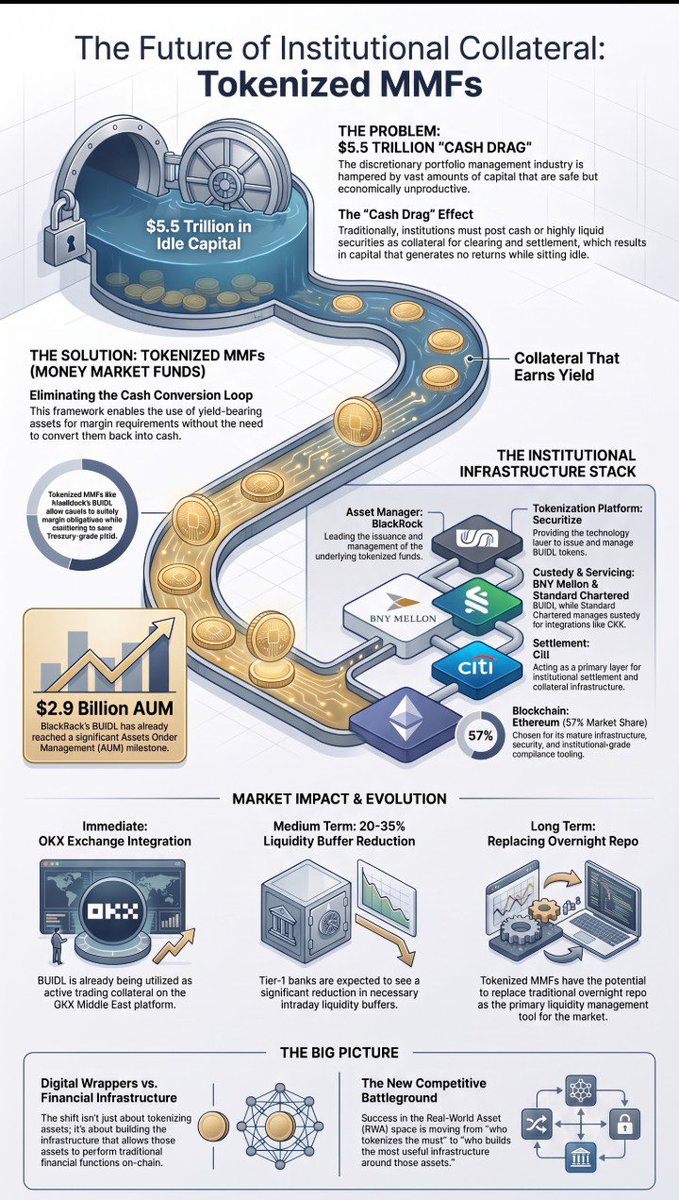
The biggest breakthrough isn't that @BlackRock tokenized a fund.
It's that institutions are starting to treat tokenized funds as collateral.
That's a much bigger story.
BlackRock, Citi, BNY Mellon, Standard Chartered, and Securitize aren't just experimenting with tokenization.
They're redesigning how institutional liquidity moves.
Here's why that matters.
Traditionally, institutions post cash or highly liquid securities as collateral for clearing, settlement, and margin requirements.
The problem?
Cash sitting as collateral isn't generating returns.
That's known as cash drag.
It's capital that is safe but economically idle.
The latest framework changes that equation.
Instead of converting assets back into cash, institutions can use tokenized money market funds like BUIDL as collateral while those assets continue earning Treasury-backed yield.
In other words:
The same asset can now satisfy margin requirements and remain productive.
That's a major improvement in capital efficiency.
Look beyond the headline.
Every participant plays a distinct role in the infrastructure stack:
• @BlackRock → Asset manager
• @Securitize → Tokenization platform
• @BNYglobal Mellon → Fund servicing and custody
• @StanChart → Custody framework for institutional trading
• @Citi → Institutional settlement and collateral infrastructure
This isn't one company launching a product.
It's multiple financial institutions coordinating across the tokenization lifecycle.
Ethereum's role is equally important.
Institutions didn't choose Ethereum simply because it's the largest blockchain.
They chose an ecosystem with mature infrastructure, security, custody integrations, and institutional tooling.
Infrastructure reliability not retail activity is becoming the deciding factor.
The broader implication is easy to miss.
The next competitive battleground in RWAs isn't Who tokenizes the most assets?
It's Who builds the most useful financial infrastructure around those assets?
Tokenization without collateral utility creates digital wrappers.
Tokenization with collateral utility creates financial infrastructure.
There's a meaningful difference.
My takeaway:
This isn't a story about another tokenized fund.
It's a signal that tokenized assets are beginning to perform the same functions as traditional financial assets inside institutional markets.
When tokenized funds become accepted collateral, tokenization shifts from asset issuance to market infrastructure.
That's the transition worth watching.
Question for the market:
If tokenized money market funds become widely accepted as collateral, what other parts of traditional market infrastructure could move onchain next?
#RWA #Tokenization #CapitalMarkets #InstitutionalFinance #DigitalAssets #Ethereum #Treasuries #Collateral #MarketInfrastructure #OnchainFinance