@HottieBabeGem@goldfishggbr The SMG integration is honestly the part that caught my attention. Turning gold exposure into something that earns 12% APY feels like a solid evolution. 🔥
A lot of tokenized gold projects stop at simple exposure.
You buy the asset, hold it, and wait.
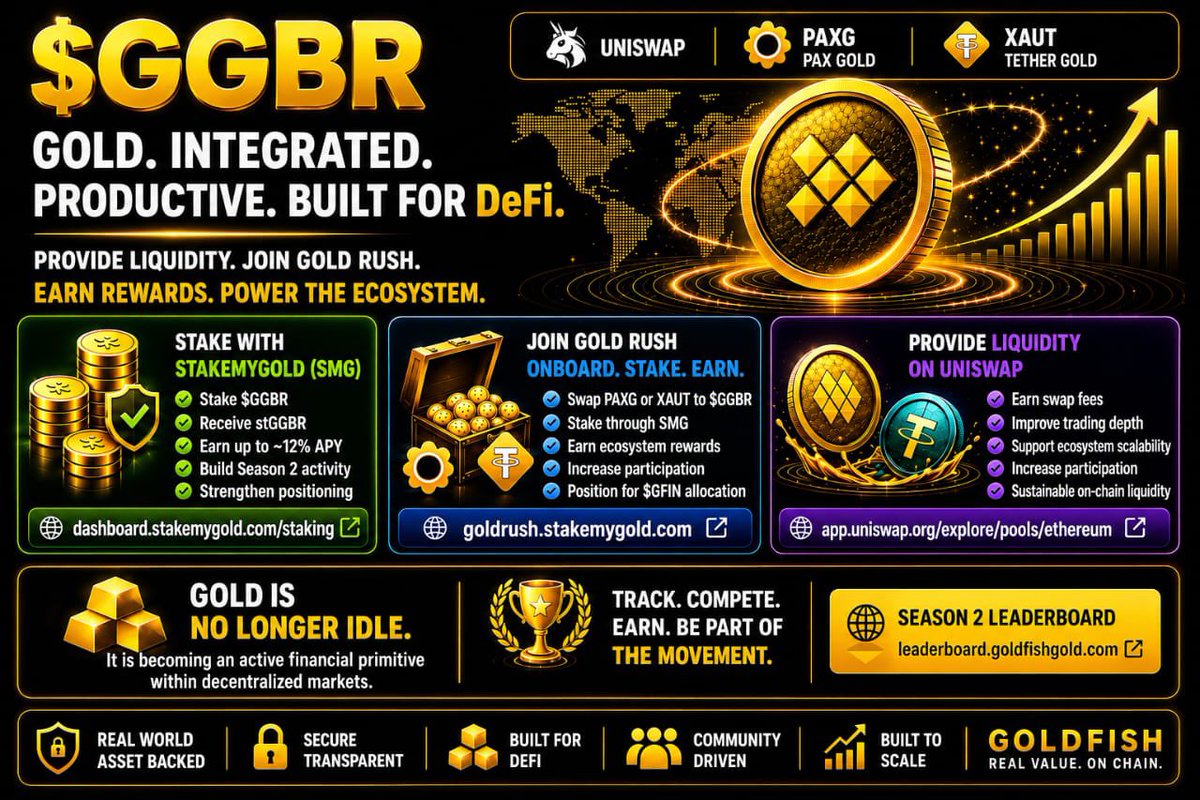
What makes the @goldfishggbr ecosystem interesting is that $GGBR is starting to become usable across different parts of DeFi instead of just sitting inactive in a wallet.
One of the biggest parts of that is the integration with StakeMyGold (SMG).
Through SMG, users can:
• Stake $GGBR
• Receive stGGBR
• Earn up to ~12% APY
• Stay active in the Season 2 ecosystem activity
There is also the Gold Rush campaign, which gives PAXG and XAUT holders a direct way to move into the $GGBR ecosystem.
Users can swap PAXG or XAUT into $GGBR, stake through SMG, and position for a $GFIN allocation through ongoing participation.
Gold Rush 👇
https://t.co/GAELSidIhi
Stake here 👇
https://t.co/N6cG5cwwPT
Beyond staking, $GGBR is also active on Uniswap through the $GGBR/USDT liquidity pool.
Liquidity providers can earn swap fees while helping improve liquidity around the asset itself.
Uniswap pool 👇
https://t.co/k6ApF98iDp
And what connects everything together is the Season 2 leaderboard.
Holding, staking, and LP activity all feed directly into the $GFIN Airdrop Leaderboard, giving users multiple ways to participate across the ecosystem.
That is the part I find most interesting.
Gold is no longer just being tokenized.
It is starting to move through DeFi infrastructure the same way other active onchain assets do.
Season 2 leaderboard 👇
https://t.co/wgIDNr7xdr
@goldfishggbr
Most crypto projects talk about community, governance, and long term sustainability.
Very few actually design systems around those ideas.
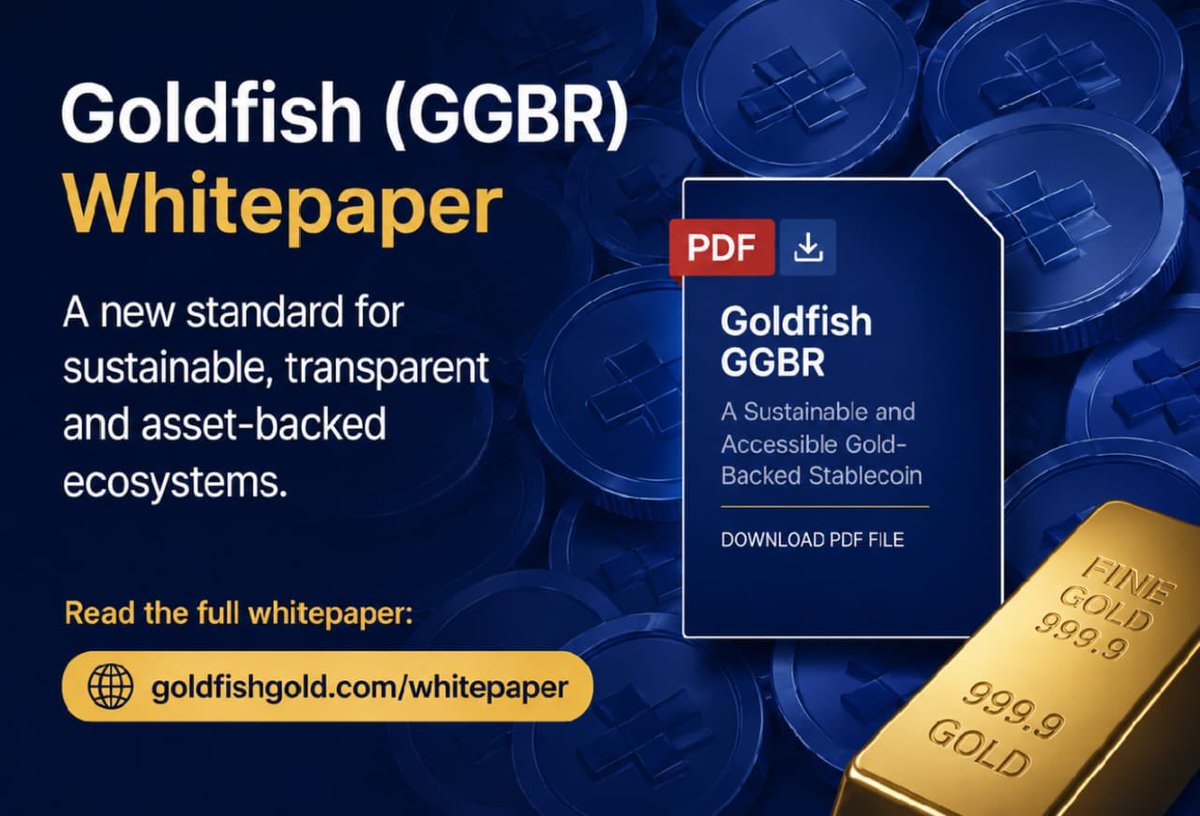
After reading the @goldfishggbr whitepaper, that was the first thing that stood out to me.
The model is clearly built around structure, transparency, and long term participation rather than short term attention.
A few parts of the whitepaper stood out the most to me 🧵
The most common response when a prediction market trader loses:
"I was right about the direction. I just lost the timing."
That's not a skill problem. That's a product problem.
The product doesn't reward being close. It only rewards being exact.
It's either Yes or No