@injective 3/3
We've seen previous Stockdrops involving Robinhood Chain and Solana. The November round continues with Solana.
So, while both are part of BuyBack, they don't work alike.
Your commitment affects your revenue share, but it does not guarantee a stock allocation.
@injective 2/3
The Stockdrop is a separate thing.
Your INJ commitment does not determine how many stocks you receive. Eligible wallets get a chance to receive one tokenized stock, whether they committed a small or large amount.
Banks can't let just anyone hold certain assets. That's why putting a bond on a blockchain isn't as simple as creating a token.
Real assets come with rules. Some can only be held by approved investors. Some can't be transferred in certain countries. Some need someone able to pause transfers or freeze an address if something goes wrong.
@injective Mint, introduced in July, lets issuers set those rules when creating a token through a guided interface, without writing custom smart contracts. The blockchain then enforces them automatically, so a wallet that isn't approved to hold the asset simply can't receive it.
Around Mint, an Injective affiliate became an SEC-registered transfer agent, which maintains official securities ownership records. @injective also launched Institutional Rail, a fast lane that gets institutions' transactions into the next block, with an early confirmation.
On the other side, INJC, a Nasdaq-listed ETF, gives people exposure to INJ through a regular brokerage account.
One connects traditional investors to $INJ. The other opens the door for traditional assets to move onchain.
@injective 5/5
Institutional Rail launched on November 2, giving institutions dedicated infrastructure to access Injective.
Veyra adds more trading and cross-chain capabilities, building on that foundation.
Together, they make Injective better equipped for institutional trading.
Thread🧵
1/5
Veyra brings IBC connectivity to injective EVM, allowing it to connect with other IBC-enabled chains.
This means assets can move across connected networks, giving tokenized assets access to more liquidity beyond @injective.
@injective 4/5
There's also groundwork for CypherOS, Injective's upcoming privacy platform.
This matters because institutions may need to trade without making every position and transaction detail publicly visible.
Veyra puts some of the technical pieces in place for that.
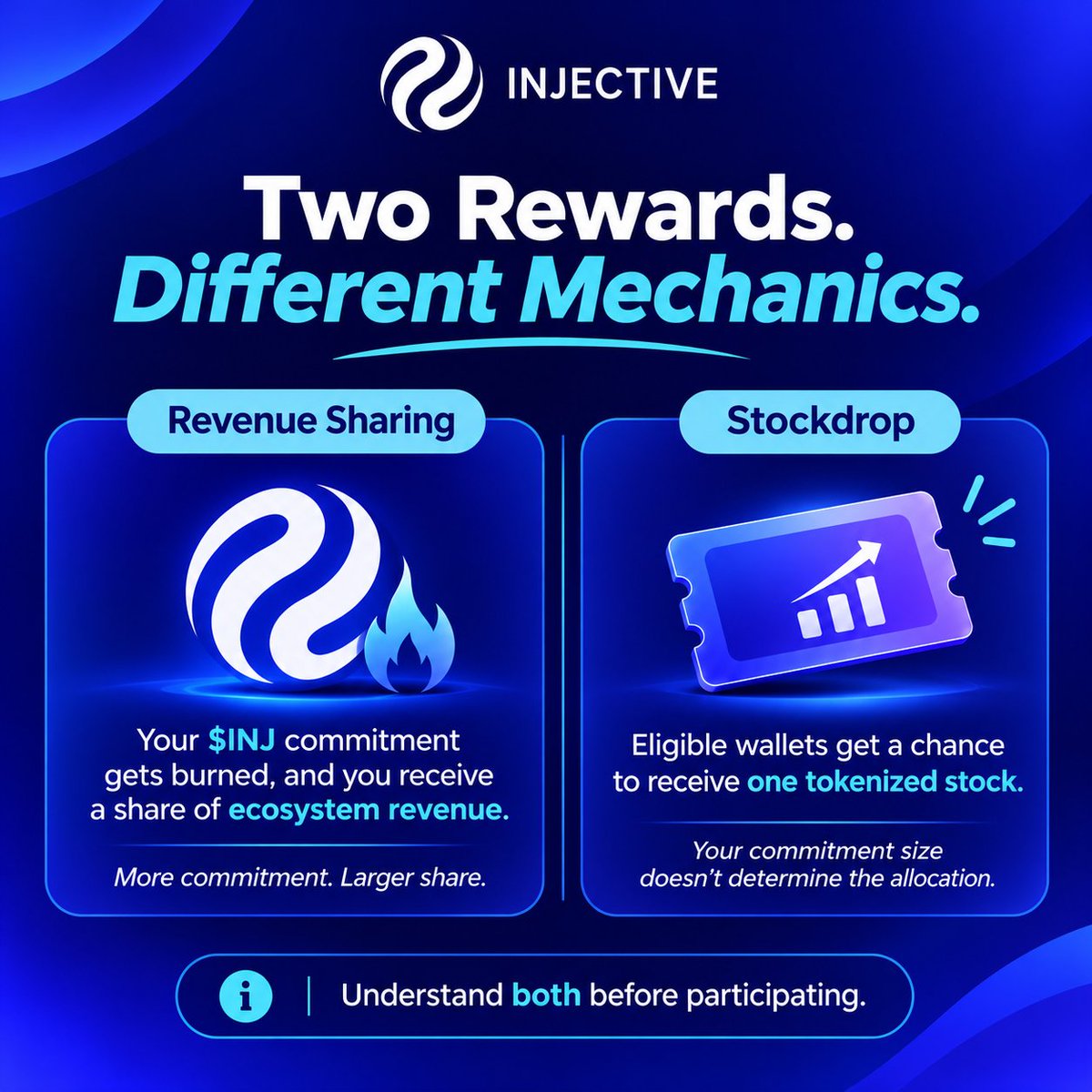
Most people see @injective's BuyBack as one reward. But there are actually two, and they work differently.
First, there's revenue sharing. You commit $INJ, it gets permanently burned, and you receive a proportional share of the ecosystem revenue. Commit more, receive a larger share.
Then there's Stockdrop. Eligible wallets have a chance to receive one tokenized stock, regardless of how much INJ they committed.
So committing 10 INJ or 10,000 INJ doesn't give you more stock allocations.
Previous Stockdrops have involved Robinhood Chain and Solana, with the November round continuing on Solana.
The important distinction?
Revenue sharing is proportional to your commitment. Stockdrop is an additional reward, not a guaranteed return.
If you're participating, understand the BuyBack for what it offers and treat any stock reward as a bonus.
@injective 6/6
The SEC proposed updates to its transfer agent rules in September, but they are still awaiting adoption.
This is another reminder that tokenizing assets also requires proper ownership records and clear regulatory rules.
Thread🧵
1/6
Putting a security onchain does not automatically tell you who owns it. There still needs to be an official record of every owner and any changes in ownership.
That's what transfer agents are responsible for in the US securities market.
@injective 5/6
Injective also has pre-IPO markets and ongoing privacy development.
Its pre-IPO perpetuals track estimated valuations of companies like SpaceX, Anthropic and OpenAI, not actual shares.
CypherOS: Meridian has shown an alpha demo, but isn't fully live yet.