🔥The Solidify Project� Zealy campaign is officially LIVE!
Complete engaging tasks, climb the leaderboard, and compete for your share of the massive $2,000 reward pool 💰⚡
✨ Earn points
🚀 Stay active
🏆 Become a qualified participant
Join the movement, dominate the leaderboard, and secure your spot among the top community members on Zealy.
https://t.co/iSXUHzexe1
🔥The Solidify Project� Zealy campaign is officially LIVE!
Complete engaging tasks, climb the leaderboard, and compete for your share of the massive $2,000 reward pool 💰⚡
✨ Earn points
🚀 Stay active
🏆 Become a qualified participant
Join the movement, dominate the leaderboard, and secure your spot among the top community members on Zealy.
https://t.co/iSXUHzexe1
Bitcoin assets have always felt hard to use for me. Too many steps.
Too many things to figure out.
While interacting with @Utexocom,
I came across Bitcoin Tribe Wallet, an #RGB wallet, and decided to try it out.
What stood out for me was the simple interface and how easy it is to move around it.
The seed phrase backup is clear, and it works on both iOS and Android, which makes it easy to access.
I also noticed @ArkLabsHQ, @Bitmask_App, @LnFinetwork, @Kaleidoswap, RGB Association and others already working in this direction, which made me more curious to explore.
So I put together this short motion to share the experience.
Still exploring, but this feels easier than what I’m used to.
Would you try it, or is Bitcoin still too complex right now? 🤔
@BitcoinTribe_@VIhnatiuk
Is $OP Undervalued Compared to Its Ecosystem Influence?
A common mistake investors make is valuing tokens purely by:
• Market cap
• Short-term hype
• Price action
But sometimes the real signal is infrastructure influence.
Optimism’s technology is now powering multiple chains.
And the list keeps growing.
Yet the token’s valuation often reflects only activity on the Optimism main chain.
This creates an interesting debate.
Should OP be valued based on:
A) Activity on Optimism only
or
B) Activity across the entire Superchain?
Because if the Superchain becomes massive, the economic footprint could be far larger than people expect.
Here’s a hypothetical example.
Chain A processes $5B in transactions
Chain B processes $8B
Chain C processes $12B
If all of them run on the OP Stack, the combined ecosystem becomes enormous.
But if the token captures little of that value, the market may ignore it.
So the real question is not just adoption.
It’s value capture.
And that’s what smart investors are watching closely.
Final question:
If the Superchain becomes the backbone of Ethereum scaling…
Does OP become one of the most important tokens in crypto, or just the governance layer behind the scenes?
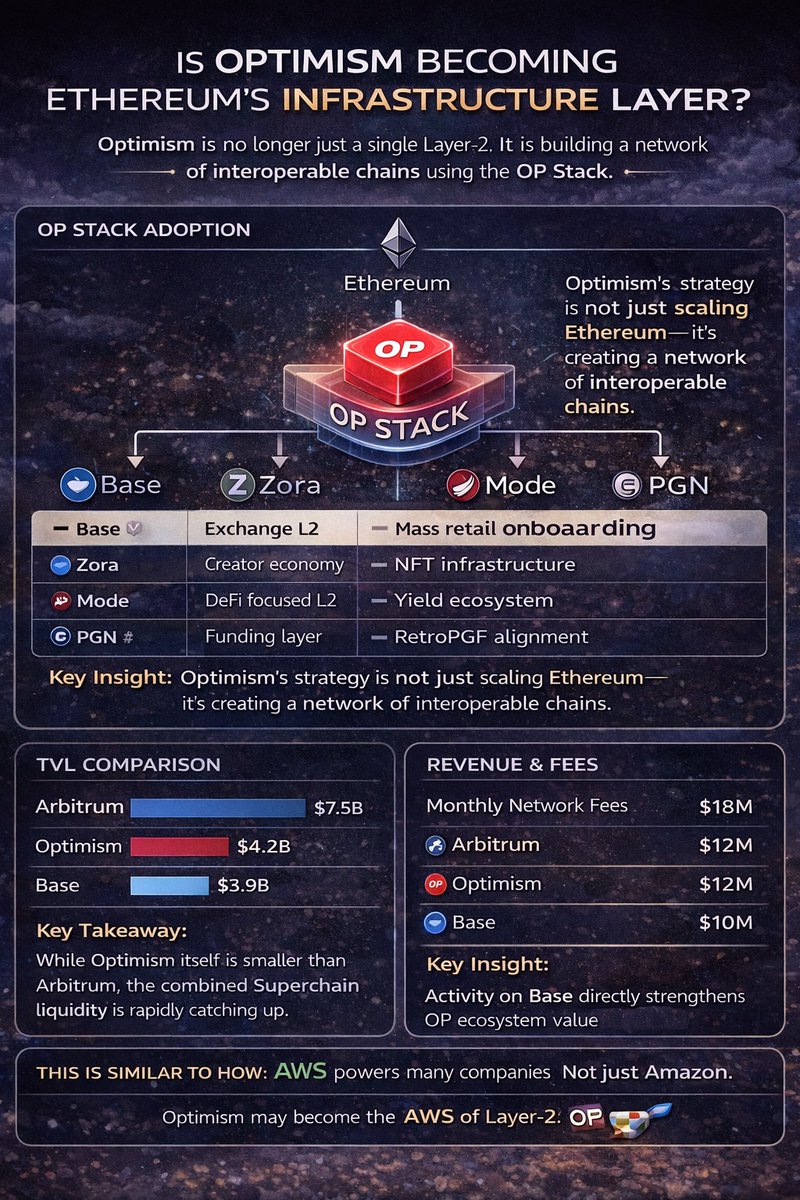
Why Optimism’s Strategy Is Different From Other L2s
Most Layer-2 networks are competing for three things:
• Liquidity
• Users
• Developers
The typical strategy is simple:
Launch incentives
Attract DeFi
Grow TVL
Optimism is doing something different.
Instead of trying to win alone, it’s expanding the total Layer-2 market.
The OP Stack allows other teams to launch their own chains while still contributing to the ecosystem.
This changes the competitive dynamic.
Instead of:
L2 vs L2
It becomes:
Superchain vs everyone else.
If dozens of projects adopt the OP Stack, Optimism’s influence scales far beyond its own chain.
This model is similar to what happened in tech.
Android became dominant not because Google built the best phone.
But because many companies used the Android operating system.
The same concept could apply here.
If the OP Stack becomes the default toolkit for launching L2s, Optimism wins regardless of which individual chain dominates.
But there’s a key question investors should ask.
If Base, Zora, and future chains generate billions in economic activity…
How much of that value flows back to OP holders?
That’s one of the biggest debates in crypto right now.
#DipAndEarnUp555%APR #WednesdayAirdrop #TradeGoldandSilver #ByXLeaderboard #FarmMNTonAlpha
$OP
Why Optimism’s Strategy Is Different From Other L2s
Most Layer-2 networks are competing for three things:
• Liquidity
• Users
• Developers
The typical strategy is simple:
Launch incentives
Attract DeFi
Grow TVL
Optimism is doing something different.
Instead of trying to win alone, it’s expanding the total Layer-2 market.
The OP Stack allows other teams to launch their own chains while still contributing to the ecosystem.
This changes the competitive dynamic.
Instead of:
L2 vs L2
It becomes:
Superchain vs everyone else.
If dozens of projects adopt the OP Stack, Optimism’s influence scales far beyond its own chain.
This model is similar to what happened in tech.
Android became dominant not because Google built the best phone.
But because many companies used the Android operating system.
The same concept could apply here.
If the OP Stack becomes the default toolkit for launching L2s, Optimism wins regardless of which individual chain dominates.
But there’s a key question investors should ask.
If Base, Zora, and future chains generate billions in economic activity…
How much of that value flows back to OP holders?
That’s one of the biggest debates in crypto right now.
#DipAndEarnUp555%APR #WednesdayAirdrop #TradeGoldandSilver #ByXLeaderboard #FarmMNTonAlpha
$OP
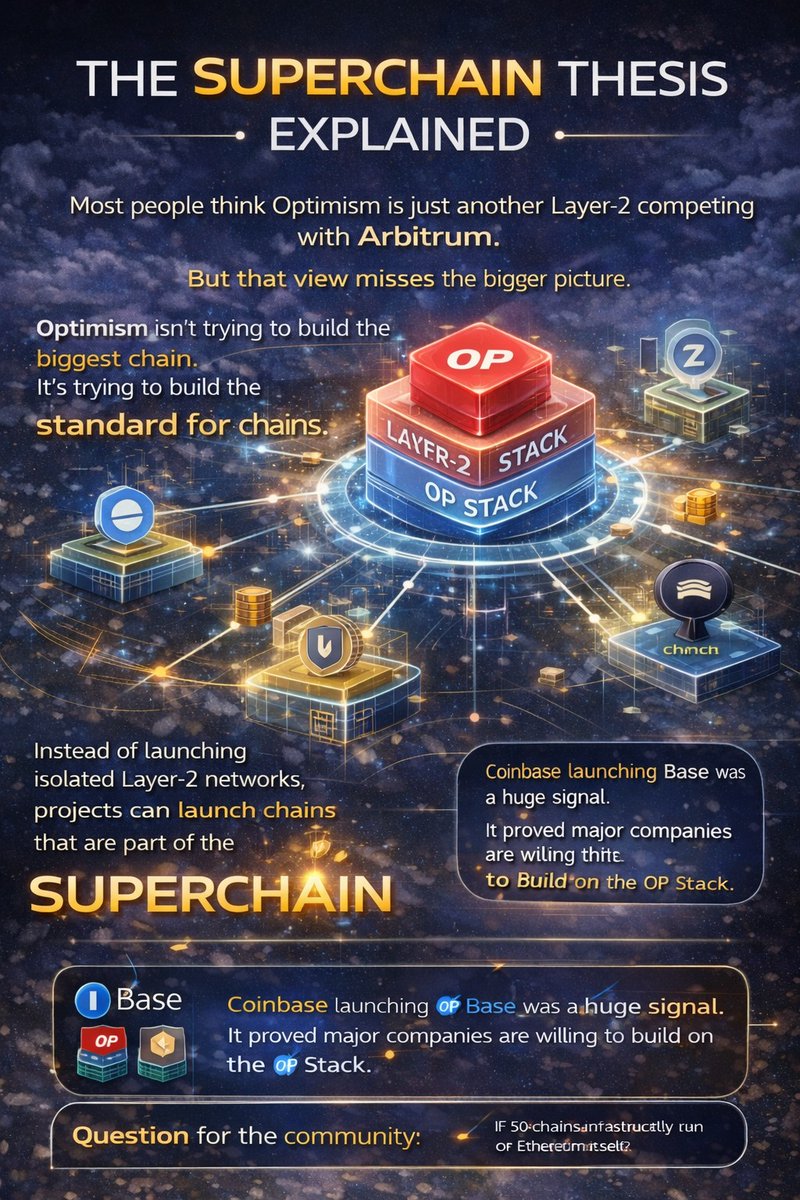
The Superchain Thesis Explained
Most people think Optimism is just another Layer-2 competing with Arbitrum.
But that view misses the bigger picture.
Optimism isn’t trying to build the biggest chain.
It’s trying to build the standard for chains.
This is where the OP Stack changes everything.
Instead of launching isolated Layer-2 networks, projects can launch chains that are part of the Superchain.
Think of it like Apple’s ecosystem.
Different devices.
Same operating system.
Shared infrastructure.
This means:
• Shared security
• Shared tooling
• Faster development
• Easier interoperability
And most importantly:
Network effects.
Every new chain strengthens the ecosystem.
Coinbase launching Base was a huge signal.
It proved major companies are willing to build on the OP Stack.
If this trend continues, Optimism may quietly become the infrastructure powering a large portion of Ethereum scaling.
The market is still trying to price this in.
Because valuing a single chain is easy.
Valuing an entire network of chains is much harder.
Question for the community:
If 50 chains eventually run on the OP Stack, should the market value Optimism like a blockchain… or like the infrastructure layer of Ethereum itself?
#DipAndEarnUp555%APR #WednesdayAirdrop #TradeGoldandSilver #ByXLeaderboard #FarmMNTonAlpha $OP
The Superchain Thesis Explained
Most people think Optimism is just another Layer-2 competing with Arbitrum.
But that view misses the bigger picture.
Optimism isn’t trying to build the biggest chain.
It’s trying to build the standard for chains.
This is where the OP Stack changes everything.
Instead of launching isolated Layer-2 networks, projects can launch chains that are part of the Superchain.
Think of it like Apple’s ecosystem.
Different devices.
Same operating system.
Shared infrastructure.
This means:
• Shared security
• Shared tooling
• Faster development
• Easier interoperability
And most importantly:
Network effects.
Every new chain strengthens the ecosystem.
Coinbase launching Base was a huge signal.
It proved major companies are willing to build on the OP Stack.
If this trend continues, Optimism may quietly become the infrastructure powering a large portion of Ethereum scaling.
The market is still trying to price this in.
Because valuing a single chain is easy.
Valuing an entire network of chains is much harder.
Question for the community:
If 50 chains eventually run on the OP Stack, should the market value Optimism like a blockchain… or like the infrastructure layer of Ethereum itself?
#DipAndEarnUp555%APR #WednesdayAirdrop #TradeGoldandSilver #ByXLeaderboard #FarmMNTonAlpha $OP
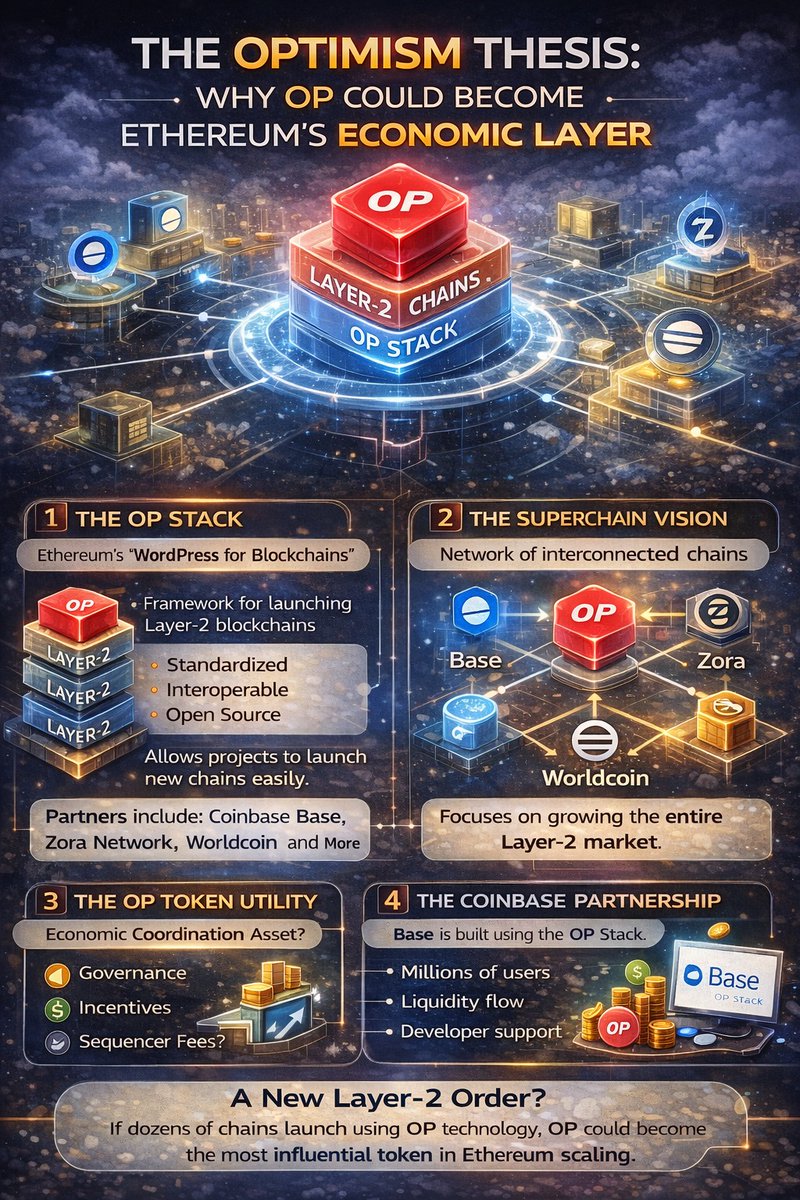
The Optimism Thesis: Why $OP Could Become Ethereum’s Economic Layer
Introduction
Over the last few years, Ethereum has faced a persistent challenge: scalability. As demand for decentralized finance, NFTs, gaming, and on-chain social networks increased, gas fees surged and transaction speeds slowed. The solution did not come from replacing Ethereum but from building on top of it.
This is where Layer-2 networks entered the picture.
Among them, Optimism has emerged as one of the most influential ecosystems shaping Ethereum’s scaling roadmap. While competitors such as Arbitrum, Base, and zk-rollups compete for liquidity and users, Optimism has taken a different approach — building a network of chains rather than a single chain.
At the center of this strategy is the OP Stack and the concept of the Superchain.
Instead of competing for a single dominant L2, Optimism is trying to become the infrastructure layer powering dozens of chains.
This article breaks down:
• What Optimism is
• Why the OP Stack matters
• How the Superchain could reshape Ethereum
• Tokenomics of OP
• Risks and opportunities for investors
1. What is Optimism?
Optimism is a Layer-2 scaling solution for Ethereum built using Optimistic Rollups.
Optimistic rollups bundle many transactions together and submit them to Ethereum as a single batch. This drastically reduces fees and increases throughput while maintaining Ethereum security.
Key benefits include:
• Lower gas fees
• Faster transactions
• Ethereum-level security
• Compatibility with Ethereum applications
Unlike some scaling solutions that require developers to rewrite code, Optimism is EVM equivalent, meaning developers can easily deploy Ethereum apps on it.
That simplicity has helped Optimism grow its ecosystem.
Today the network hosts:
• DeFi protocols
• NFT platforms
• Gaming ecosystems
• Social applications
• Infrastructure tools
But technology alone is not what makes Optimism unique.
Its economic vision is what sets it apart.
2. The OP Stack: Optimism’s Biggest Innovation
The OP Stack is essentially a framework for building Layer-2 blockchains.
Think of it as:
“Ethereum’s WordPress for blockchains.”
Instead of every project building its own blockchain from scratch, developers can launch chains using the OP Stack.
This is powerful for several reasons.
First, it dramatically lowers the cost of launching new networks.
Second, it standardizes infrastructure across chains.
Third, it allows different chains to interoperate easily.
This has led to the birth of the Superchain.
3. The Superchain Vision
Optimism is not trying to win as just another Layer-2.
It is attempting to create a network of interconnected chains.
This network is called the Superchain.
The idea is simple:
Many chains
Shared standards
Shared security
Shared infrastructure
Chains built on OP Stack contribute value back to the ecosystem.
Some major players already using the OP Stack include:
• Base (by Coinbase)
• Zora Network
• Worldcoin’s upcoming chain
• Several gaming and DeFi networks
If this model succeeds, Optimism does not just compete for users.
It becomes the infrastructure behind an entire ecosystem of blockchains.
That is a much bigger opportunity.
4. Optimism’s Ecosystem Growth
Optimism has grown rapidly across multiple metrics.
Total Value Locked (TVL)
TVL measures how much capital is deployed in DeFi protocols on the network.
Rising TVL indicates:
• Trust
• Liquidity
• User activity
Optimism’s TVL growth has been driven by:
• Velodrome
• Synthetix
• Aave
• Uniswap deployments
Liquidity incentives and ecosystem grants have also attracted developers.
Developer Activity
One of Optimism’s strongest advantages is developer traction.
More developers means:
• More applications
• More innovation
• More users
This is a critical metric for long-term success.
The Optimism Thesis: Why $OP Could Become Ethereum’s Economic Layer
Introduction
Over the last few years, Ethereum has faced a persistent challenge: scalability. As demand for decentralized finance, NFTs, gaming, and on-chain social networks increased, gas fees surged and transaction speeds slowed. The solution did not come from replacing Ethereum but from building on top of it.
This is where Layer-2 networks entered the picture.
Among them, Optimism has emerged as one of the most influential ecosystems shaping Ethereum’s scaling roadmap. While competitors such as Arbitrum, Base, and zk-rollups compete for liquidity and users, Optimism has taken a different approach — building a network of chains rather than a single chain.
At the center of this strategy is the OP Stack and the concept of the Superchain.
Instead of competing for a single dominant L2, Optimism is trying to become the infrastructure layer powering dozens of chains.
This article breaks down:
• What Optimism is
• Why the OP Stack matters
• How the Superchain could reshape Ethereum
• Tokenomics of OP
• Risks and opportunities for investors
1. What is Optimism?
Optimism is a Layer-2 scaling solution for Ethereum built using Optimistic Rollups.
Optimistic rollups bundle many transactions together and submit them to Ethereum as a single batch. This drastically reduces fees and increases throughput while maintaining Ethereum security.
Key benefits include:
• Lower gas fees
• Faster transactions
• Ethereum-level security
• Compatibility with Ethereum applications
Unlike some scaling solutions that require developers to rewrite code, Optimism is EVM equivalent, meaning developers can easily deploy Ethereum apps on it.
That simplicity has helped Optimism grow its ecosystem.
Today the network hosts:
• DeFi protocols
• NFT platforms
• Gaming ecosystems
• Social applications
• Infrastructure tools
But technology alone is not what makes Optimism unique.
Its economic vision is what sets it apart.
2. The OP Stack: Optimism’s Biggest Innovation
The OP Stack is essentially a framework for building Layer-2 blockchains.
Think of it as:
“Ethereum’s WordPress for blockchains.”
Instead of every project building its own blockchain from scratch, developers can launch chains using the OP Stack.
This is powerful for several reasons.
First, it dramatically lowers the cost of launching new networks.
Second, it standardizes infrastructure across chains.
Third, it allows different chains to interoperate easily.
This has led to the birth of the Superchain.
3. The Superchain Vision
Optimism is not trying to win as just another Layer-2.
It is attempting to create a network of interconnected chains.
This network is called the Superchain.
The idea is simple:
Many chains
Shared standards
Shared security
Shared infrastructure
Chains built on OP Stack contribute value back to the ecosystem.
Some major players already using the OP Stack include:
• Base (by Coinbase)
• Zora Network
• Worldcoin’s upcoming chain
• Several gaming and DeFi networks
If this model succeeds, Optimism does not just compete for users.
It becomes the infrastructure behind an entire ecosystem of blockchains.
That is a much bigger opportunity.
4. Optimism’s Ecosystem Growth
Optimism has grown rapidly across multiple metrics.
Total Value Locked (TVL)
TVL measures how much capital is deployed in DeFi protocols on the network.
Rising TVL indicates:
• Trust
• Liquidity
• User activity
Optimism’s TVL growth has been driven by:
• Velodrome
• Synthetix
• Aave
• Uniswap deployments
Liquidity incentives and ecosystem grants have also attracted developers.
Developer Activity
One of Optimism’s strongest advantages is developer traction.
More developers means:
• More applications
• More innovation
• More users
This is a critical metric for long-term success.
The Battle for Layer-2 Dominance Has Already Started
Most people still think the Layer-2 race is just beginning.
In reality, it is already well underway.
Several ecosystems are competing to become the primary execution layer for Ethereum.
Among the leaders are:
Arbitrum
Optimism
Polygon
Starknet
Each is taking a different strategic approach.
Arbitrum is focusing on DeFi liquidity and developer friendliness.
Optimism is building a network of interconnected chains known as the Superchain.
Polygon is investing heavily in zero-knowledge technology and enterprise partnerships.
Starknet is pushing cutting-edge cryptography that could dramatically improve scalability.
The outcome of this competition will shape the entire Ethereum ecosystem.
In many ways, this race resembles the early internet era.
Multiple platforms compete for users, developers, and capital.
Some will thrive.
Others may fade into history.
For investors, the opportunity lies in identifying which ecosystems are building real economic activity rather than temporary hype.
Because once a network reaches critical mass, its growth can become exponential.
And by the time the broader market realizes it, the biggest gains may already have happened.
So the real question is:
Which Layer-2 network will dominate the next phase of crypto adoption?
And more importantly…
Are we still early enough to benefit from it?
#DipAndEarnUp555%APR #WednesdayAirdrop #TradeGoldandSilver #ByXLeaderboard #FarmMNTonAlpha
$ARBUSDC
A Simple Framework for Evaluating Layer-2 Tokens
The Layer-2 sector has become one of the most competitive areas in crypto.
Every new project claims faster speeds, lower fees, and revolutionary technology.
But investors need a simple framework to separate hype from substance.
Here are four metrics that can reveal the real strength of a Layer-2 network.
1. Economic Activity
Look beyond TVL.
Ask how often people are actually using the chain.
High transaction counts usually indicate real adoption.
2. Revenue Generation
Networks that consistently generate fees demonstrate that users find them valuable.
Sustainable revenue is one of the strongest signals of long-term viability.
3. Developer Growth
The number of applications being built on a network often predicts future adoption.
Developers are the lifeblood of any ecosystem.
4. Liquidity Stability
A healthy ecosystem maintains liquidity even during market downturns.
Temporary spikes can be misleading.
When applying this framework to projects like Arbitrum and Optimism, interesting patterns begin to appear.
Both networks have strong developer ecosystems, but their growth strategies differ.
Arbitrum has focused heavily on DeFi liquidity.
Optimism is pushing an ambitious Superchain vision, partnering with major platforms to expand its reach.
The competition between these ecosystems could shape the future of Ethereum scaling.
For investors, understanding these fundamentals can provide a significant edge.
Because in crypto, narratives may drive short-term prices — but fundamentals tend to win over time.
#DipAndEarnUp555%APR #WednesdayAirdrop #TradeGoldandSilver #ByXLeaderboard #FarmMNTonAlpha
$ARBUSDC
A Simple Framework for Evaluating Layer-2 Tokens
The Layer-2 sector has become one of the most competitive areas in crypto.
Every new project claims faster speeds, lower fees, and revolutionary technology.
But investors need a simple framework to separate hype from substance.
Here are four metrics that can reveal the real strength of a Layer-2 network.
1. Economic Activity
Look beyond TVL.
Ask how often people are actually using the chain.
High transaction counts usually indicate real adoption.
2. Revenue Generation
Networks that consistently generate fees demonstrate that users find them valuable.
Sustainable revenue is one of the strongest signals of long-term viability.
3. Developer Growth
The number of applications being built on a network often predicts future adoption.
Developers are the lifeblood of any ecosystem.
4. Liquidity Stability
A healthy ecosystem maintains liquidity even during market downturns.
Temporary spikes can be misleading.
When applying this framework to projects like Arbitrum and Optimism, interesting patterns begin to appear.
Both networks have strong developer ecosystems, but their growth strategies differ.
Arbitrum has focused heavily on DeFi liquidity.
Optimism is pushing an ambitious Superchain vision, partnering with major platforms to expand its reach.
The competition between these ecosystems could shape the future of Ethereum scaling.
For investors, understanding these fundamentals can provide a significant edge.
Because in crypto, narratives may drive short-term prices — but fundamentals tend to win over time.
#DipAndEarnUp555%APR #WednesdayAirdrop #TradeGoldandSilver #ByXLeaderboard #FarmMNTonAlpha
$ARBUSDC
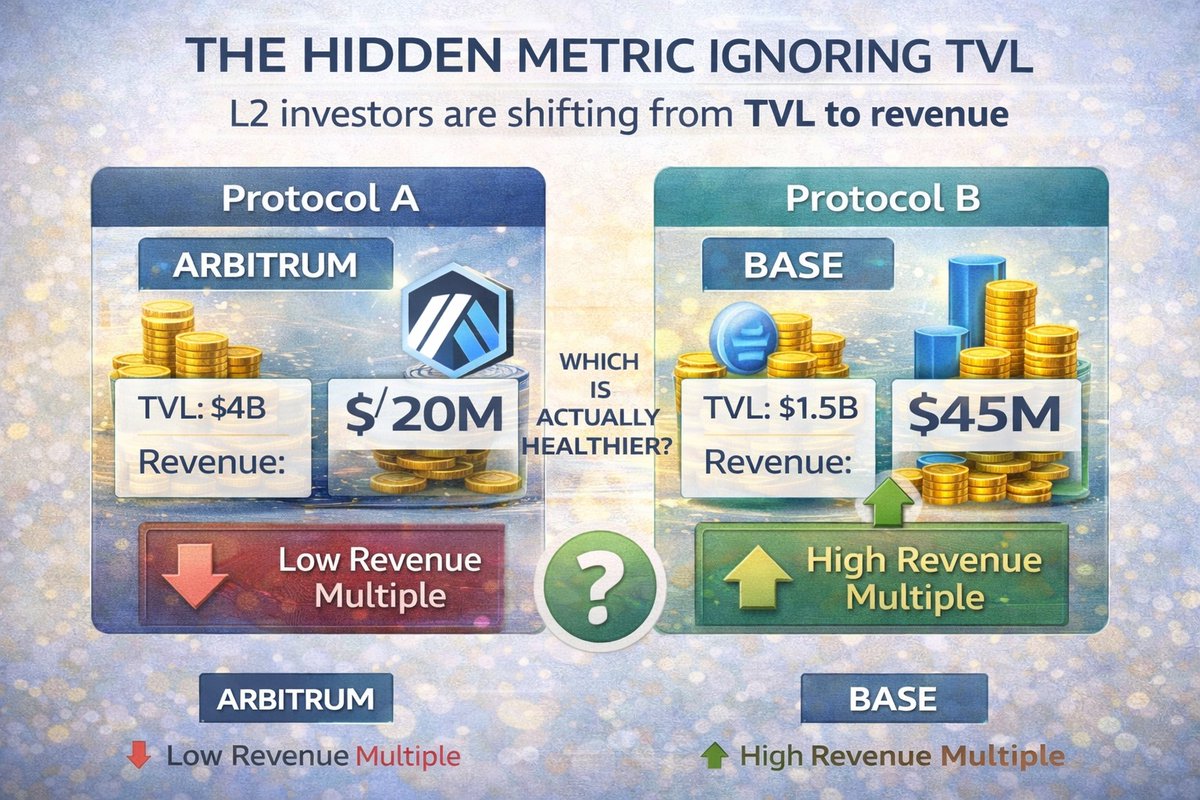
The Hidden Metric Most Crypto Investors Ignore
When analyzing Layer-2 networks, most investors focus on flashy numbers:
• Total Value Locked
• Token price
• Market cap
• social media hype
But these metrics often hide the real story.
A much more important metric is revenue generation.
Think about how traditional businesses are evaluated.
Investors ask questions like:
How much money does the company make?
Is revenue growing?
Is the business sustainable?
Crypto is slowly moving toward the same analytical framework.
Let’s use Layer-2 networks as an example.
A chain might boast billions in TVL, but if users are not actively transacting, that liquidity does not necessarily translate into economic activity.
Another network might have lower TVL but generate far more fees because people actually use it daily.
This is why analysts are beginning to track Market Cap to Revenue ratios.
If a protocol generates large revenue relative to its valuation, it might be undervalued.
If a protocol has a huge valuation but little revenue, it may be driven purely by speculation.
In the case of Arbitrum, the network consistently ranks among the most active Layer-2 ecosystems.
Transactions, DeFi activity, and liquidity movement all contribute to fee generation.
But the debate continues.
Should crypto investors begin valuing networks the same way they value technology companies?
Or is crypto fundamentally different?
Because if traditional valuation models eventually dominate the space, some of today’s most overlooked tokens might become tomorrow’s biggest winners.
And many investors are positioning themselves before that shift happens.
#DipAndEarnUp555%APR #WednesdayAirdrop #TradeGoldandSilver #ByXLeaderboard #FarmMNTonAlpha
$ARBUSDC
The Hidden Metric Most Crypto Investors Ignore
When analyzing Layer-2 networks, most investors focus on flashy numbers:
• Total Value Locked
• Token price
• Market cap
• social media hype
But these metrics often hide the real story.
A much more important metric is revenue generation.
Think about how traditional businesses are evaluated.
Investors ask questions like:
How much money does the company make?
Is revenue growing?
Is the business sustainable?
Crypto is slowly moving toward the same analytical framework.
Let’s use Layer-2 networks as an example.
A chain might boast billions in TVL, but if users are not actively transacting, that liquidity does not necessarily translate into economic activity.
Another network might have lower TVL but generate far more fees because people actually use it daily.
This is why analysts are beginning to track Market Cap to Revenue ratios.
If a protocol generates large revenue relative to its valuation, it might be undervalued.
If a protocol has a huge valuation but little revenue, it may be driven purely by speculation.
In the case of Arbitrum, the network consistently ranks among the most active Layer-2 ecosystems.
Transactions, DeFi activity, and liquidity movement all contribute to fee generation.
But the debate continues.
Should crypto investors begin valuing networks the same way they value technology companies?
Or is crypto fundamentally different?
Because if traditional valuation models eventually dominate the space, some of today’s most overlooked tokens might become tomorrow’s biggest winners.
And many investors are positioning themselves before that shift happens.
#DipAndEarnUp555%APR #WednesdayAirdrop #TradeGoldandSilver #ByXLeaderboard #FarmMNTonAlpha
$ARBUSDC
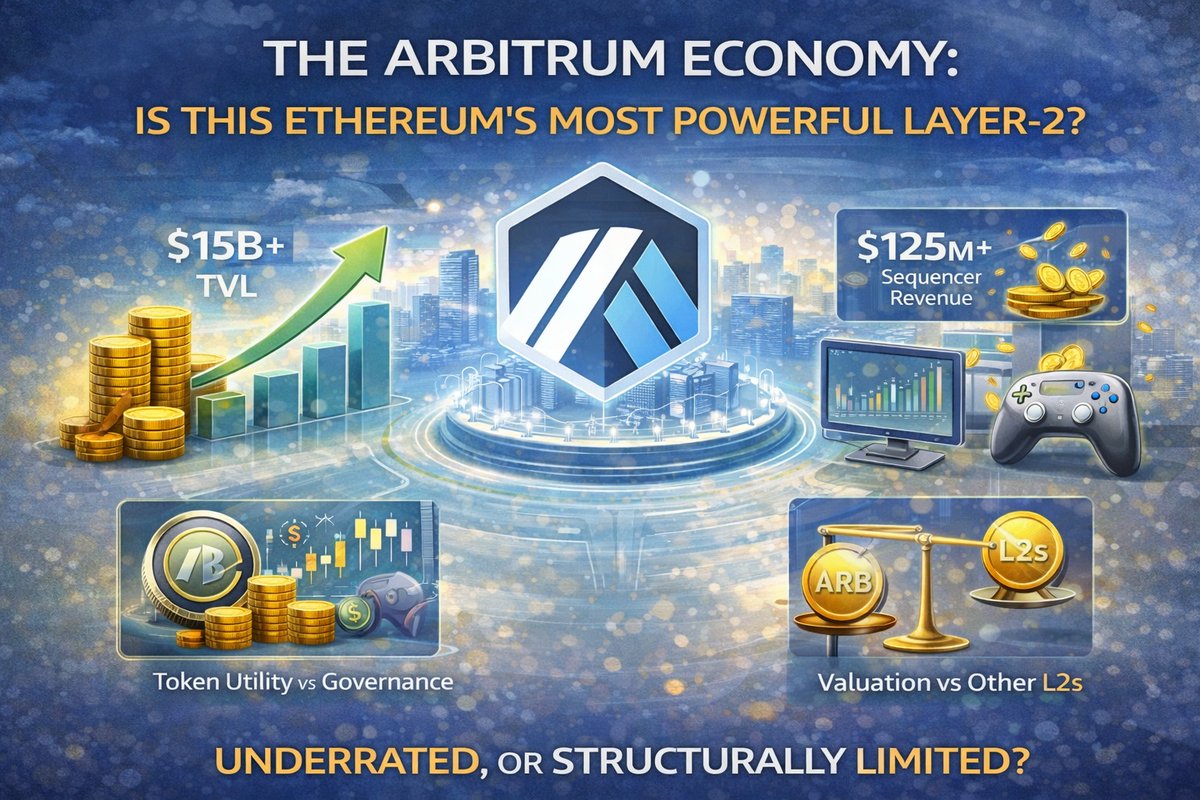
THE ARBITRUM ECONOMY: Is it Ethereum most powerful L2?
The Ethereum ecosystem has entered a new phase.
For years the biggest challenge facing Ethereum was scalability. High gas fees, slow confirmations, and congestion made everyday usage difficult. While Ethereum remained the most secure smart-contract platform, it struggled to scale to global demand.
This is where Layer-2 networks came in.
Layer-2s promised to inherit Ethereum’s security while dramatically improving speed and reducing transaction costs. Over the last few years dozens of projects have attempted to solve this problem, but only a few have emerged as serious contenders.
Among them, Arbitrum has built one of the largest on-chain economies in crypto.
But the real question investors are asking today is not about technology anymore.
It is about value capture.
Does the success of the Arbitrum ecosystem actually translate into value for the ARB token, or is the token simply governance without economic backing?
This article explores Arbitrum’s growth, revenue generation, competitive position, and whether the market is currently undervaluing its potential.
THE RISE OF LAYER-2 ECONOMICS
To understand Arbitrum’s position, we must first understand how the Layer-2 landscape evolved.
In the early days of crypto, blockchains were judged mainly by:
• transaction speed
• decentralization
• security
But as decentralized finance exploded during the 2020-2021 bull market, a new metric emerged:
Total Value Locked (TVL).
TVL represented the amount of assets deposited across DeFi protocols on a network.
When DeFi boomed, Ethereum fees became extremely expensive. This created a massive opportunity for Layer-2 solutions.
Projects like:
Arbitrum
Optimism
Polygon
began attracting liquidity and developers looking for cheaper alternatives.
Among them, Arbitrum quickly established itself as a dominant force.
WHAT MAKES ARBITRUM DIFFERENT
Arbitrum is built using Optimistic Rollup technology, which processes transactions off-chain and posts compressed data back to Ethereum.
This allows the network to achieve:
• lower fees
• faster confirmations
• Ethereum-level security
But technology alone does not build an ecosystem.
What made Arbitrum special was its developer-first approach.
Instead of trying to force new programming models, Arbitrum remained extremely compatible with Ethereum tools. Developers could migrate applications easily without rewriting their code.
This created a powerful flywheel:
More developers → more applications → more liquidity → more users.
Over time Arbitrum became home to some of the most important DeFi protocols in crypto.
ARBITRUM ECOSYSTEM GROWTH
The Arbitrum ecosystem includes a wide range of sectors:
DeFi
Major decentralized exchanges, lending markets, and derivatives platforms operate on Arbitrum.
This liquidity attracts traders seeking lower fees compared to Ethereum mainnet.
Gaming
Blockchain gaming projects are increasingly choosing Layer-2s to avoid expensive transactions.
Arbitrum has become one of the preferred destinations.
Infrastructure
Bridges, oracles, and developer tools have matured significantly on the network.
This makes building new applications easier than ever.
Stablecoin Activity
Stablecoins play a massive role in DeFi ecosystems. Arbitrum’s growing stablecoin liquidity has helped stabilize its financial infrastructure.
All these components together form a self-sustaining economic environment rather than a simple scaling solution.
$ARBUSDT