🚀 A must-join knowledge hub for GUI Agent builders
Building GUI Agents today is noisy.
Papers explode, products iterate weekly, and real signal is hard to track.
That’s exactly why WebAgentLab exists.
An open-source community focused on GUI Agents, with 5,000+ members across academia and industry.
More than a knowledge base — it’s a collaborative brain for the GUI Agent era:
🔹 Curated industry briefs (daily → weekly → monthly)
🔹 Structured paper database to spot trends fast
🔹 Top conference guides & global event radar
🔹 GUI Agent product landscape & hands-on evaluations
🔹 Open-source collaboration toward industry standards
🔹 High-signal job matching inside the core circle
If you’re building, researching, or betting on GUI Agents
this is where the signal lives, not the noise.
Feishu knowledge base
https://t.co/EoEnijFDvX
follow us on Xiaohongshu (RED)
Today, we're releasing SolidWorks-Bench: can AI models do real mechanical engineering tasks in SolidWorks?
Models get close on individual parts but struggle to assemble them. No model completes a single machine.
Fable 5.2 leads with a 57% mean reward.
Full report below
1/ We measured with Scale AI how well computer-use agents work on each OS, and where they fail today.
On Omarchy, Cua Driver lets an agent work while you keep typing: 97% of trials left your keyboard, mouse and windows alone, vs 83% on macOS, 41% on Windows and 40% on Ubuntu.
🚀 Excited to unveil PrismaCoder: our latest push in Multimodal Code Intelligence!
We built the largest-ever visual-coding dataset (2M!) and trained open-source models that rival Claude Opus 4.6 & Gemini 3.1 Pro. 🔥
All data, models & code are open! 👇
🏠 Homepage: https://t.co/mlEmmNvBWu
🤗 HF: https://t.co/veH03OCkGO
Microsoft Research's WildAWM
A scalable pipeline that synthesizes executable computer-use agent environments and tasks using only open-source models, yielding 341 long-horizon env-task pairs and Qwen agents that generalize to 8 unseen benchmarks.
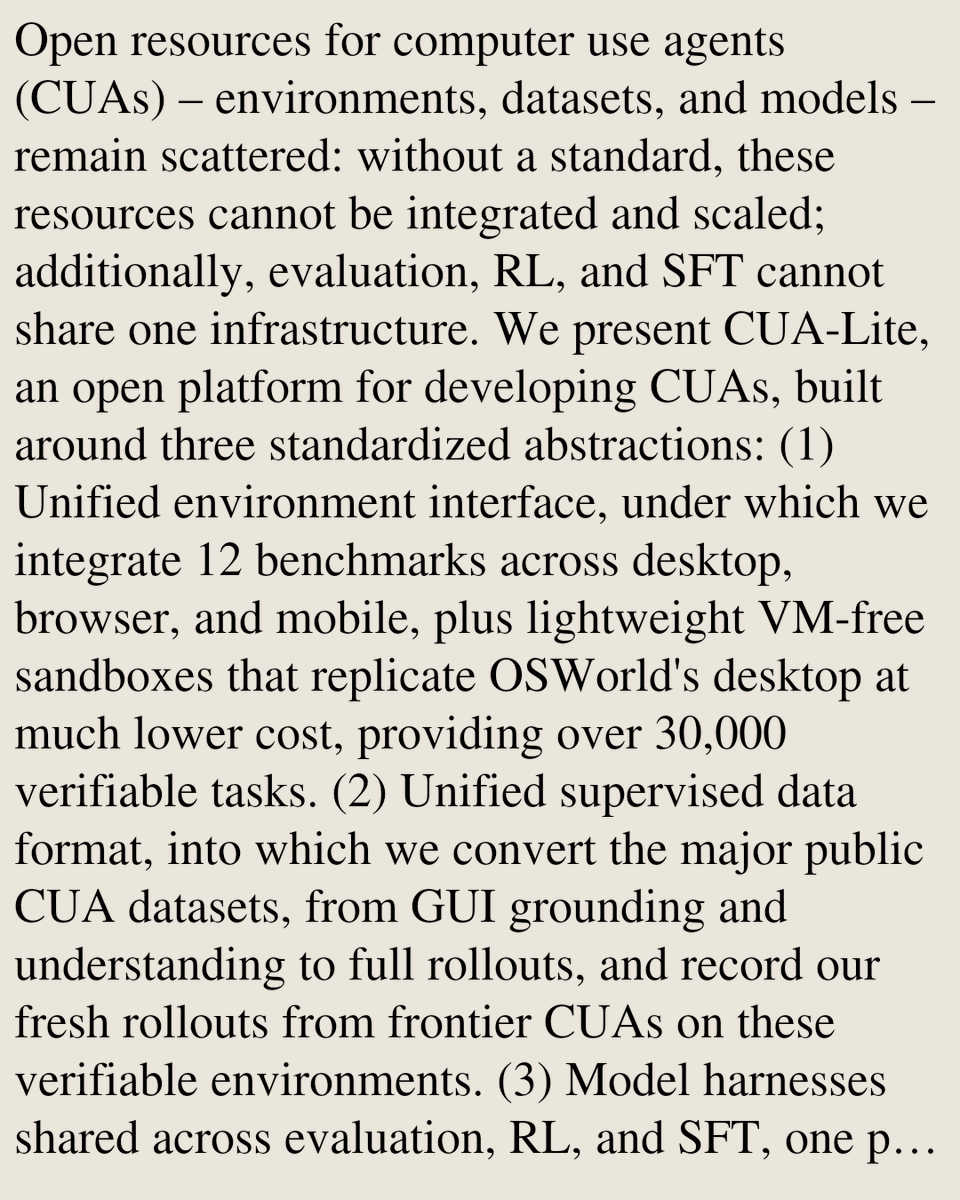
CUA-Lite: An Open Platform for Computer Use Agents
Zhanhui Zhou, Weichen Zhang, Haoran Liu, Lingjie Chen, Tianneng Shi, Kevin Lin, Zhengyuan Yang, Lijuan Wang, Dawn Song
https://t.co/CiuMpWcVfX [𝚌𝚜.𝙰𝙸]
People long believed in human-like computer use. But software (even terminals) is built for humans, not AI agents. Why not let agents build their own?
Meet 𝗔𝗴𝗲𝗻𝘁 𝗦𝟰, an agent scientist evolving its own interfaces, letting an open 27B model beats GPT-5.5 & Opus 4.8.
With its evolved interfaces, the same model improves 𝟯.𝟴× and costs <𝟱% as much per task as either frontier model.
Agents today read screenshots and act through click, scroll, type, maybe a shell. So an agent fills a spreadsheet cell by cell when one line of code would do, or prints two thousand lines of a file to find one function.
Every new app or model release means a human reads trajectories, diagnoses failures, and hand-writes new primitives. Skill-distillation methods can reorder what the interface allows, but they can’t extend it. Agents compensate with more test-time compute instead of a better interface.
𝗠𝗼𝗱𝗲𝗹𝘀 𝗶𝗺𝗽𝗿𝗼𝘃𝗲; 𝗶𝗻𝘁𝗲𝗿𝗳𝗮𝗰𝗲𝘀 𝘀𝘁𝗮𝘆 𝗳𝗿𝗼𝘇𝗲𝗻.
“We want AI agents that can discover like we can, not which contain what we have discovered.”
— Rich Sutton, The Bitter Lesson
Hand-designed interfaces are what we have discovered. Agents can read their own trajectories, spot what’s missing, and write and test code. 𝗜𝗻𝘁𝗲𝗿𝗳𝗮𝗰𝗲 𝗱𝗲𝘀𝗶𝗴𝗻 𝘀𝗵𝗼𝘂𝗹𝗱 𝗯𝗲 ��𝗻 𝗮𝗴𝗲𝗻𝘁 𝗰𝗮𝗽𝗮𝗯𝗶𝗹𝗶𝘁𝘆.
That’s what Agent S4 does.
Agent S4 makes a 𝗿𝗲𝗽𝗼𝘀𝗶𝘁𝗼𝗿𝘆 𝗼𝗳 𝗶𝗻𝘁𝗲𝗿𝗳𝗮𝗰𝗲𝘀 𝗮𝗻𝗱 𝘂𝘀𝗮𝗴𝗲 𝗸𝗻𝗼𝘄𝗹𝗲𝗱𝗴𝗲 the unit of evolution. A task agent attempts synthetic tasks with no success labels or verifiers. A meta-agent studies the trajectories, forms hypotheses about which actions, observations, or knowledge would help, and builds descendants through mutation or crossover. Validation tasks the meta-agent never sees decide which repositories survive.
The model and harness stay fixed, and the meta-agent 𝗻𝗲𝘃𝗲𝗿 𝘀𝗲𝗲𝘀 𝗮 𝗯𝗲𝗻𝗰𝗵𝗺𝗮𝗿𝗸 𝘁𝗮𝘀𝗸. 𝗢𝗻𝗹𝘆 𝘁𝗵𝗲 𝗶𝗻𝘁𝗲𝗿𝗳𝗮𝗰𝗲 𝗲𝘃𝗼𝗹𝘃𝗲𝘀.
With the evolved repository, Qwen3.8-27B goes from 𝟱.𝟲% to 𝟮𝟭.𝟯% on OSWorld V2, 𝟯.𝟴× the same model with fixed interfaces and a new state of the art for open-source computer-use agents.
It beats GPT-5.5 (13.0%, $25.50/task) and edges past Opus 4.8 (20.6%, $72.40/task) at $𝟭.𝟭𝟬 per task.
On ScienceBoard, the same model goes from 41.4% to 58.6%.
The analysis is the more interesting part. Evolution mostly deepens interfaces the agent already has: 4 new interfaces and 127 extensions. Give the meta-agent a scratch VM to test its code, and it builds 12 new interfaces and 253 extensions, reaching music scores, audio projects, and 3D scenes. The best repository came from crossing two earlier branches.
In one case study, the seed agent hand-builds a browser client mid-task and debugs through failure after failure; the evolved agent calls page_text and reaches the same message at tool call 𝟭𝟭 instead of 𝟯𝟳.
Human-like computer use was a starting point, not the destination. The interface an agent acts through is a second axis of improvement, beyond better models and harnesses, and agents can now design it themselves. 𝗘𝘃𝗼𝗹𝘃𝗶𝗻𝗴 𝗮𝗴𝗲𝗻𝘁 𝗶𝗻𝘁𝗲𝗿𝗳𝗮𝗰𝗲𝘀 𝗶𝘀 𝗮 𝗻𝗲𝘄 𝗱𝗶𝗺𝗲𝗻𝘀𝗶𝗼𝗻 𝗼𝗳 ���𝗴𝗲𝗻𝘁 𝘀𝗲𝗹𝗳-𝗶𝗺𝗽𝗿𝗼𝘃𝗲𝗺𝗲𝗻𝘁.
Computer use and browser use toolsets are now built into the Python and TypeScript SDKs for Claude.
The API tells you what Claude wants to click or type.
Previously, you had to write your own loop and map clicks and keystrokes to commands, but the SDKs now run the loop and send actions to drivers.
1/ Today we're announcing the stable Cua Driver release for Omarchy - a new foundation for computer use, built into the OS from the ground up.
Over the last month, we worked directly with @dhh, @SpencerGBull and @vaxryy to bring a native synthetic cursor to Omarchy's Hyprland compositor, enabling true multi-cursor computer use at the OS level.
Cua Driver is open source and available at https://t.co/0R5fWjfpGg
1/ You can now run OSWorld tasks on Cua Cloud Fleets. Our new guide shows how to turn the official OSWorld Ubuntu image into a Fleet desktop with Cua Driver, then run your agent and evaluate the tasks.
Get started: https://t.co/T3Xx7ZcasW
There is no benchmark tells you if your agent could resolve your mechanical CAD design in accurate, editable, reliable, efficiently.
We designed the benchmark CADWORLD from professional prospective that really focused on the engineers workflow. https://t.co/a4Km2kzoXG
We just raised $5.7M for @PolarBrowser, the AI browser that beats Anthropic and OpenAI on every major web agent benchmark.
- 4,500,000+ actions taken for users, automating sales, recruiting, and ops
- One company cancelled Clay and saves 25+ hrs/wk per person
- Team is from MIT, YC, Prod, Citadel, Jane Street, Perplexity, Modal, and Apple
100 hours of work. From 30 seconds of typing.
Download the world's most powerful AI browser: https://t.co/lUOm01Stm0
New blog post: What's the Point of Computer Use Agents?
There's been a lot of hype about CUAs recently. But where do CUAs shine? When should we use CUAs over API- or text-based agents?
And what are the remaining research problems?
https://t.co/7os4wHBbsd
Introducing ApprenticeBench: computer use + continual learning on a real job.
We show Fable 5.1 and GPT-6 Astra can now continually learn on a job and surpass human professionals. A decisive step change in AI's job readiness.
No FDEs. Agents deploy themselves into the job. 🧵
Watch Fable 5.1 agent onboards itself in the accounts payable department at a simulated California-based construction company.
Learn the ERP system, conventions from company history, and lifelong learning from feedback.
A glimpse into what the future of work may look like.
35 of the 88 RSI-Exam tasks are now public! 🎉
We’re continuously expanding RSI-Exam and always welcome new contributors across fields.
Bring a challenging task from your own research area:
🔗 https://t.co/n1zf35CpH8