My Running Journal 019–020 | Already at Run No. 20 / Still Need to Stick to “Gentle Runs” / Production Tools Must Never Fail
🚩On the morning of December 20, at the track of Hunan Normal University in Changsha, I completed my 19th outdoor run since starting the Journey (10 km).
In Run No. 17, I deliberately chased pace. Run No. 18 was all about a gentle run. Today, Run No. 19 was also a gentle run, so my knee joints could recover better.
Throughout the run, I kept reminding myself to stay steady and slow—never rush the pace.
The numbers looked pretty good: my heart rate stayed mostly in Zone 2, with an average pace of 6′15″ and an average cadence of 182 steps per minute.
That tells me my running condition is already quite stable.
/
For this run, I reset the voice alerts on my Apple Watch, so it would prompt me on several metrics at the same time: distance, heart-rate zone, pace, and cadence. For example: when my heart rate drops below my target zone, it gives me a voice prompt; once I get back into the target zone, it notifies me again.
This voice-alert feature is genuinely useful—like having a “personal coach” giving me real-time guidance.
The data came out this well largely thanks to the watch.
/
After the run, when I wrote this log, I used ChatGPT voice input directly: I said everything I wanted to say in one go, and once ChatGPT finished listening to the whole recording, it transcribed it into text all at once. This works much better than what I used before.
Before, I used Doubao’s voice input plus Get Notes. That workflow converts speech to text while you’re talking, but only one sentence at a time. It can’t transcribe a full paragraph in one shot; the accuracy is average, and the sentence breaks are terrible.
Next, I want to really explore the value of this capability in ChatGPT.
/
Last night, I ate half a salted-and-spiced duck. Even after rinsing it three times with warm water, it was still heavily seasoned—spicy and salty—and probably full of additives. I woke up in the middle of the night with stomach pain.
This morning I still didn’t feel great, and it affected today’s run.
Diet is just as important as training—if not more so—when it comes to health.
A lot of so-called “local specialties” are basically extreme foods: too salty / too sweet / too spicy / loaded with additives. Better to eat less of them—or simply avoid them.
——
——
🚩On the morning of December 22, at the track of Hunan Normal University in Changsha, I completed my 20th outdoor run since starting the Journey (10 km).
Already at Run No. 20…
I started outdoor running on November 14. Since then, I’ve consistently followed the rhythm of “exercise every other day—run one day, rest the next.”
Ever since Run No. 17, when I deliberately pushed the pace and set a new PB, over the past few days I’ve been occasionally feeling pain around my knee.
That’s an important reminder, and I’m taking it seriously. So in the next few runs, I’ve kept reminding myself to slow down, stay steady, and keep things as gentle as possible.
During this run, I could feel a slight knee pain again. Looks like I still need to stick with gentle training for now.
It reminds me of last year when I started building my indoor cycling habit. Early on, I also dealt with knee pain. I didn’t quit—I kept training at a controlled intensity, and eventually my body fully adapted.
I haven’t run much for years, and now that I’m rebuilding the habit, I may be going through the same adaptation process. For now, the key is to keep the rhythm and train consistently within a reasonable range.
/
It was cloudy today, but not very cold, and the whole run felt fairly relaxed.
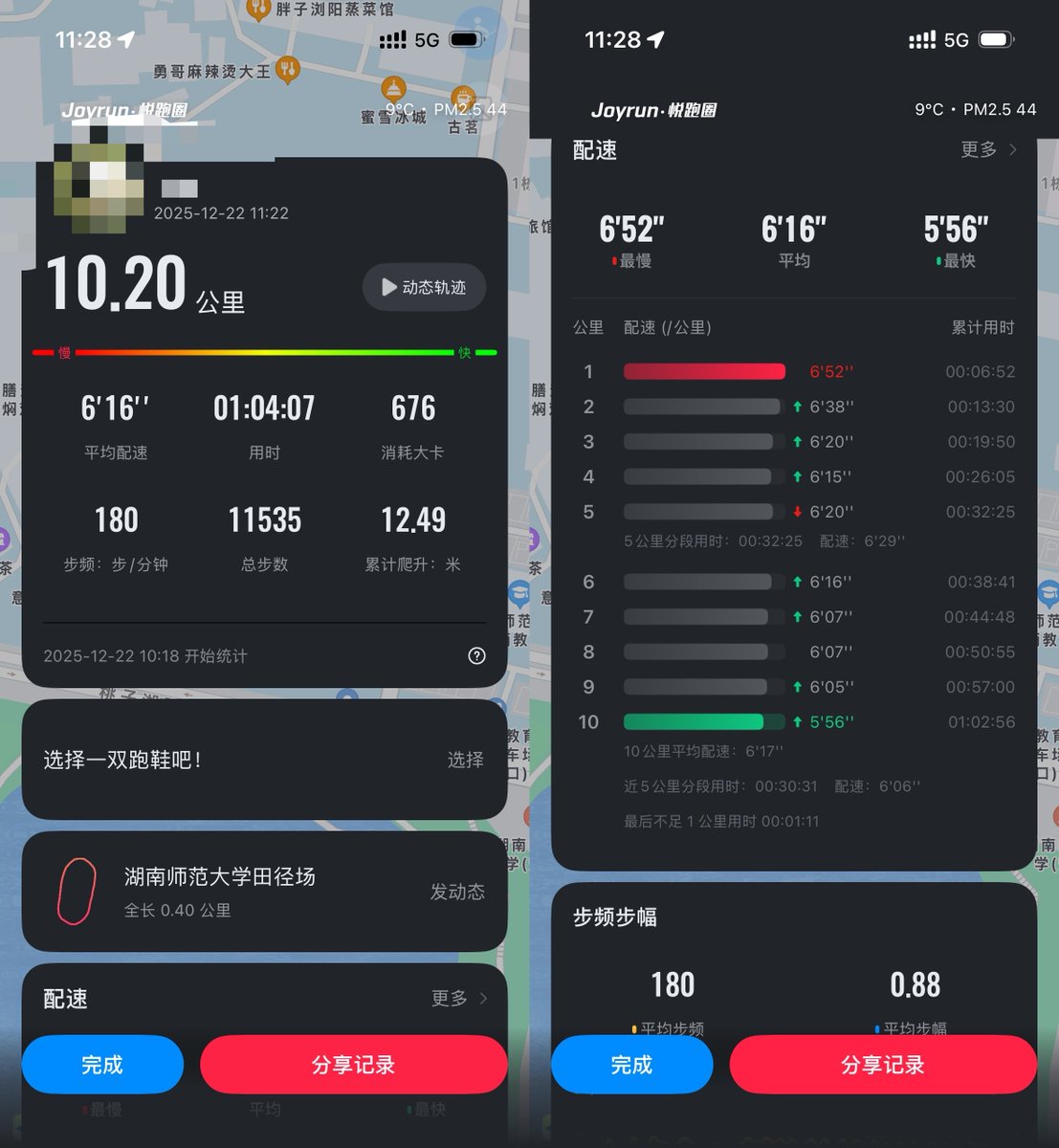
The numbers were decent: average pace 6′16″, average cadence 180 steps per minute, heart-rate zone (no data recorded).
The data came from the Yuepaoquan app on my phone.
/
My Apple Watch—literally the thing I just praised in the previous log for its great voice alerts—decided to drop the ball today!
Right as I started running, it warned me “low battery” (even though the battery level was actually fine), then automatically shut down. I restarted it twice, but the same thing happened.
Last night before bed it was charged to over 90%. This morning it stayed on the charger right up until I left home. Based on my usual experience, it should easily last the whole day—there’s no way it should die before I even get started.
After I got back from the run, I put it on the charger and it powered on instantly. Shockingly, it still had over 70% battery left. I didn’t even recharge it, and it worked normally from the afternoon into the evening.
I’ve had this watch for almost five years. It may simply be developing a hardware issue.
/
That sudden failure this morning seriously disrupted my running plan!
To record the workout, I had to temporarily use the Yuepaoquan app on my phone.
But the phone has one key limitation: it can’t record heart-rate data.
Still, at least it can record the other metrics, and its voice prompts are solid too—very helpful for controlling my running rhythm.
In one sentence: our production tools/devices have to be good—and they have to be strong.
/
One more thing:
In the previous log, I had just said ChatGPT’s voice feature was much better, and then this time I ran into a roadblock.
It wasn’t a ChatGPT product issue—my “connection route” suddenly stopped working last night…
I asked a friend for help this morning. He was rushing to catch a flight, and I didn’t get it fixed until the afternoon.
So for today’s raw notes, I didn’t use ChatGPT—I went back to the old method: Get Notes’ built-in voice recording.
Once we get used to good tools and products, we really can’t go back.
When something unexpectedly drops the ball, it genuinely hurts your experience and efficiency.
/
In practice, we’ll run into all kinds of problems. Stay calm, solve them actively, and keep accumulating experience.
(Word count: 1062.)
My Running Journal 016–018 | A Full Month + A New Record + Safety First
🚩On the morning of December 14, at the track of Hunan Normal University in Changsha, I completed my 16th outdoor run (10 km) since starting my ongoing Journey.
A full month.
From November 14 to December 14, I’ve been building my outdoor running routine for exactly one month. I’ve found my groove—and it’s become a habit.
During this period, I followed a “run every other day” rhythm (run one day, rest the next), and I’ve now finished 16 runs of 10 km in total.
I also wrote fairly detailed reflections after each run and posted them on my personal official account. If you’re interested, feel free to check them out.
/
Starting from Run #15, I changed my old habit of “counting laps while running.” That day felt great—steady, fast, and surprisingly enjoyable—and I even set a new PB.
Today, I still didn’t count laps. I didn’t look at my watch the whole time either—I just ran by feel. But my rhythm wasn’t as good as the previous run.
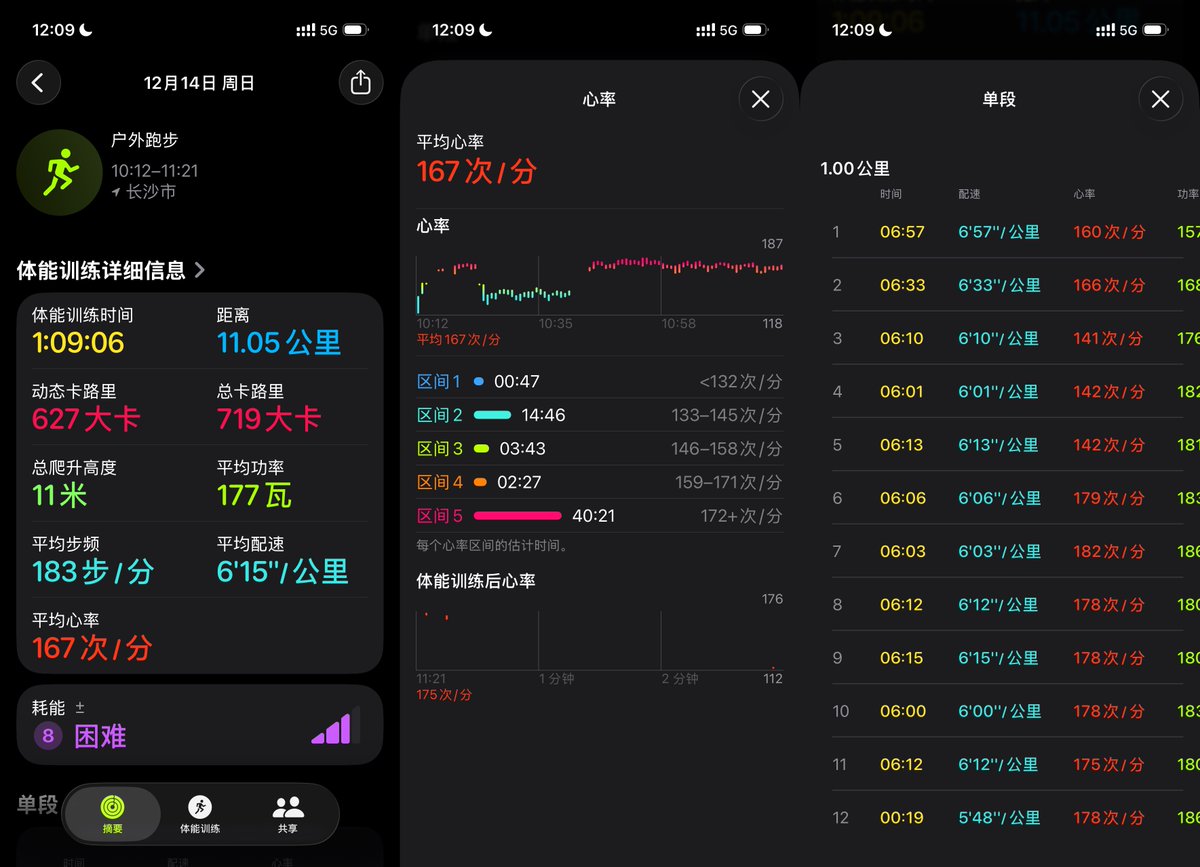
The biggest issue? My heart rate went off the rails…
/
Even though my average pace improved again (6′15″), and my cadence was high (183), the heart-rate zones recorded by the watch showed I spent most of the run in Zone 5—way too high.
Keeping my heart rate in a reasonable range matters more than chasing pace!
My heart rate was so high for two reasons, as far as I can tell:
First, I didn’t use any guidance tools at all—no lap counting, no real-time watch data, no voice prompts. I just ran hard, blindly. With zero feedback, my rhythm was bound to drift. When I finally checked my watch near the end, I realized I’d already run 11 km.
Second, there were a few breaks in the heart-rate chart recorded by the watch, so the data itself probably had some error as well.
/
One takeaway:
In the first couple of laps next time, I still need to glance at the watch. If the heart rate looks clearly wrong right from the beginning, I should stop and re-wear the watch properly. That alone can dramatically improve measurement accuracy.
/
On the day I hit my one-month mark, the weather cleared up. The sun was warm, and everything felt extra comfortable—almost like I’d received a small congratulatory gift. Thank goodness!
——
🚩On the morning of December 16, at the track of Hunan Normal University in Changsha, I completed my 17th outdoor run (10 km) since starting my ongoing Journey.
This one was fantastic—I “broke my record” just a little:
5 km under 30 minutes (27′16″)
10 km under 1 hour (59′10″)
Average pace under 6 minutes (5′56″/km)
High cadence throughout (average cadence 185 steps/min)
And the crazy part is: I achieved all of this while my heart rate stayed mostly in Zone 2.
/
For this run, I recorded the workout using both my watch and my phone.
Before, I only used my Apple Watch—but I couldn’t get voice prompts working, so every time I ran on the track, I had to count laps manually (10 km = 25 laps). That inevitably pulls your attention away, and you can’t fully immerse yourself in the run.
After looking into it, I realized a running app on the phone could give me exactly the voice prompts I needed.
Today I used the Yuepaoquan app. Every kilometer, it automatically announced: “which kilometer I’m on, total time so far, and the exact pace of the last kilometer.”
This feature is so good. It means I no longer have to waste mental energy counting laps—I can stay focused on running. And I can track the latest data in real time throughout the entire run, which gives me clear guidance in the moment—so the rhythm for this run was excellent from start to finish! It was steady and fast—fast and steady.
/
I’m genuinely grateful for how much these great tech tools can support training. So valuable. So happy.
——
🚩On the morning of December 18, at the track of Hunan Normal University in Changsha, I completed my 18th outdoor run (10 km) since starting my ongoing Journey.
In the previous run, I deliberately pushed the pace a bit and hit this goal: 5 km under 30 minutes, and 10 km under 1 hour.
The intensity really was a bit too high. After the run, my knee felt uncomfortable—and I could still feel it the next day.
That was an important signal and a clear reminder.
/
So today, I didn’t chase pace at all. I just wanted to run in a relaxed, natural way and keep my heart rate mostly in Zone 2.
During the run, I still felt some knee discomfort, and I adjusted the rhythm in time.
Finishing the run gently like this, my heart rate stayed mainly in Zone 2 and Zone 1. My average pace was 6′29″, and my average cadence was 178—solid enough.
I reminded myself to hold onto this key principle:
Safety first. Avoid injury. Build slowly. Don’t push too hard.
/
One more update—a conclusion I want to share:
Apple Watch can do spoken prompts during workouts.
Before, I didn’t know how to set it up, so I asked ChatGPT. In the end it told me: Apple Watch currently can’t do kilometer spoken alerts out loud without headphones. This is a system-level limitation, not a settings issue.
Later, when I visited an Apple Store, I asked the staff on purpose. They clearly told me: Apple Watch has a speaker, and it can speak during workouts—the key is that the mute toggle (the little bell icon) must be set correctly…
That’s when I finally understood: my watch had been in Do Not Disturb + Silent Mode for a long time, which caused the issue.
I also shared this small tip with friends in my fitness community right away.
/
When it comes to AI answers, we really do need to stay critical and verify things from multiple sources—don’t believe too easily, or you’ll end up wasting time and delaying things.
(Word count: 1,029.)
My Running Journal 014–015 | Another Important Milestone, a Technical Adjustment, and Another Breakthrough
This year on November 14, I completed the first outdoor run since starting my “Journey.” From that point on, I followed a rhythm of running every other day, one day on and one day off. Up to now, it has been about a month, and I have completed 15 ten-kilometer runs in total.
During this period, my running level has been improving continuously and rapidly. Each run has been followed by a detailed summary and record, making the process of improvement clearly traceable. At this point, my running has become relatively mature, and I’ve also gotten noticeably more tanned~
Next, I plan to upgrade both the written content and video content of my personal account. You’re welcome to follow and witness the process.
🚩 On the morning of December 12, at the track of Hunan Normal University in Changsha, I completed the 15th outdoor run of my Journey (10 kilometers).
The 10th run was an important milestone in my development of outdoor running, and this 15th run is yet another important milestone!
During this run, I made a small technical adjustment:
Recently, my runs have all taken place on standard 400-meter university tracks. Running 10 kilometers means completing 25 laps, and each time I used to run while counting laps in my head. This time, however, I didn’t count laps. Instead, I set my watch to automatically notify me of each kilometer. This significantly reduced the mental burden, greatly minimized distraction, and allowed my attention to rest entirely on the technical details and sensations of running.
During the run, my sense of awareness became stronger. I could clearly feel that, in that moment, I was running fast, steady, and comfortably. At the same time, I reminded myself to run both steady and fast, which further strengthened my focus on running. Immersed in the process, my cadence naturally increased, and in the end I set a new personal PB.
My heart rate was still mainly in Zone 2. Cadence reached 184 steps per minute, and pace improved to 6′22″ per kilometer.
5 kilometers took a little over 30 minutes, and 10 kilometers took a little over 1 hour and 3 minutes. I expect to enter under 30 minutes and under 1 hour before long—a small anticipation!
In terms of physical sensation, there was no obvious pain or discomfort.
In terms of mood and feeling, I ran with greater focus, achieved another breakthrough, and felt especially happy. It was cloudy, windy, and quite cold, but it didn’t have much impact on my condition. Thank goodness!
No matter what we do, seriousness and focus are always required. We should try our best to stay fully engaged and immersed, and resolutely eliminate the factors that distract us.
🚩 On the morning of December 10, at the track of Hunan Normal University in Changsha, I completed the 14th outdoor run of my Journey (10 kilometers).
First, I’d like to share a small running tip:
After each run, deliberately choose to walk up and down stairs a few extra times, and observe whether any parts of the body—such as around the knees or feet—develop pain. This can serve as an indirect way to evaluate whether the running intensity was appropriate.
I currently live on the fourth floor, and I try to take the stairs whenever possible. During this process, I carefully observe how my body feels and evaluate whether the intensity of that run was reasonable. Stair climbing itself is also beneficial for training the lower body.
No matter what kind of exercise we do, the basic premise is always to ensure that we do not accumulate any physical injury.
In terms of mood and feeling during this run:
The weather was excellent, with warm sunshine, and once again I ran shirtless.
Bathed in gentle sunlight, with blue sky overhead and the wide ground supporting my feet, and with especially fresh outdoor air, at that moment I felt as if I were inside a “vast natural field”, wrapped in it and embraced by it. Joy arose naturally—perhaps something determined by human nature itself!
If you can exercise outdoors, do so as much as possible. The experience that outdoor exercise brings may be completely different from that of indoor exercise.
The technical focus remained the same: constantly reminding myself to feel my running form, placing my full attention on this sensation, never deliberately chasing speed, and minimizing distraction as much as possible.
I noticed that constantly counting laps in my head while running caused significant distraction. As a result, I plan to set my watch to automatically notify me every kilometer, thereby reducing mental burden.
In terms of data, my heart rate was still mainly in Zone 2, which was relatively good. Pace was 6′40″ per kilometer, also relatively good. Cadence was 177, slightly slower, and I could already sense this during the run.
The main influencing factor was likely that I changed restaurants for lunch the previous day. The food didn’t sit well, and my stomach felt uncomfortable that day. I could still feel some discomfort during the run the next morning, which indeed affected my performance.
This reminded me once again that eating well and sleeping well are very important aspects of daily life and deserve special attention. Eat well every day, and sleep well!
In terms of physical sensation, there was no obvious pain or discomfort.
(Word count: 1,005. Written on December 13, 2025.)