Glad to be featured in that EMBL communication item which summarises my 3 months exchange at @SciLifeLab_DC 🥳 Amazing enriching experience that was highly useful to bring forward https://t.co/o1oyPLwswd 📊
Travel broadens the mind - an excellent example of that is EMBL ARISE Fellow Thomas Weber, who expanded his data science skills during his secondment at @scilifelab 🇸🇪.
👉 Read the full story about his journey: https://t.co/ztkYIFJCe9
🎉 #Preprint alert!
Excited to share this new study from our postdoc Carsten Hain on centromeres!
https://t.co/dkthxm0PrD
This work presents HORoSCOPE, a computational framework that infers centromere architecture and size directly from short-read sequencing data.
(1/3)
Can an AI tool help us better understand the origins of cancer?
Researchers from EMBL's Korbel Group have developed a new AI method – MAGIC – which, through a game of molecular laser tag, is shedding light on how chromosomal abnormalities form in cells.
https://t.co/qYNMyAFoex
🚀 Excited to announce Depictio is now LIVE with a public demo!
An open-source platform for creating interactive dashboards using outputs from bioinformatics workflows.
Try it: https://t.co/FKK0UYo8xm
#DataScience#OpenScience@embl#workflows
🎮 Try the demo:
• Explore pre-loaded demo datasets (Iris, Penguins)
• Upload your own data (CSV, Parquet, Excel)
• Create your dashboard
• Play with real-time updates & filtering
Meet Melanie Schneider, an ARISE fellow studying protein flexibility & drug adaptability.
Her project leverages @emblebi’s expertise in bioinformatics & @EMBLGrenoble’s competence in structural biology.
Read more about her experience as an ARISE fellow👇
https://t.co/8lHE9H974o
Founded half a century ago, Europe’s life sciences laboratory continues to champion innovative scientific research, services, technology development, & training, with support of its member states.
Join us as we celebrate our birthday this week #EMBL50🎂
https://t.co/bvLtAd7Vn1
I am so very excited to share that my PhD work exploring somatic structural variation in healthy human HSPCs has now been published in @NatureGenet! So grateful to everyone involved for their hard work.
https://t.co/7jsB6H3iYA
A short 🧵 on our findings in this fun project:
Exciting Announcement!📢 After a decade of growth as a computational biologist and genome explorer, I am thrilled to return to where it all began 🔃. In January 2024, I will be joining @CRGenomica in #Barcelona as independent fellow and team leader. [1/5]
7/ 🌍 Thanks for following our twittorial on MosaiCatcher v2! Have questions or want to discuss more? Feel free to comment or DM! GitHub code: https://t.co/1St3pBmrQl
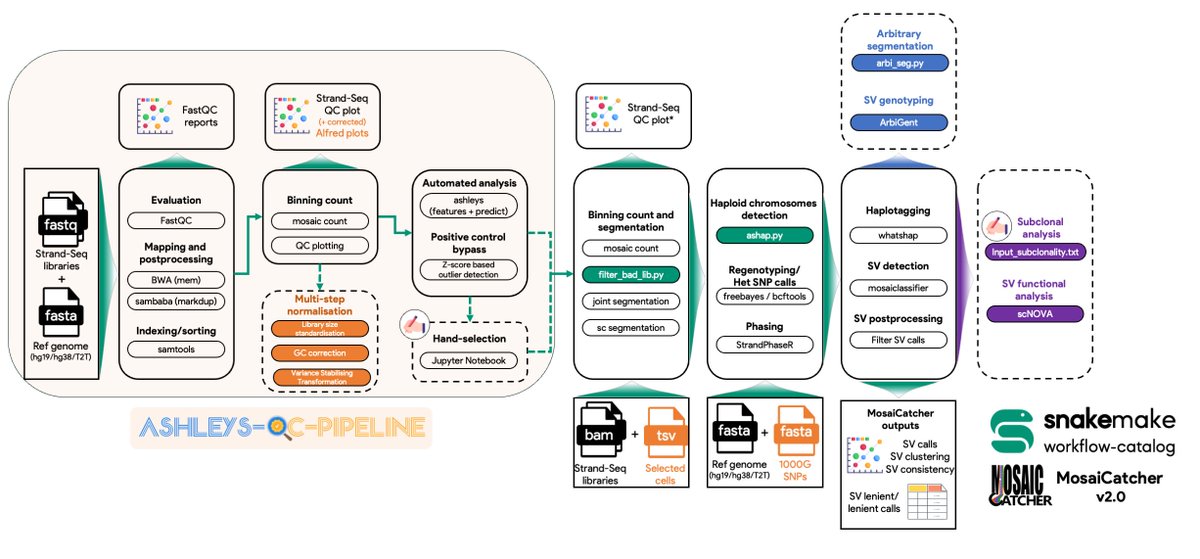
Excited to publish MosaiCatcher v2! A cutting-edge snakemake workflow for Structural Variation (SV) detection at the single-cell level using Strand-seq data. Dive into our twittorial to learn more! 🧵
Many thanks to @JanKorbel5 & Marco Cosenza ! #EMBL
https://t.co/qKZT02TsK1
6/ 🌐 Bonus feature: it is also possible now to directly compute in MosaiCatcher v2 ready-to-use UCSC & IGV sessions to load your Strand-seq data (Watson & Crick read counts, as well as SV calls) on your favourite genome browser
#IGV#UCSC