🚨 Launching Sept 3
China:Technosphere, my new biweekly brief — built for those interested in understanding how China controls at home and influences abroad. At the intersection of national security and technology.🔔Subscribe now to get the first issue: https://t.co/EKYkZEDwua
🌅 In this week's #ThoughtsOnTheHorizon, we’re looking at the cancellation of RightsCon in Lusaka 🇿🇲, and how China’s exports of digital authoritarianism or other forms of authoritarian influence might impact civil society and democratic development in places like Zambia.
“Because Zambia both strongly relied on Chinese surveillance technology and stated that China is a central influence on how it manages technology domestically, I placed it in the core of China’s technosphere. Only 7 other countries displayed such deep influence at the time [of my 2021 research]: Egypt, Iran, Tanzania, Thailand, Uganda, Vietnam and Zimbabwe.”
📝 In his latest Technosphere Substack, Forum collaborator @weberv_ examines the increasing digital partnerships between Lusaka and Beijing, from “Safe City” surveillance technologies to alleged intercepting of digital communications between journalists. The use of these digital tools- combined with the abrupt cancellation of the world’s largest digital rights conference- represents a new wave of digital authoritarianism impacting democracies like Zambia and autocracies like Iran.
Full article here ➡️ https://t.co/ONtBtWgD4m
For years, #China has quietly expanded its technological footprint in the #MiddleEast, and now, these systems may offer Beijing insights into the current actions of the #UnitedStates on the ground.
The Forum spoke with AC’s @NSC and @dgapev’s @weberv_ about the Orwellian nature of Venezuela's tech-enabled surveillance capacities – and how the PRC provided them with much of the needed hardware.
Listen to that interview here: https://t.co/f2AG22NVFk
In our new op-ed Myf Ma and I propose that the #Taiwanese government should initiate a discussion about constructing the world’s first national #mesh network with the purpose of increasing digital resilience.
https://t.co/808ELxKapg
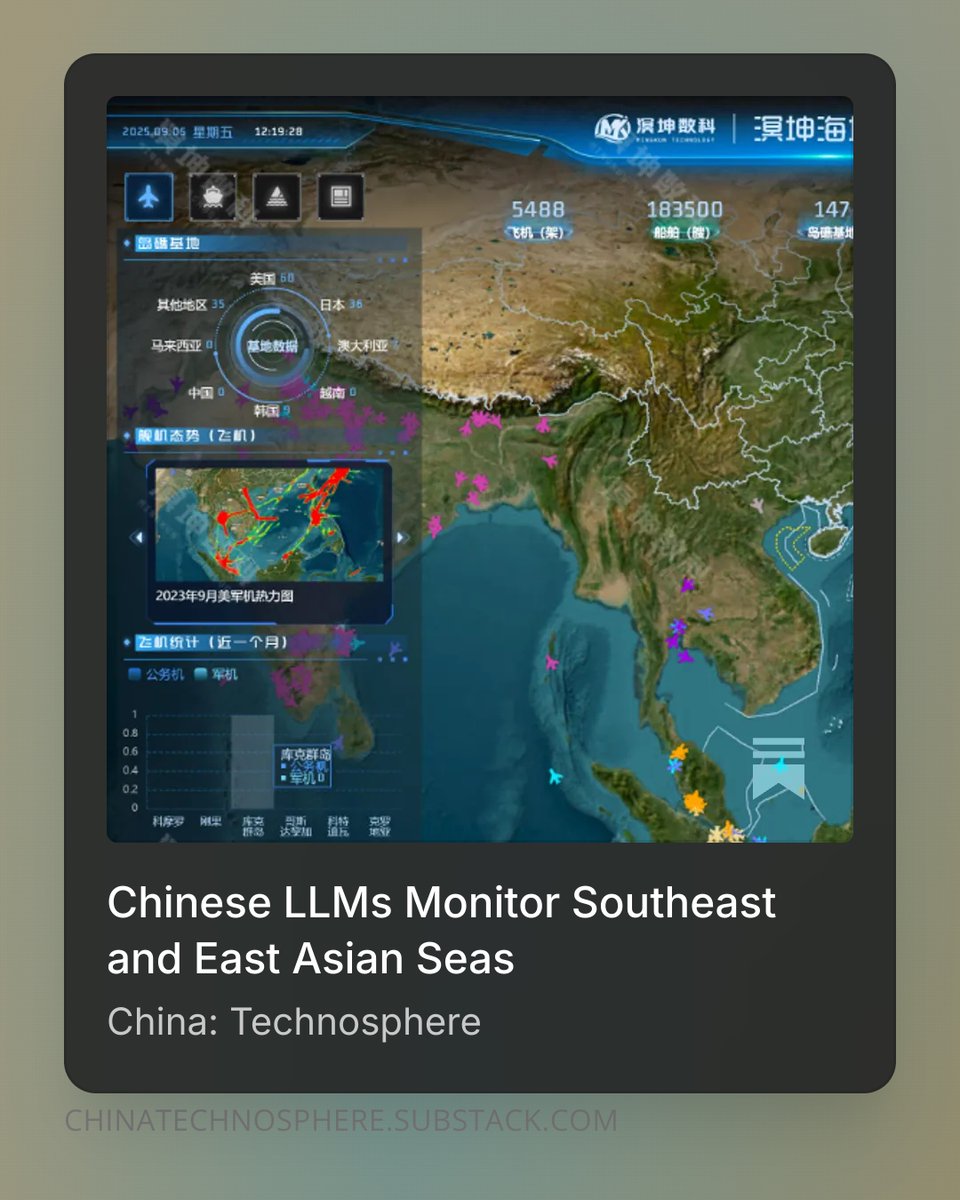
As #Chinese machine patrolling solutions scale and interconnect, they point toward #autonomous units that operate under an emerging machine-led #command and #control structure.
Lenovo, headquartered in #China and the #US, does not only redefine #AI frontiers, it also supplies hardware and software to a variety of #PLA units and the Chinese #police.
Germany should consider supplying weapons to Taiwan – as the US has been doing for years now. We should also view defense and security cooperation as a geo-economic lever. An article worth reading by @AylinMatle@weberv_
https://t.co/nCbliHh8Lw
Part II of my analysis on China’s Lianyungang Forum is out. It breaks down how the Forum’s Global Public Security Index pushes China’s security agenda, using biased rankings based on a survey by Dataway, a firm tied to UFWD work on Xinjiang/Tibet.
https://t.co/IbzvJzPQcB
Just as China’s approach to cyber operations has developed, so has its counter-attribution strategy. Western attribution strategies haven’t kept pace, argues @weberv_ in his latest for Binding Hook: https://t.co/jmlpiYX79C
„Sicherheit ist kein Zustand, sondern ein Prozess“, so Bundesminister der Verteidigung Boris Pistorius in seiner Videobotschaft anlässlich unserer Zentrumseröffnung. Sein Wunsch an das Zentrum ist es, „einen Raum für kritische & faktenfokussierte Debatten“ anzubieten. /3
The Lianyungang Forum is #China's blueprint for an alternative global #security architecture. The Forum has been taking place since 2015 and gathers hundreds of #police and government officials from across the world in China. Here is my analysis of it 👇
https://t.co/6naIDCjd0n
In our new @dgapev memo, Maria Pericàs Riera and I lay out what #Europe should do to mitigate the risks emanating from connected vehicles.
https://t.co/wJ3ESi1rTJ
Soon you’ll watch horror movies and go to Halloween parties. But real horror is out there. Chinese “smart prisons” show tech control at its peak—and the same monitoring systems are spreading to elderly care and military sites worldwide. #Surveillance
https://t.co/WvQE9pt2Gz







![ThinkDemocracy's tweet photo. 🌅 In this week's #ThoughtsOnTheHorizon, we’re looking at the cancellation of RightsCon in Lusaka 🇿🇲, and how China’s exports of digital authoritarianism or other forms of authoritarian influence might impact civil society and democratic development in places like Zambia.
“Because Zambia both strongly relied on Chinese surveillance technology and stated that China is a central influence on how it manages technology domestically, I placed it in the core of China’s technosphere. Only 7 other countries displayed such deep influence at the time [of my 2021 research]: Egypt, Iran, Tanzania, Thailand, Uganda, Vietnam and Zimbabwe.”
📝 In his latest Technosphere Substack, Forum collaborator @weberv_ examines the increasing digital partnerships between Lusaka and Beijing, from “Safe City” surveillance technologies to alleged intercepting of digital communications between journalists. The use of these digital tools- combined with the abrupt cancellation of the world’s largest digital rights conference- represents a new wave of digital authoritarianism impacting democracies like Zambia and autocracies like Iran.
Full article here ➡️ https://t.co/ONtBtWgD4m](https://pbs.twimg.com/media/HIN8tBqW8AIVCpn.jpg)