Real compounding of equity happens in the early years in a high growth startup.
Your knowledge, network and equity all should compound in a fair world.
Don't work just for a year or two, one should lock-in the fair upside and commit till the right milestone is achieved.
Someone I know joined Swiggy in the initial days. Then quit within couple of years. Now suddenly made 60 crores. Now confused what to do, has a stable job. All incremental horders of money envy the windfall guy.
This is the kind of reality we don't talk about ... often people will hide incompetency behind "being nice" to everyone; it's better to deal with people who can criticize you & call a spade a spade; it takes some baseline internal security to accept that state but only post that can you truly face ambiguous random problems ; if people are too nice you'll realize they can't take a stand for you or for themselves or for anyone else ; this is how big organizations operate, people hanging on to their dear jobs by not offending anyone, but you can't get work done by this mindset because good quality work will need some kind of criticism, feedback driven iteration loop; more importantly there will always be some level of criticism when you create work that isn't clearly understood in one go - which is what raw work looks like - because you haven't spent weeks convincing people on the side; if you have spent too much time communicating what needs to be built or being built - you've over spent more time communicating than building, which is again a reason why big companies don't move fast or do high quality work;
Last month: Management was pushing us to hit 100% AI adoption, so half the team was basically having casual chats with Claude just to boost AI usage metrics for performance reviews.
This month: Mandatory sessions on Copilot token optimization and reducing AI consumption.
My org moved from "use more AI" to "please stop using so much AI" in about two weeks. 😂
One of the biggest problems in selling a product in India to Indian founders is that everyone thinks they can build anything. You show them Salesforce CRM, and they say they can build it :) You show them any software, they'll quickly ask for a price, and then they say they can build it themselves. People don't understand the meaning of opportunity cost. The time they spend understanding these small problems and building solutions for them, which are in no way related to their core business, doesn't matter to them. It's more of a technical ego. This problem has been exacerbated in the age of AI. Imagine, before AI, people used to believe that they could build any software they wanted to build. Now, with AI, you go and pitch anything to any customer. They simply say, "I'm going to put my team on it and ask Claude to build it." So the sales cycles get longer. They will not stop. People need to understand that. The cycles will just become longer until the internal team tries and fails, and then they come back to the bargaining table. Added to this is the problem that every company now has an AI team, and in general, that team believes they can do everything because AI is all-encompassing. So when everyone is building shovels in the gold rush (AI harnessing software), then who will buy the shovels? I learned this lesson almost 10 years ago. I was the quintessential technical founder, where if anybody came to me and showed me a product, I would immediately start thinking about how I could replicate it. Instead of buying that software, I would start working on building it. That was the biggest time wastage of my life. I have been much happier, and the company has progressed much further since I realized that its better to concentrate on core focus of OzoneTel and built only software that helps the core product of OzoneTel. Anything else, I just buy or partner.
I used to be a banker. Then I was a leftist. Then I started a business and took some color of pill not sure what it was.
During those days I met a prominent and vocal leftist at one of the barcamps and she was going on and on about how unfair it is that someone can make millions just for writing a song.
So I said well one of the things states do is tax income to give to the less fortunate. Then the songwriter can make money from all the joy they brought people and we can buy textbooks for the less fortunate. She had no answer infact this might have been the first time she had heard of such a possibility - that this isn't a zero sum game.
Much of leftist discourse is just undiagnosed rage.
Today I am launching Latch Family. My second product.
"iPad kids" is not really a joke about screen time. It is what happens when you hand a kid a device with no friction and no explanation. Just a loading spinner and then a feed built by someone whose job it was to make leaving harder.
Steve Jobs once told a journalist that his kids had never used the iPad. "We limit how much technology our kids use at home." The man who built the thing did not let his own children touch it. I think about that a lot.
Doomscrolling is the same problem for adults. You open one tab at 11pm. An hour later you feel worse and learned nothing.
I wanted to build the other side of that.
Latch blocks categories at the network level: social, gaming, short-form video, AI chat, gambling. You can also block specific apps, set weekly schedules, run focus sessions with a timer, and create separate profiles. Guardian lock sits behind a PIN, so a kid cannot spend 30 seconds undoing the setup. And when protection is on, they cannot delete the app to get around it either. Most people don't expect that.
The thing I spent the most time on is what happens when something gets blocked. Most apps show a dead page. Latch lets you write the message yourself. The kid sees whatever you actually typed. "Social is off during homework. You set this rule." "This is your sleep schedule. It lifts at 7am." I don't know if this sounds like a small detail from the outside, but it is the whole philosophy of the app. A wall doesn't explain anything. A message from a person does.
Data stays on the device. No cloud dashboard, no server logging your kid's block history. I was not going to build an app that fixes one thing by quietly doing another.
My first product taught me how long the boring parts take. App review, edge cases in features that seemed simple, the thing you cut three times and then build anyway. I still find it strange to ship something new. But this one I feel good about.
Out now on the App Store today!
Download it now → https://t.co/RBIT3j81NG
Website → https://t.co/SA515Wj4Ac
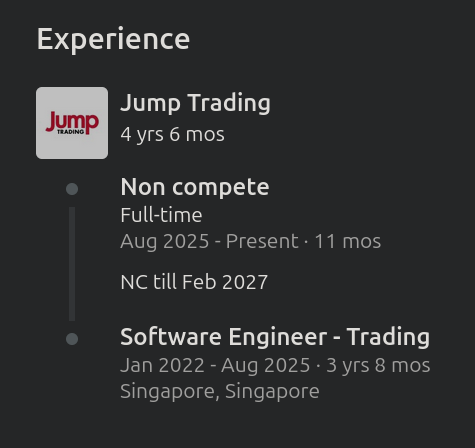
When you leave an HFT, they put you on a non-compete for 1 or even 2 years! This is the biggest gift from HFTs to open source world.
Aman Gupta is being paid by Jump Trading (to sit at home) just added multi-token prediction to llama.cpp which speeds up local LLM models by 2x
As an AI Engineer. Please learn
>Harness engineering, not just prompt engineering
>Context engineering, not just long prompts
>Prompt caching vs. semantic caching tradeoffs
>KV cache management, eviction, reuse, and memory pressure at scale
>Prefill vs. decode latency and why they optimize differently
>Continuous batching, paged attention, and throughput optimization
>Speculative decoding vs. quantization vs. distillation tradeoffs
>INT8, INT4, FP8, AWQ, GPTQ, and when quantization hurts quality
>Structured output failures, schema validation, repair loops, and fallback chains
>Function calling reliability, tool contracts, argument validation, and idempotency
>Agent guardrails, loop budgets, tool budgets, and termination conditions
>Model routing, graceful fallback logic, and degraded-mode UX
>RAG architecture: chunking, embeddings, hybrid search, reranking, and freshness
>Retrieval evals: recall, precision, grounding, attribution, and citation quality
>Evals: golden sets, regression tests, adversarial tests, LLM-as-judge, and human evals
>LLM observability as a first-class discipline: traces, spans, tokens, latency, errors, and drift
>Cost attribution per feature, workflow, tenant, and user journey not just per model
>Safety engineering: prompt injection defense, data leakage prevention, and permission boundaries
>Multi-tenant isolation, cache safety, and cross-user context contamination prevention
>Fine-tuning vs. in-context learning vs. RAG vs. distillation and when each is the wrong tool
>Latency, quality, cost, and reliability tradeoffs across the full inference stack
>Production failure modes: hallucinated tool calls, malformed JSON, stale retrieval, runaway agents, and silent eval regressions
This is terrible news. Anthropic is gaslighting Developers.
Because claude max subscription would be limited to only $100 usage after this change in proxies. ( currently we have 5x usage with $100 max plan )
Claude -p is used by third party proxies becuase anthropic doesn't allow usage of claude max plan directly in third party apps.
When they divert the claude -p usage to separate credits, we'll no longer get subsidized 5x usage.
That means 5x less experiments for me as a developer building over claude APIs. The incentive to shift to codex is increasing.
VoidZero, the team behind Vite, Vitest, Rolldown, Oxc, and Vite+, is joining Cloudflare. Vite stays open source, vendor-agnostic, and built for everyone. https://t.co/DJTpX4Q9Xt
Cloudflare has acquired Vite / VoidZero
Void is vite's fullstack Intertia-like framework.
This gives Cloudflare control over the entire stack. They have all the primitives from frontend/backend framework, linting, testing, formatting, JS runtime, db, kv, inference, blob storage, access, etc...
smart move. A tidy package they can hand to an LLM to make a site.
It was sometime in the early 2000s, at an Industry gathering in Mumbai, speaker after speaker stood up and thundered India is the IT superpower, ready to take on the world.
Then it was the turn of Pramod Haque to speak, he started -
I am as unabashedly an American as I am proud of my Indian origin, and it gives me great pleasure to see India's progress. But let me add a bit of a warning here to you all. We Americans are giving you the work of yesterday and the work of today, so we can work on the technology of tomorrow…’
That message has stayed with me since. I remember it every time a new wave of technology hits us.
I have narrated this to many people over the years; mostly, people smirked and moved on to talking about something else.
Svelte Efferd by @Sikandar_Bhide is a collection of Svelte shadcn/ui blocks for marketing pages - including header blocks, hero sections, calls to action, FAQs & more 📦️ - https://t.co/cgfeso3iqZ
Me parece superinteresante esta web sobre estándares abiertos que SE MOJA sobre cuales adoptar y cuales no ahora mismo.
Pone en barbecho desde el FTP a XSLT o JMS... https://t.co/F1GZ13qUrv
In most professions, when you hit the 90th percentile in technical skill, the best use of your time is getting 90th percentile soft skills
the best barbers are therapists
the best photographers are comedians
the best engineers are iconoclastic cult leaders that inspire their team with a vision nobody else can see, and even fewer can beleive
stop maxing out your CAD skills, and start dreaming bigger!
Hallmark v1.1 is out 🎉
The open source design skill for beautiful UIs. Now with new themes, better designs, more AI slop detectors, and a new mode to drastically redesign apps.
Here's what's new:
◆ 4 new themes: Carnival, Lumen, Hum, and Cobalt
◆ Better design: sharper hero headlines & navs, hand-built SVGs and animations, and cleaner type & spacing
◆ New Custom mode: generate a fully custom page from scratch while still passing every anti-slop gate
◆ Tighter catalog: Heard feedback that some themes looked AI generated so we cleaned a bunch of them up
Try it today: npx skills add nutlope/hallmark