LATEST: 📊 Hyperliquid’s perpetual futures open interest has topped $10B as it expands into equities, commodities and pre-IPO markets, according to Talos.
Stocks are no longer just ledger entries inside brokerage systems — they are becoming 1:1 programmable representations of real-world equity exposure onchain.
Two structural shifts matter:
First, financial assets are being redefined as programmable units rather than account-based records.
Second, Coinbase is evolving from an exchange into a distribution layer for traditional assets entering crypto rails.
Zooming out, the stack is becoming clear:
stablecoins form the cash layer,
RWA forms the yield and asset layer,
and tokenized equities complete the equity layer.
This is not migration. It is financial re-architecture.
What matters here is not Kalshi itself, but what it is becoming:
An AI agent built on Claude is now:
* reviewing contracts
* flagging risks
* suggesting listings
* tracking market-moving news
This is no longer an analytics layer.
It is an operational layer inside the exchange itself.
Prediction markets are essentially pricing engines for real-world events.
With AI embedded, the system starts to shift:
from humans defining markets
→ to AI maintaining markets
→ while humans mainly supply liquidity.
If this trajectory continues, the next phase is not better trading tools.
It is financial infrastructure becoming agent-native.
⚡️KALSHI BUILDS “HARRISON” AI TO STRESS-TEST PREDICTION MARKETS
Built on Claude, the agent reviews contract wording, flags risks, suggests listings, and tracks news as Kalshi handles BILLIONS in monthly volume.
Capital markets aren’t just betting on AI innovation anymore — they’re financing future AI income streams.
As Big Tech raises record debt to scale AI infrastructure, the next frontier is transforming AI-generated cash flows into investable assets.
That’s the financial layer Kvoucher is building for the AI economy.
🔥 BIG: Alphabet, Amazon, Meta, Microsoft, and Oracle have issued a record $159B in corporate bonds in 2026 to fund the AI buildout, already up 47% over all of 2025.
Today, @SpaceX (Nasdaq: SPCX) makes its public market debut with a $75Bn offering (pre-greenshoe) at $135 per share, marking the largest IPO in history.
Congratulations to the SpaceX team. We are honored to serve as joint lead bookrunner and sole stabilization agent.
Coinbase launches Coinbase for Agents, allowing AI agents to trade, manage portfolios, and autonomously execute financial actions under user-defined rules. Over 30 partners including Coinbase, Ripple, Solana, and Polygon are integrated.
✅ Highlight: Multi-chain, multi-platform autonomous revenue flow aligns directly with Kvoucher’s vision of AI Super Agents + Web3 revenue financialization.
🔥 NEW: Coinbase has launched Coinbase for Agents, allowing AI agents to trade, manage portfolios, and autonomously execute financial actions under user-defined guardrails.
With SpaceX getting priced at $135 today, Bloomberg estimates Musk's net worth is now $970.5B
Tomorrow, any pop above the IPO price (or a Tesla rally) could make him the first Trillionaire!
AI agents are evolving from assistants into economic actors.
Mastercard building payment rails for autonomous transactions validates a key trend: AI-native commerce needs AI-native finance.
As agents start earning and spending onchain, tokenized claims on future AI cash flows become increasingly meaningful.
NEW: @Mastercard has launched a payment system designed for AI agents to transact autonomously, with @Coinbase, @Ripple, @Solana and @0xpolygon among 30+ partners already signed on.
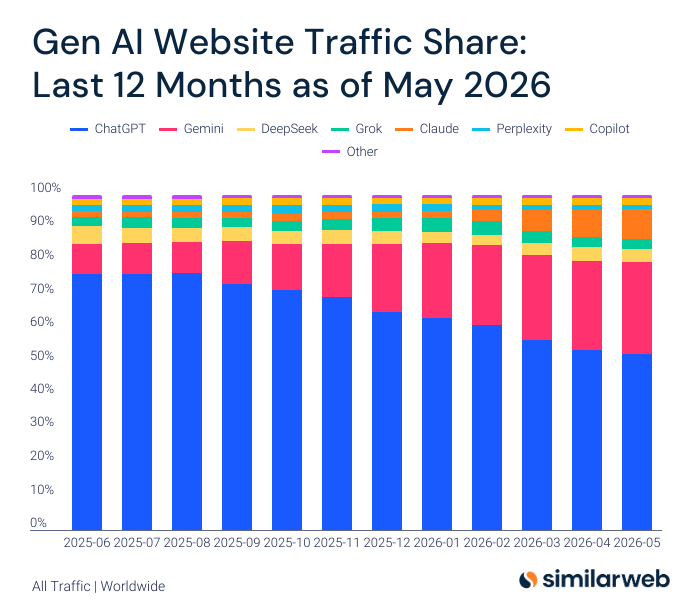
The leaderboard is changing, but the bigger story is AI becoming a mainstream distribution layer.
More users → more AI-native transactions → more value creation.
The next challenge isn’t access to AI. It’s building financial rails around the economy AI creates.
Ranking of leading Gen AI websites in the list of top-visited sites, May 2026:
#5 ChatGPT (no change from April)
#12 Gemini (+3)
#36 Claude (no change from April)
#75 DeepSeek (+3)
#122 Grok (-10)
#235 Perplexity (-28)
SPACEX BETS ON TRILLION-DOLLAR AI FUTURE
Morgan Stanley projects SpaceX revenue could soar to $3.4 trillion by 2040, helping justify its targeted $1.77 trillion IPO valuation. The forecast is driven largely by explosive growth in the company’s AI business, with revenue expected to rise sharply from current levels. SpaceX generated $18.7 billion in revenue in 2025 and plans to raise about $75 billion in what could become the largest IPO ever.
Everyone talks about tokenizing assets.
Goldman is showing what comes next:
tokenizing ownership.
Once ownership moves onchain, future income streams become far easier to package, distribute, and price globally.
That’s a much bigger market than real estate alone.
Crypto spent years trying to build payment networks.
Now payment networks are integrating crypto.
That changes the direction of adoption.
The next phase may be less about onboarding users to crypto and more about embedding crypto into systems people already use every day.
🚨BREAKING: Elon Musk's SpaceX in talks with banks to cut its IPO fee to below 0.75%, one of the lowest rates in history.
For context, most IPOs pay banks 2% to 7% of proceeds.
On a $75 billion raise, even a 2% spread would mean $1.5 billion in fees.
Below 0.75%, that pool shrinks to under $560 million.
Everyone focuses on the banks.
The more interesting signal is SWIFT.
When legacy financial infrastructure starts integrating crypto rails, adoption is no longer a crypto-native story.
It’s becoming a global financial system story.
The biggest shifts happen when new networks stop competing with incumbents and start powering them.
BREAKING: Binance is launching US stock trading for non-US users, with fractional shares starting from just $5.
Users could buy with USDT, USDC or BNB, tokenize eligible shares onchain, and potentially use them across DeFi for lending and liquidity.
This could make it much easier for global crypto users to invest in famous US companies like Apple and Nvidia.