Dear friends, good morning!
For the BBC, Vikas Pandey, India Editor came all the way down to Kochi to spend time with me.
https://t.co/foWrFt9zsh
He visited my home, spoke to my family and friends, and then spent two whole days with me in my outpatient department at Rajagiri Hospital, watching me diagnose and treat patients and interact with their family.
This report is the culmination of that visit and I am very glad for this opportunity. I hope you will like this read.
Loved and loathed: The making of India's viral liver doctor
https://t.co/foWrFt9zsh
Isometric Exercises aren’t flashy & look easy… but this is exactly what People need.
Holding yourself perfectly still in a difficult position for extended periods of Time is good for the Body & Brain.
Modern Society is plagued with Scatter Brained people that can’t sit still.
A Japanese immunologist spent 20 years proving that the chemicals trees release into the air walk into your bloodstream, hunt down your stress hormones, and arm your immune system in ways no therapist or pharmaceutical has ever matched, and most of the data has been sitting in Japanese medical journals for two decades waiting to be translated.
His name is Qing Li.
He is a clinical professor at Nippon Medical School in Tokyo and the president of the Japanese Society of Forest Medicine. The Japanese government has been funding his research since 2004, and the body of work he has produced is the reason forest bathing is now an officially prescribed clinical therapy in Japan and Korea.
The story actually starts in 1982, when the Japanese Ministry of Agriculture, Forestry and Fisheries coined the term shinrin-yoku to describe the practice of slow, mindful walking in a forest. They did it for a practical reason.
Japan was urbanizing fast, stress-related illness was climbing, and the country had thousands of square kilometers of forest sitting unused. The idea was to give people a reason to walk into the trees... They had no idea what was actually happening to the human body during those walks until Qing Li ran the first proper experiment in 2005.
He took twelve healthy adult men on a three-day, two-night trip to a forest park. They walked for a few hours each day. Nothing strenuous. No prescribed routes or breathing exercises. They simply walked slowly through the trees, breathing the air, looking at the forest.
Li drew blood and urine samples before the trip, on the second day, on the third day, on day seven after returning home, and again on day thirty.
The numbers that came back from the lab were not what anyone expected.
The activity of a specific type of immune cell called the natural killer cell, which is the cell your body uses to hunt down cancer cells and virus-infected cells before they can spread, had jumped by roughly 50 percent during the forest trip. The actual number of natural killer cells circulating in the bloodstream had increased significantly.
Three different anti-cancer proteins that those cells produce, called perforin, granzymes, and granulysin, had all risen sharply. And the effect did not disappear when the men went home. The immune boost was still measurable on day seven and was still partially present on day thirty.
Two hours a day in a forest had upgraded the immune system for a full month.
Li ran the same experiment with women a year later and found nearly identical results. Then he ran it with a control group who took a three-day trip through an urban area with the same amount of walking, the same hotel quality, and the same diet.
The urban group showed no measurable change in natural killer cell activity at all. The forest was doing the work, not the vacation.
The mechanism turned out to be a class of airborne molecules called phytoncides. Trees produce these compounds to defend themselves against insects, bacteria, and fungi. Pine, cedar, oak, and cypress trees release them in particularly large amounts, especially in warmer weather and after rainfall.
When you walk through a forest, you are inhaling those molecules into your lungs and absorbing them through your skin, and once inside your body they appear to directly stimulate the production and activity of the very immune cells Li was measuring in his lab.
Roughly 50 percent of the health benefit of a forest walk, according to Li's data, comes from the chemistry of the air itself. The other half comes from what the forest is doing to your nervous system.
This is where it stops being only about the immune system and starts being about stress.
A separate Japanese research team measured cortisol, the body's main stress hormone, in 84 participants across 35 different forest sites. They drew samples before and after a 30-minute walk in each forest and compared them to control walks in matched urban environments. The cortisol levels of the people who walked in the forest were lower than the cortisol levels of the people who walked in the city by a significant margin. Their heart rates were lower. Their blood pressure was lower.
The activity of their parasympathetic nervous system, which is the part responsible for rest and recovery, had gone up. The activity of their sympathetic nervous system, which is the part that drives fight or flight, had gone down.
Then a researcher at the University of Michigan named MaryCarol Hunter ran the cleanest version of this experiment ever done. She recruited participants from a city and told them to take a nature pill three times a week for eight weeks.
They were free to choose the time, the place, and the duration of the nature experience, as long as it was outside, in daylight, and free of phones, conversations, and aerobic exercise. They sent her saliva samples before and after each session so she could measure cortisol changes accurately and rule out the normal daily drop in stress hormones that happens to everyone.
The result was that participants experienced a 21.3 percent drop in cortisol per hour spent in nature, with the biggest payoff happening between minutes 20 and 30 of the walk.
After that, the cortisol kept dropping, but more slowly. The threshold dose for measurable stress relief was just 20 minutes outside in something that looked and felt like nature.
What none of this means is that nature is a substitute for therapy or for medication when someone genuinely needs them. Therapy treats different things than a walk does, and Li himself has been careful in interviews to call forest bathing a complementary intervention rather than a replacement for clinical care.
But what the research has settled is that the human body has a physiological response to being among trees that operates on the same biological systems modern medicine is trying to reach with drugs and clinical protocols, and that response is fast, measurable, and free.
The strangest part of Li's work is the implication he keeps repeating in interviews. The average person now spends more than 90 percent of their life indoors. Their cortisol stays elevated. Their natural killer cells stay sluggish.
Their parasympathetic nervous system rarely gets a chance to take over. The system that was tuned by millions of years of life under a canopy of trees is being asked to run permanently inside a box made of drywall and screens.
Your body has not forgotten what it is supposed to do in a forest. It is waiting for you to walk into one.
I wish to thank Shri @DKShivakumar, the Chief Minister of Karnataka for believing in me and entrusting the responsibility of Finance Adviser to the Chief Minister. It is a privilege and big responsibility and I hope to do my best.
I will continue to be Chairman of the Bengaluru Business Corridor.
🇪🇺| Europe will require all mobile phones to be sold with user-replaceable and longer-lasting batteries starting 2027.
The regulation demands the availability of spare parts and manuals for 10 years to curb planned obsolescence.
As per the USB-C ruling, Europe is a giant that can change markets to put European consumers’ needs first.
Dear Friends, please help this message reach the makers of the malayalam movie Vazha 2. It is long, but very important.
A recent malayalam movie, called Vazha 2 portrayed a character who keeps consuming ayurvedic medicine -(arishtam, a herbal liquor, with 10-15% alcohol, which Ayurveda practitioners blindly claim to have "health benefits")- and ends with serious fatal liver disease.
The people behind the movie are intelligent and well-informed. For decades, the Ayurveda community has been feeding public and patients the narrative that herbal medicine is safe and effective, even the ones containing toxic botanicals and alcohol. This narrative is now being challenged because there is a large body of peer-reviewed evidence that without reasonable doubt show that Ayurvedic herbals can be extremely toxic to the liver, sometimes even leading to death or liver transplantation. Now the movie format is bringing this to public's notice.
My most impactful publication on this was literally about a 14 year old girl developing severe alcohol-related hepatitis due to long term use of PRESCRIBED ayurvedic herbals (the same category mentioned in the movie) for epilepsy management.
Published paper: https://t.co/m1xklJH4eh and media report: https://t.co/8P6BKsEyLM
There are also other reports that show ayurvedic herbals can cause cirrhosis (https://t.co/bVhEfxm7N6), severe liver injury (https://t.co/DUM6upItUL, https://t.co/7vus6pBDQi), liver failure (https://t.co/XWRkbH9H4q) and death (https://t.co/oJcSFUi2eD).
Analysis of Ayurvedic herbals - classical formulations, proprietary herbals as well as traditionally prepared ones have consistently shown alcohol, liver toxic botanicals, liver toxic heavy metals and organ damaging adulterants (https://t.co/t8EzBeDS9S). Ayurveda is a harmful pseudoscience which which even global experts agree with (https://t.co/maJjdzYffe).
Now, the Ayurveda Medical Association of India (AMAI), which is in fact, a third rate society of Ayurveda practitioners and the herbals manufacturing companies that they are in cahoots with, has served legal notice against the movie writers and producers. They have threatened further action if the specific segment in the movie was not removed.
The same AMAI group sent complaints against me to the police, Courts and also Prime Ministers Office also when I published peer reviewed papers on harms of Ayurvedic herbals. They could not even scratch my epidermis with all of that legal drama, because science wins. Evidence shines.
These so-called Ayurveda Practitioners are losing business because public is realising that their products and services are one, useless (no evidence) and now two, dangerous also (more side effects than beneficial effects). An existential crisis is looming over their quackery business.
I would like to offer my complete and highest level of academic expertise and support to the makers of the movie Vazha Part 2 to fight these cheap, fragile ego suffering so-called alternative medicine practitioners (SCAM) of Ayurveda who think they, and their unscientific businesses are above evidence based medicine and public health.
DO NOT. I REPEAT, DO NOT, modify or remove anything from the movie. It is perfect and a huge needed public health activism. Keep up the good work! Do not bow down to any legalized glorified quacks!
And for everyone here, watch both parts of Vazha movie. It is brilliant and worth your time and money.
- The Liver Doc
abbyphilips(at)theliverinst(dot)in
The answer can be found in Europe, where the principle of degressive proportionality is applied to the composition of the European Parliament — since they have the same problem of small and big states coexisting in one Union.
India also needs a compromise between strict democratic representation (one person, one vote) and the necessity of ensuring smaller political entities have a meaningful voice. It essentially means that while larger populations get more seats, the ratio of citizens to representatives increases as the population grows.
In the European Parliament, the allocation must follow these constraints:
*Minimum Threshold: No member state can have fewer than 6 seats.
*Maximum Ceiling: No member state can have more than 96 seats.
*Inverse Ratio: The "efficiency" of a vote must decrease as population increases. For example, a Member of the European Parliament (MEP) from Malta might represent roughly 80,000 citizens, while an MEP from Germany represents roughly 850,000 citizens.
The goal is to prevent the "Big Four" (Germany, France, Italy, and Spain) from holding a permanent absolute majority that could override the collective interests of the smaller nations, thereby maintaining the federalist spirit of the Union.
Applying this to India is what we need to debate, not women’s representation which no one objects to. We need to address the North-South divide that has arisen over delimitation. A strict population-based reallocation (proportional representation) would drastically increase seats for northern Hindi-belt states like Uttar Pradesh and Bihar, while states that successfully implemented population control (like Kerala and Tamil Nadu) would see their relative political influence diminish.
If India were to adopt a degressive model, the Parliament could be structured to balance population with federal equity. Similar to the EU, a "floor" could be set for smaller states (e.g., Goa, Sikkim, or the Northeast) to ensure they aren't reduced to insignificance. Instead of a fixed ratio of, say, 2 million citizens per MP, the ratio could scale. A state with 200 million people might have 2.5 million citizens per MP, while a state with 30 million might have 1 million per MP. This is to ensure no state feels disenfranchised. As @revanth_anumula suggests, another factor could be a state’s contribution to national GDP. It would be dangerous for our federalism if smaller states felt their prosperity & human development were being punished with relative disenfranchisement.
One could argue that the Rajya Sabha already exists for federal representation. However, degressive proportionality in the Lok Sabha would provide a "weighted" democratic mandate that acknowledges population without penalizing states for their developmental successes.
Finding a mathematical formula that satisfies both the high-growth and low-growth states, and both the large and small states, would require a level of bipartisan and interstate cooperation that it is in the interests of the central government to promote. I urge PM @narendramodi to initiate extensive consultations, with all parties and with all states, before rushing into a hasty delimitation process that leaves the core underlying issues unaddressed.
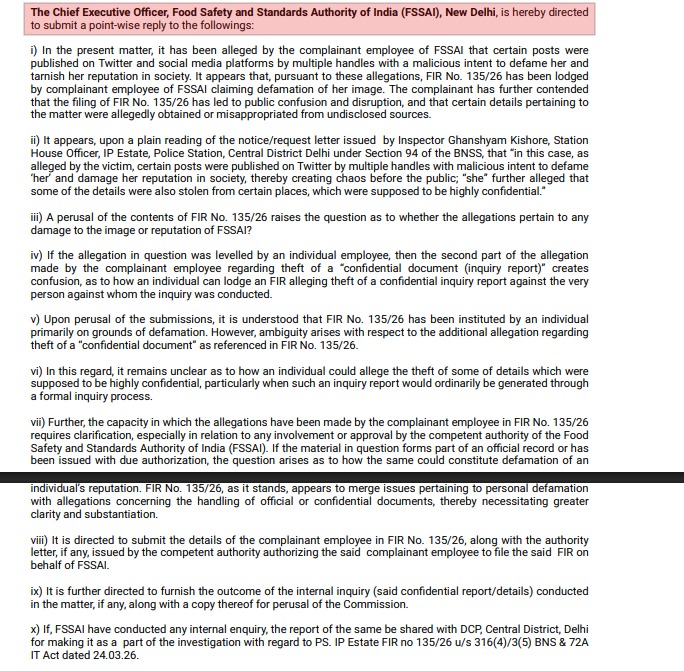
UPDATE - National Human Rights Commission has now sought reports from 3 key authorities in the FSSAI matter:
> FSSAI CEO — Point-wise reply, authority behind FIR, details of complainant employee, internal inquiry report, and whether that report was shared with police.
> DCP Central Delhi — Protect whistleblower identity/privacy, include the FSSAI inquiry report in investigation, and act if irregularities in recruitment are established.
> Health Secretary — Clarify whether any internal inquiry was done, what action was taken, how the FIR was filed, and what action the Ministry took against FSSAI.
In short, NHRC is not just asking questions about the FIR, but also about the recruitment irregularities, internal inquiry, whistleblower protection, and ministerial accountability.
Thank you, NHRC, for taking cognizance and asking the real questions. 🙏
Suspicious Bolero car with number plate UP38AD1638 has been repeatedly spotted moving around Banashankari 2nd Stage and Banagirinagar areas in Bengaluru.
Many locals have noticed this vehicle behaving suspiciously.
Concerned residents are requested to file a complaint at the nearest police station.
@BlrCityPolice, please investigate this vehicle and take necessary action.
Video uploaded on Instagram : divyaalurofficial