The man who called 2008 just said the AI labs have no moat. 2.8M people watched. Most missed where it ends.
Microsoft, Nvidia, Alphabet and Amazon are four of the biggest weights in your index fund. All four are wired to the labs.
Steve Eisman's words: "token maxing is over," and open-weight models are taking the market.
Follow it:
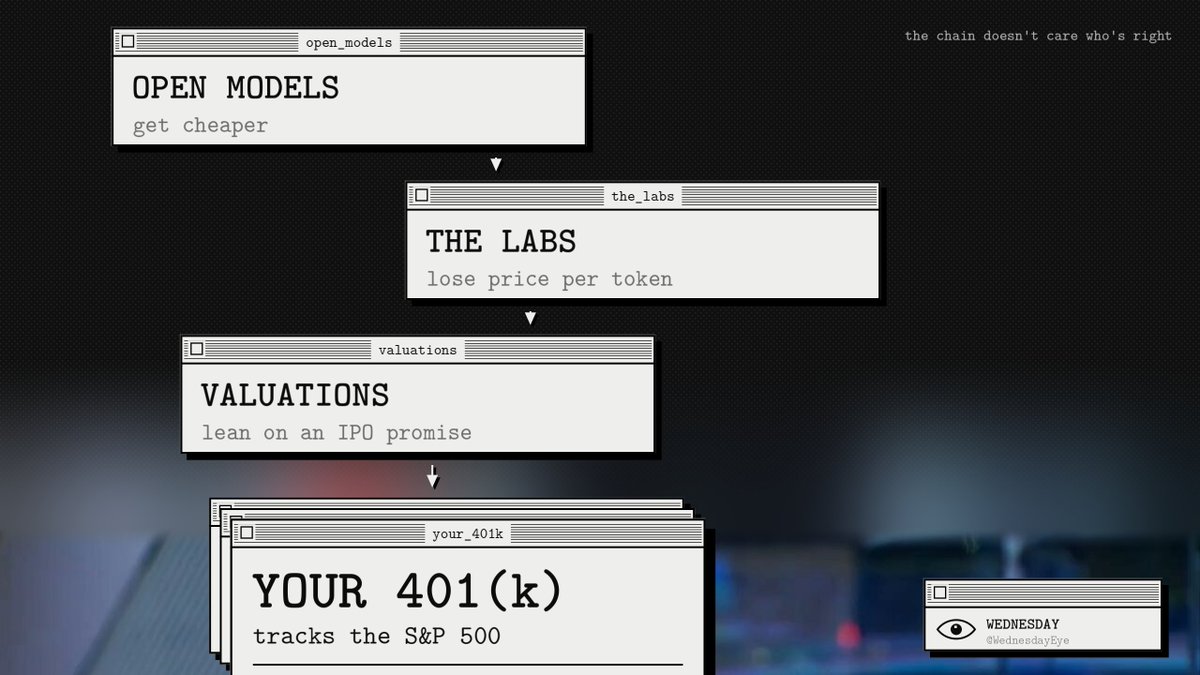
open models get cheaper
→ the labs lose their price per token
→ their valuations lean on an IPO promise
→ that promise sits inside the four biggest names you own
He could be wrong, and the chain doesn't care who's right, only who's standing in it: anyone whose 401(k) tracks the S&P 500.
The man who called 2008 just said the AI labs have no moat. 2.8M people watched. Most missed where it ends.
Microsoft, Nvidia, Alphabet and Amazon are four of the biggest weights in your index fund. All four are wired to the labs.
Steve Eisman's words: "token maxing is over," and open-weight models are taking the market.
Follow it:
open models get cheaper
→ the labs lose their price per token
→ their valuations lean on an IPO promise
→ that promise sits inside the four biggest names you own
He could be wrong, and the chain doesn't care who's right, only who's standing in it: anyone whose 401(k) tracks the S&P 500.
Big Short investor Steve Eisman says the AI labs know they have no moats and are manufacturing a crisis to get regulation that hands them a duopoly
"I think this is all nonsense."
[ You think it's all nonsense? ]
"All nonsense. I think that there's something else completely going on here. ... What I think is happening is that token maxing is over. The open weight models are taking big market share. I think these companies are very nervous. They realize that there are no moats around their business whatsoever, and they're trying to manufacture a crisis that will create regulation, and that they think they can then manipulate to create the moats, to create the duopoly that they want."
[ Wow. ]
"That's what I think is going on."
"Honestly, I think this whole Terminator thing is garbage. That's for sure."
Amazon just ordered $8 billion of backup generators. Your power bill is part of the down payment.
The House just voted 417-3 on it, because grid upgrades for data centers get spread across everyone's bill.
The receipt nobody mailed you:
Generac: stock up as much as 40% on Sept 16
Amazon: $2.4B of generators landing by 2028
Your electricity: +27% since 2019
Illinois: +16% in a single year
Same deal. One side got a 40% day. The other side pays monthly.
Oil jumped 46% in ten weeks. The people holding it got richer. Everyone else got the first Fed hike since 2023.
Kevin Warsh raised rates on Wednesday. The decision was made at a Saudi pipeline.
Houthi strikes knocked that pipeline out for weeks and pushed exports off the Red Sea route, so Brent, under $72 in early July, hit $105.68 on Monday. Gasoline is $4.32. Inflation, 3.4%.
The Fed can't pump oil.
So it did the one thing it can, 12 votes to 0: rates to 3.75–4.00%, two days after the 10-year yield touched 5% for the first time in three years. Mortgage quotes are built on that 5%.
One check worth doing tonight: which of your payments float with the rate. Credit cards and variable loans reprice off this decision, a fixed mortgage doesn't.
Which bill of yours moves first?
🚨🇺🇸 THE FED JUST RAISED RATES TO 3.75–4.00%
THE FIRST HIKE SINCE JULY 2023
RATES GO UP
→ MORTGAGES, CREDIT CARDS AND BUSINESS LOANS COST MORE
→ MORE MONEY DISAPPEARS INTO INTEREST
→ PEOPLE BUY LESS AND COMPANIES GROW LESS
→ PROFITS GET HIT
THEN COMES THE SECOND HIT
CASH AND BONDS NOW PAY MORE
→ INVESTORS HAVE LESS REASON TO HOLD EXPENSIVE STOCKS AND CRYPTO
AND THE FED IS ALREADY POINTING TO ANOTHER HIKE BEFORE YEAR-END
MARKETS SPENT MONTHS WAITING FOR CHEAPER MONEY
WARSH JUST PUSHED IT EVEN FURTHER AWAY
You missed the last 15 years of software money because you couldn't code. The second wave doesn't ask.
For 15 years a developer's salary decided what got built. If an idea couldn't pay for one, it stayed in somebody's head.
That price is collapsing. An AI agent now writes more than 90% of the code at Cognition, and Mercedes finished an eight-month migration in eight days.
Where the money shows up first:
1. Work that was never worth hiring a developer for. The internal tool, the niche app, the report someone rebuilds by hand every Monday. Andreessen's word for these is uneconomical, and cheap code is what changes it.
2. Old systems nobody wanted to touch. Mercedes had one, and so do the banks where Devin already patches vulnerabilities across thousands of repos.
3. People who know the problem better than any programmer does. Once writing code stops being the hard part, knowing exactly what to build is the scarce skill.
Write down every time someone at your work said "we'd need a developer for that." That list is your share of the second wave.
Andreessen closed his 2011 essay and this one with the same line: I know where I'm putting my money.
What's the first thing on your list?
He never saw the circuit that paid him $6 billion. It's still live.
Tehran falls. Oil bids. Defense bids. One cause, two tickers that never move together.
He was 27, and he called it luck. A supply shock and a procurement cycle are one event read from two desks, and in 1979 he was sitting where both printed.
Three nodes. He named none of them.
druckenmiller at 27, running $6 billion with no experience, when the shah of iran fell:
"I said this is easy, let's put all our money in oil stocks and defense stocks. if I had been a little older, a little wiser, I would have diversified. it went up a lot, so everybody thought I was a genius."
"I wasn't a genius. I just didn't know any better."