Consumers may eventually move to saying this to their person AI assistant: Find me running shoes under 8000, deliver them before Friday, use whichever website/app or a card gives me the best offer. You need agentic payment protocol built on UPI.
Conventionally, UPI has always required human to enter a PIN while AI is capable of find best deal. P3P by Pine Labs is designed to allow an authorised agent to complete the transaction without bringing the human back into every checkout.
Then, there is also UPI Reserve Pay.
A user can currently authorise up to 10000, after which multiple debits can occur against that reserved pool without repeated authorisation, subject to the mandate's limits.
And this becomes reality: You have 8000. Buy groceries for this week. Stay within my dietary requirements. Don't spend more than 2000 at any one merchant.
But the bigger story is not AI makes payments. Agentic commerce potentially changes merchant discovery itself.
An agent needs machine-readable access to:
- catalogue
- price
- inventory
- delivery
- offers
- refund rules
- credit/EMI
- payment methods
- merchant reputation
This reemphasizes thesis on build data products around agentic usecases.
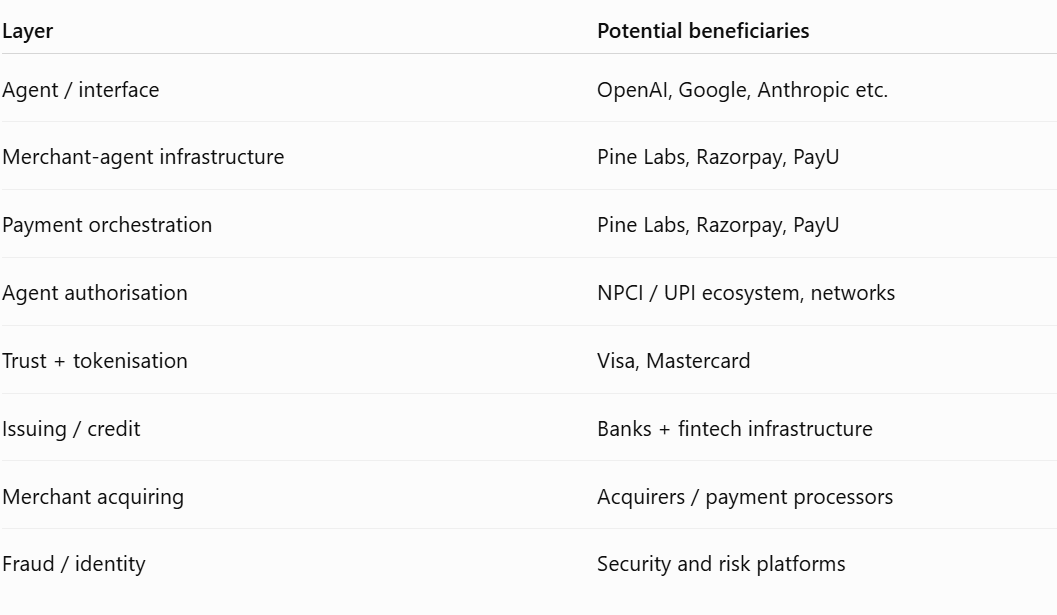
Who else is doing what:
Razorpay already has an Agentic Payments Suite covering LLM checkout, in-app agents, voice commerce, UPI Reserve Pay and AI-ready APIs/MCP.
PayU is also enabling merchants to accept orders and payments from first- and third-party AI agents.
Visa and Mastercard are building the trust/tokenisation layer globally.
@riteshmjn At what point will the bond yields start to soften? There should be a situation where they can't go up further right and what happens to gold when that happens?
@unseenvalue When management answered to your 1st question, they mentioned when there is idle capacity, they use it for their own product. Is there a possibility that someday it's client's can become its competitors, unlike in the case of divis?
A disclaimer: This is not a perfect framework, but I believe it is a far better reflection of ground reality.
I know what I know, and I don’t pretend to know everything. I am learning, testing and refining my views as the evidence evolves.
I am invested in most of these companies, so my views are obviously biased. This is not a recommendation for anyone to play “Monkey See, Monkey Do”.
By the time return ratios look very good and starts showing in everyone's screens as " investable" a lot of the story is already priced in , it is the rate of change we are playing that works more than already playing a high ROCE , in fact the risk to a high ROCE company is Birla , Adani and JSW group that comes to dilute with large capital employed
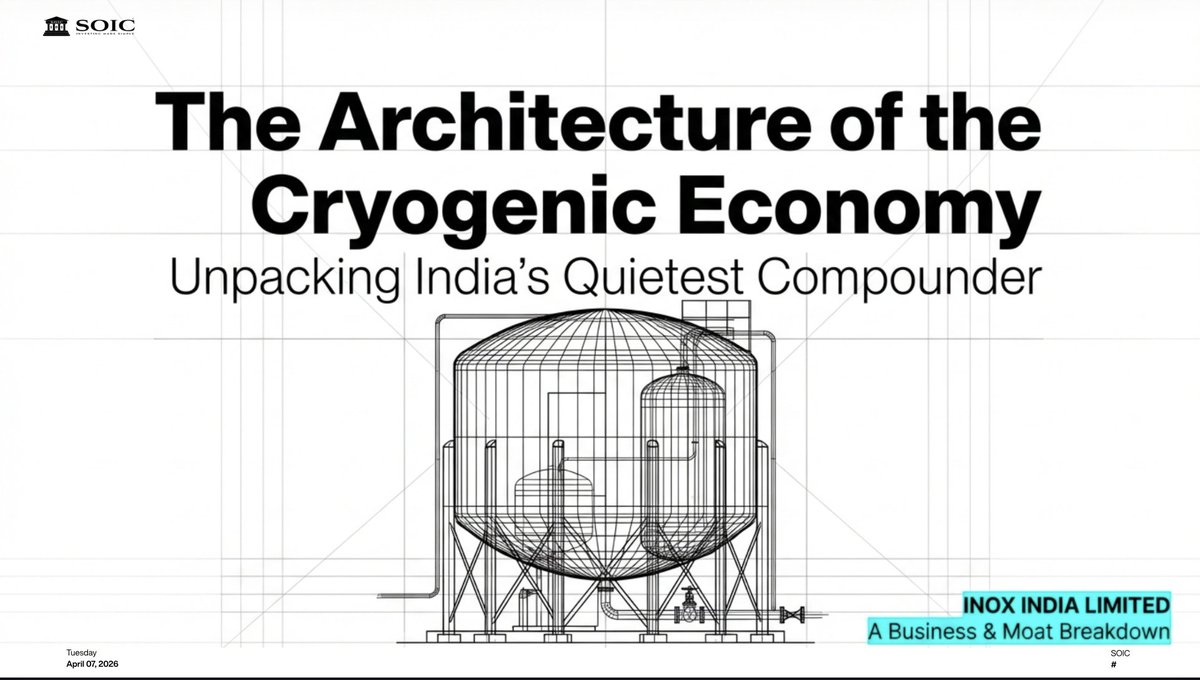
One of the unique capital good companies that checks our filter of unique businesses -
→ High barriers to entry
→ Cannot be replicated just via blank cheque
→ Good return ratios
→ Limited competitors
→ Doing something cutting edge
Let’s discuss more on Inox India’s Business in 3 simple steps
→ Why this business is Unique
→ Financial Health
→ Growth Triggers
@riteshmjn Ritesh ji, I am chartered accountant from Mumbai (India). I am currently in employment, making INR 10L per annum. I feel life of a blue collar is way better than mine, even it comes to freedom and peace. Should I seriously consider switching profession? My family will not accept.
Blue collar is the new white collar
1. Ageing western societies, South Korea, Japan , Taiwan and isreal put together will clean out India”s healthcare workers.
2. Ukraine, Russia, Israel,GCC reconstruction will clean out India”s construction workers
3. West Bengal elections will clean out illegal immigrant workers who are currently suppressing wages in India.
4. Agniveers will get all expenses paid with citizenship thrown in to enlist in western world armies.
This is probably my most important post.
The FED stole your future and there is no going back
"The system is rigged. The deep state does not want us to be free. The American dream is dead."
Statements like these conjure images of deep pessimism, a worldview where you have no agency, where you are merely a puppet dancing for malignant powers you cannot see or touch. We are not people who live in that camp. But sometimes, certain data points are so damning that they leave us no choice but to admit: something is seriously wrong, and it needs to be laid out in the open.
Every time I visit India now, I find people agitated. Even those in the top 10% of the income bracket, earning anywhere from ₹50 lakhs to a crore per year, feel like they are running on a treadmill that keeps accelerating. No matter how fast they move, it is never enough. At the ground level, the situation is far worse. It is the same story everywhere. In Canada, both partners in a household work full time and still fall short each month. In Australia, young professionals earn well and own nothing. In Germany, the middle class quietly shrinks. The geography changes. The exhaustion does not.
And the origins of this mess are not in New Delhi or Ottawa or Berlin. They are in Washington D.C. All of us are paying the price for a policy disaster handed down from ivory towers, by people most of us never elected and, frankly, never even saw.
Consider this: the U.S. money supply (M2) grew by 40% in just 2 years
*The Federal Reserve United States Money Supply M2*
January 1, 2020: $15.4 trillion
January 1, 2022: $21.6 trillion
A staggering ~40% increase
As of Mar-26, $ 22.6 Tn
( so they never reversed the increased money supply although Covid got over)
Unprecedented in the history of the Federal Reserve post-World War 2 era. (Source: FRED) This massive injection of liquidity created asset bubbles across the economy. Wages stayed stagnant. Those who owned capital benefited enormously. Everyone else got the inflation.
Most people have not yet identified the cause of their frustration, but they have begun to feel its effects viscerally. And that feeling, that the system simply cannot deliver on their aspirations, has become the quiet tailwind driving a very dangerous behavioural shift.
The more people sense that conventional paths are closed off, the more they reach for asymmetric bets, even knowing the odds are stacked heavily against them. The explosion of betting apps and prediction markets, Kalshi, Polymarket, Dream11 and their many cousins, are not trends. They are symptoms of a broken economy. The feverish rise in F&O trading and the massive uptick in exchange volumes are different expressions of the same underlying truth: when people stop trusting the system to reward honest effort, they start gambling on outcomes instead.
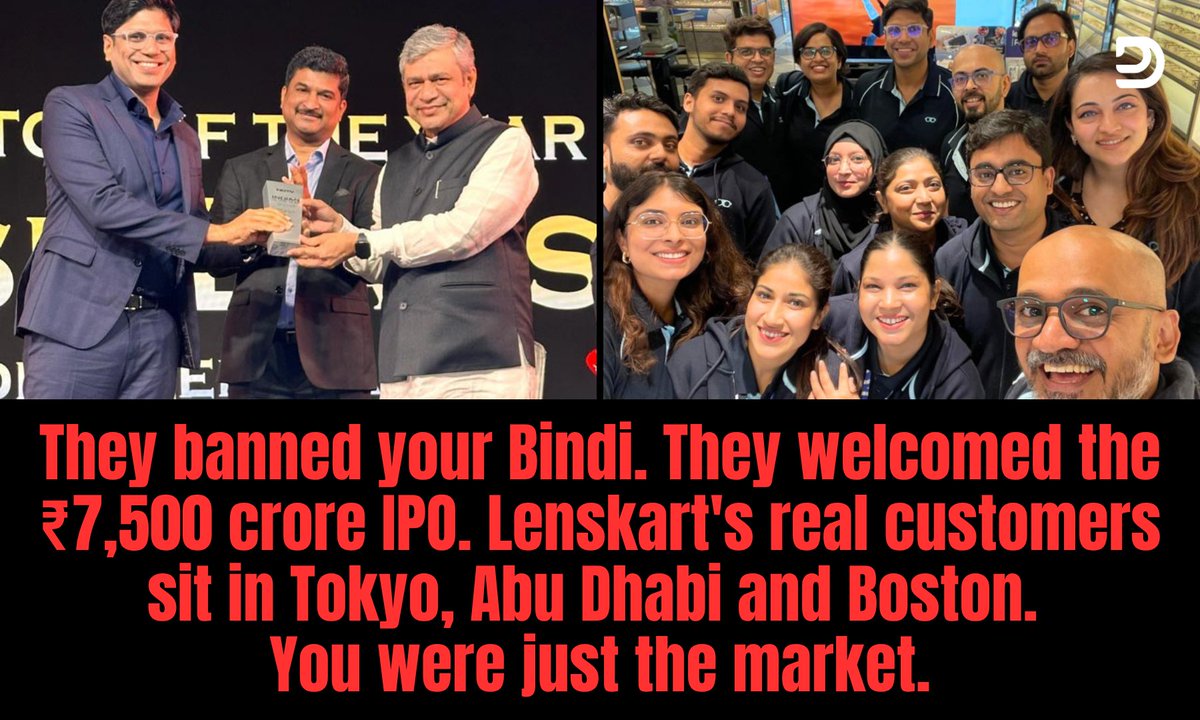
Lenskart cannot respect your bindi.
Not because they hate you.
Because they literally cannot afford to.
Let me show you exactly why.
Peyush Bansal tweeted:
"We are proudly built in Bharat, for Indians."
Beautiful line.
Terrible lie.
Start with the factory.
Lenskart's India plant opened in 2023.
Before that, China joint venture.
That JV still runs today.
Frames.
Raw materials.
Supply chain.
All from China.
Indian factory mostly assemble.
Now look at who owns this "Bharatiya" company.
Peyush Bansal: 10.28%
Neha Bansal: 7.74%
Amit Chaudhary: 0.98%
Sumeet Kapahi: 0.96%
All four founders combined: 20%.
The remaining 80%?
SoftBank: Japan.
Temasek: Singapore.
ADIA: Abu Dhabi.
KKR: New York.
Fidelity: Boston.
Now here is what nobody tells you.
Every foreign investor runs ESG compliance.
Before writing a cheque.
ESG = Environmental, Social, Governance.
A scoring system that has nothing to do with Environment.
Built in New York and Amsterdam.
It decides who gets capital.
Inside ESG lives another animal.
Called DEI.
Diversity. Equity. Inclusion.
DEI was designed in America.
Built on American horrors.
Black minorities.
Gender wars.
LGBTQ rights.
Never designed for India.
Does not understand India.
Here is what DEI scores as "positive":
Hijab at work = Positive signal.
Turban at work = Positive signal.
Here is what DEI marks as risk:
Bindi = Majority religion marker.
Tilak = Majority religion.
Kalawa = Majority religion.
In Western DEI logic,
The majority is the oppressor.
Majority does not need protection.
So when Lenskart's HR writes a grooming policy,
They are not writing for you.
They write for their colonial masters.
Because Lenskart is chasing a $10 billion IPO.
Does your bindi sit anywhere in that number?
Their first customer is not you.
Their first customer is SoftBank.
Their first customer is ADIA.
Their first customer is an ESG agency in Amsterdam.
You buy one pair of glasses.
They invest $500 million.
Do the math on who Lenskart listens to.
Now the government.
You think they don't know?
They know everything.
Every ministry understands how foreign capital
erases civilizational identity.
SEBI approved the DRHP.
Not one clause protecting Hindu identity.
Because the government also wants the IPO.
GST. Tax. Economic headline.
Your kalawa / kada is not in that equation.
This is not a Lenskart problem.
This is every unicorn in India.
Swiggy.
Zomato.
Ola.
Meesho.
Zepto.
Check their cap tables.
Check the ESG reports.
Check the grooming policies in their HR folders.
Every company 60-80% owned by foreign capital
is a branch office of Western values.
"Built in Bharat" is a tagline.
"For Indians" is a marketing campaign.
The policy document tells you who they serve.
Your Bindi.
Your Kalawa.
Your Kada.
Your 5,000 years.
Irrelevant to billionaires chasing an IPO.
But minority appeasement?
That scores points in Amsterdam.
And we call ourselves an Independent Nation.
Massive global investments have poured into only 2 sectors in India.
1. Consumption spending and
2. Healthcare.
Not in investments
Global investors love to take the wallet share of Indians.. serve them quick commerce… fatten them with 15 minutes deliveries.. and then also own Indian healthcare to serve unhealthy and obese Indians. They own the most lucrative part of Indian economy system.
South Korea is the Most Cunning Partner India have :)
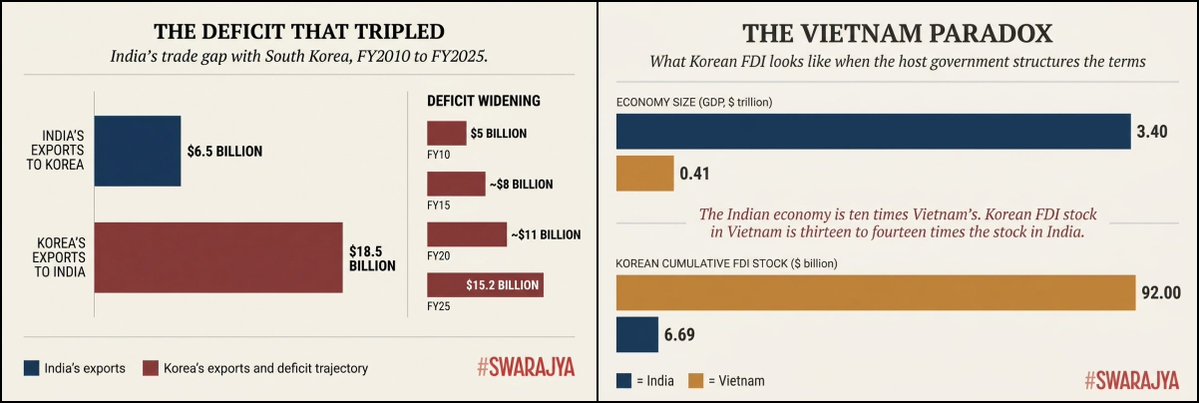
FDI Comparison if we do - Korea total investment in Vietnam is 13-14 times higher than in India. Vietnam economy is only 1/10th India's size.
Samsung alone exports $54 billion a year from Vietnam. India has huge market but gets less factories and jobs. Vietnam got the real manufacturing boom.
Even Recently Samsung going to build new factory there in Vietnam, in case of china we know the problem but in case of South Korea they do business under Radar, even this is bigger than i Imagine
How South Korea Used free trade deal with India is just a Case study - when yu read it in detail yu will get it.
Korea got a free trade deal (CEPA) in 2010. Under that deal, Korean goods entered India at zero or low duties.
Samsung, Hyundai, LG used this to sell massively into India - phones, cars, appliances.
India's imports from Korea went from $10B to $21B. India's exports to Korea actually fell - from $8B (FY22) to $5.8B (FY25). The trade deficit tripled from $5B to $15.2B.
But selling wasn't the only play. The real play was value extraction:
Hyundai - Paid itself a ₹10,782 crore special dividend (7.2x its normal payout), then did India largest IPO - 100% offer-for-sale. Every rupee of the $3.3B IPO went to the Korean parent.
Then raised royalty rates from 2.5% to 3.5% per car. Three moves, one after another, all designed to drain cash from the Indian subsidiary to Seoul.
LG - Same template. 100% offer-for-sale IPO, $1.4B to the Korean parent. The Indian subsidiary now trades at $12.5B market cap - higher than the Korean parent itself.
LG used Indian investors money to value an Indian business that it still controls and still pulls dividends from.
Samsung - Royalties paid to Korea jumped 50% to ₹3,322 crore in one year. After Korea changed its tax law in 2023 (no tax on foreign dividends coming home), Samsung pulled ₹22B worth of dividends from all overseas units in 9 months.
India was one of the biggest sources.
Combined - Hyundai + LG alone pulled $4.7B out of India in 12 months. All legal under CEPA. Best way to fuck RBI stricter Foreign Outflow
What Korea did in Vietnam (same period)
Korea put $92B of FDI into Vietnam. India got $6.7B. India economy is 10x Vietnam size. Samsung alone runs 6 plants in Vietnam, employs 100,000 people, exports $54B/year from there - that's 13% of Vietnam's entire exports.
Vietnam got factories + jobs + exports. India got imports + deficit + cash extraction.
Why Delhi stayed quiet for 15 years
Diplomatic politeness. Also, during 2010–2020, India negotiating leverage was weaker. India needed Korean investment, Korean tech, Korean defence platforms. So the imbalance was a known problem that time but that time of dealmaker didn't think of long term
MEA Secretary Kumaran publicly named the $15.2B deficit before President Lee landed. Commerce Minister Goyal called the 2010 CEPA irrational and lopsided. This was intentional signaling.
What India wants in CEPA 2.0 - Four things:
Services access - Indian IT exports to Korea are only $200M (vs $200B globally). India wants visa quotas for Indian engineers in Korean semiconductor/AI projects, and recognition of Indian professional qualifications.
Pharma access - Indian generic drug exports to Korea are just $167M. Korea has rules that kill generic price advantage. India wants those removed.
Forced local content - Like what Vietnam and Indonesia did. India wants 50% local value-addition by year 5, 70% by year 10. If you want to sell in India, build in India.
Reciprocal sourcing - For every $1B defence/steel/shipbuilding contract India gives Korea, Korea must buy equivalent value of Indian services, pharma, components.
Must read this Article:
https://t.co/ic1VSoP2fB