Some basic lessons for new investors to live by:
1/ Ignore the crowd. You make money by going against the consensus.
2/ Always pick stocks where you feel you have a research edge.
3/ You rarely go wrong investing in the company with the best product.
4/ Don’t listen to management. They are paid to be bullish.
5/ Study competitors, suppliers, and customer behavior. Be a product junkie.
6/ Have in your mind what you think a stock is worth, which is different from price.
7/ Be able to articulate in one sentence why you own a stock.
8/ Develop specific downside scenarios that would cause you to sell the stock.
9/ The highest quality of growth is unit growth, then pricing, then margin expansion, then cash reinvestment.
10/ Be wary of companies that grow by buying other companies.
11/ Sell discipline is selling a stock once it exceeds your price target, or if your investment thesis changes.
12/ Short stocks that have bad businesses, and not because they trade at high P/Es.
13/ Two big value creators are brand extension and TAM expansion stories.
14/ High P/Es are a function of high future growth rates, and not the industry.
15/ When investing in growth stocks always look for a controversy (“fight”).
16/ Buy stocks that can leverage key secular megatrends, and avoid those that will be hurt by them.
17/ Always consider cannibalization of existing products when sizing up new product opportunities.
18/ Be wary of “hockey stick” sales forecasts absent new products or expansion to new distribution channels.
19/ Stock buybacks are accretive if the E/P ratio exceeds the after tax cost of debt or return on cash.
20/ Price cuts rarely add value since they often create a race to the bottom.
21/ Stocks are cheap if price is less than the present value of future cash flows. A high P/E does not make a stock expensive.
Visa ( $V) dipped -1% AH after Visa reported 3Q earnings, revs, and payments that beat expectations, but guided to lower than expected 4Q earnings due to higher than expected expense growth.
3Q actuals
- Adj EPS $3.32 vs $2.98 exp
- Net revs $11.6B (+14% YoY) vs $11.4B est
- Operating exp $4.76B (+19% YoY) vs $4.0B exp
- Payments volume (+10% YoY) vs +9% YoY exp.
4Q guidance
- Adj EPS low-end of mid-teens growth vs +16% exp.
- Net revs high end of low double digit growth vs +12% exp
- Operating expense growth low double digit growth vs +8% exp.
We believe $V price could move lower after results (similar to AXP last week) if the 3Q margin compression from higher expenses is confirmed to continue into 4Q on the conf call at 5pm ET.
U.S. stocks slipped as a deepening chipmaker rout spurred by the plunge in Korean semiconductor stocks and AI spending doubts outweighed gains from lower oil prices and treasury yields. Brent crude fell 3.5% to $85 amid an extended U.S.-Iran pause and Hormuz talks; 10-year yields eased to 4.61% ahead of a Fed meeting widely expected to hold rates. Big Tech and consumer earnings loom, with focus on AI capex. S&P 2026 EPS estimates have risen +25% YoY to $346 (21.4x P/E). I remain cautious on $TSLA due to declining forward earnings estimates, the likely commoditization of unsupervised autonomy technology, and a seemingly excessive valuation.
I expect $TSLA to fall below $300/share and $SPCX to break $100/share in the coming weeks on valuation concerns. Both trade at FY’26 P/E in excess of 175x which seems excessive as AI-related valuations continue to unravel.
I am amazed how many investors are holding $TSLA because they believe $SPCX will buy it. IMO, that won’t happen anytime soon since the potential dilution to SPCX shareholders is too significant if SPCX paid a 20% premium for TSLA only to have the combined entity trade at TSLA’s lower multiple. Own $TSLA if you believe unsupervised autonomous FSD will lead more consumers to buy Teslas, or you believe unsupervised autonomy will scale much quicker than the market believes, or some other fundamental driver of TSLA earnings. Owning TSLA for a buyout by SPCX is buying the greater fool theory.
U.S. stocks rallied (SPX +1.0%, NDX +1.6%) as a pause in U.S.-Iran attacks pushed down oil prices (brent -7.3% to below $90/bbl), with 10-year TYs easing ahead of the Fed’s expected fifth consecutive hold at this week’s Fed meeting. About one-third of the S&P 500 reports this week, led by $MSFT, $META, $AAPL, and $AMZN (AI CapEx focus) plus several consumer bellwethers ($V, $KO, $PG. $CMG). 2026 S&P EPS estimates have risen to $346 (+25% YoY) on AI and energy strength (P/E 21.4x). I remain cautious on $TSLA due to falling estimates, the likely commoditization of unsupervised autonomy, and TSLA’s stretched valuation. See more detail in my daily pre-mkt summary for Subscribers.
# unsupervised autonomous vehicles without safety monitors:
- Waymo 3,500
- Tesla ~40
# paid unsupervised autonomous rides per week without safety monitors:
- Waymo 500K
- Tesla ~4K
The last metric is where the rubber meets the road since it’s what drives earnings and cash flow. The TSLA promoters who focus on # autonomous vehicles in operation or # cities where TSLA operates are deluding themselves. Safety monitors in vehicles = supervised. $TSLA $GOOG
$TSLA stock (-14.5%) had its worst day since March 2025 (and before that Sept 2020) as investors took to heart management’s caution about not scaling up unsupervised autonomy until the ~40 test vehicles can demonstrate that it’s safe to do so. We have long argued that at a 180x forward P/E the market was way too aggressive in assuming TSLA gets to the finish line first on unsupervised autonomy and that other competitors can’t match its ability to scale.
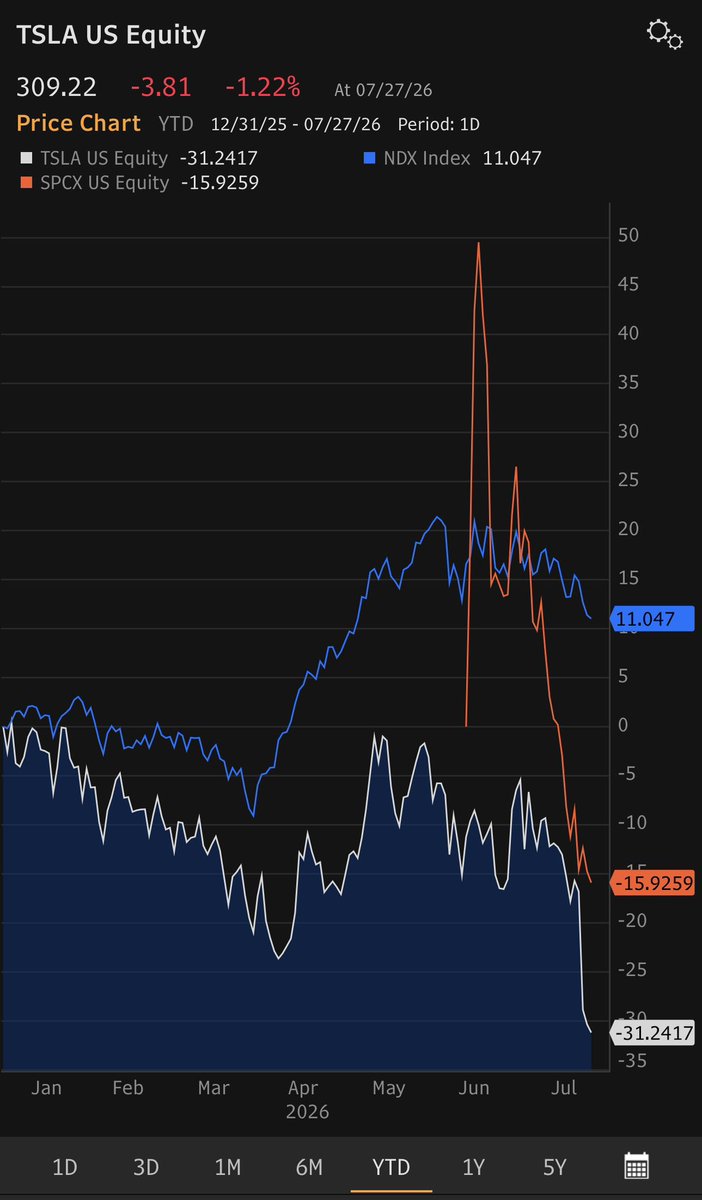
$TSLA -7% this morning and if the pre-mkt decline holds is now -23% YTD vs NDX +15%.
TSLA management could have provided one or two common unsupervised autonomous metrics with yesterday’s earnings: 1/ # of unsupervised autonomous vehicles operating without safety operators, which we estimate to be ~40 vs Waymo at 3,500; or its close cousin: 2/ #paid unsupervised autonomous rides completed per week without safety monitors (we estimate TSLA at 4,000 vs Waymo ~500K) so investors could measure TSLA’s progress in unsupervised autonomy vs peers. Instead, TSLA provided largely irrelevant metrics on its 2Q earnings call, like cumulative unsupervised autonomous miles since starting its unsupervised autonomous ride-hailing program (380,000), and % weekly gain in unsupervised miles driven per week year-to-date (10%+ per week) without clarifying the metric or providing a starting base.
Investors hate uncertainty and $TSLA seems unwilling or unable to reduce the uncertainty associated with its scale-up of unsupervised autonomy with their disclosures. That obfuscation is clearly hurting TSLA stock. The idea that TSLA stock is down this morning because of its planned FY2026 capexp spend of $25 billion (no change vs prior) is absurd.
@travisraxelrod
U.S. stocks fell pre-market (SPX/NDX -0.3%) after Iran-backed Houthis attacked Saudi oil tankers in the Red Sea, sending Brent crude +4% to $98/bbl. $GOOG dropped -3.5% on higher AI capex guidance and an EPS miss ex-one-time Anthropic equity gains. $TSLA fell -5.6% after weak auto gross margins and cautious unsupervised autonomy scale-up guidance, lagging rivals like Waymo in unsupervised miles and paid rides. AI spending has boosted 2026 S&P 500 earnings by +25%YoY, but rising oil prices have pushed 10year treasury yields above the S&P 2026 earnings yield, negating the valuation benefit. I remain cautious on $TSLA due to its stretched valuation (2026 P/E 190x vs +35% long-term forward eps growth) and slower than expected unsupervised autonomy roll-out. For more detail, please see my pre-market summary for Subscribers posted every morning.
$GOOG -3% AH after missing on 2Q non-GAAP earnings and boosting its FY’26 CapExp, potentially triggering a new CapExp arms race.
$GOOG now projects a 2026 CapEx range of $195B to $205B, up $15B from its prior guidance, which the company says is necessary to meet the demands of the AI infrastructure boom. Many analysts were expecting GOOG to lift its CapEx outlook, after Google announced an $85 billion equity raise last month. The higher guidance reflects the company’s efforts to accelerate its expansion of AI computing capacity and book more revenue from cloud-computing clients. Still, the negative free cash flow and heavy bill for AI infrastructure is fueling investor jitters.
$GOOG 2Q cloud revenue totaled $24.8B, up +82% from a year ago and above the $22.5B analysts had expected. The company’s cloud backlog, a measure of contracted work that hasn’t yet been recorded as revenue, grew to $514B, up from roughly $460B, a quarter earlier.
At a 2026 P/E of 23.6x and +15% forward long-term rev growth and +17% forward long-term eps growth, $GOOG still looks compelling and should be bought on weakness.
$TSLA (-3% AH) after missing on auto gross margins ex-reg credits (16.3% vs 18.4%) which drove huge miss in non-gaap eps ($.33 vs $.55 WS est). CapExp of $5.8B caused free cash flow to go negative -$1.1B, which was expected. On the positive side, active FSD subs of 1.48M was 16% QoQ vs 1Q (+63% annualized) and the 2Q attachement rate of FSD to North American deliveries was a record 55%. Optimus production is still scheduled to begin late-2026.
Conf call at 530ET. Investors most want to hear how quickly unsupervised autonomy without safety monitors (currently 40 TSLA vehicles vs Waymo 3,500 vehicles) can scale.
US stocks slipped pre-market Wednesday as continued US airstrikes on Iran and dim peace prospects drove Brent crude +4% to $95/bbl (now +30% this month). Gold and silver rose while BTC and $NVDA fell ahead of earnings. Surging gasoline prices to above $4/gallon threaten Republican control of the House and possibly the senate before November midterms. S&P 2026 EPS estimates have climbed +25% YoY on AI/energy strength but at a 4.6% forward earnings yield, equities remain fairly priced relative to risk-free bond yields. Despite a likely 2Q earnings beat tonight, I remain cautious on $TSLA due to its stretched valuation (2026 P/E 190x vs +35% long-term forward eps growth) and slower than expected unsupervised autonomy roll-out. More detail in pre-market summary for Subscribers posted every morning.
Well said @DillonLoomis. The reality is $TSLA (-15% YTD) has underperformed both $GM (-2% YTD) and $F (+9% YTD), largely because TSLA management continues to overpromise and underdeliver. Does anyone really believe that GM and F unsupervised autonomy platforms are superior to TSLA’s? Of course not. But Elon keeps making outlandish promises such as this one a year ago on the TSLA Q2 '25 conference call: “I believe half of the population of the US will be covered by Tesla's Robotaxi by the end of the year.” The comms at TSLA are sorely lacking and @elonmusk needs to bring on 1-2 adults to shore up credibility.
My $TSLA 2Q adj EPS est is $.60, which is above WS consensus of $.55, likely due to my higher than expected auto gross margin ex-reg credits (18.8% vs 18.4% WS est) and operating leverage of R&D/SG&A with 480K deliveries in 2Q.
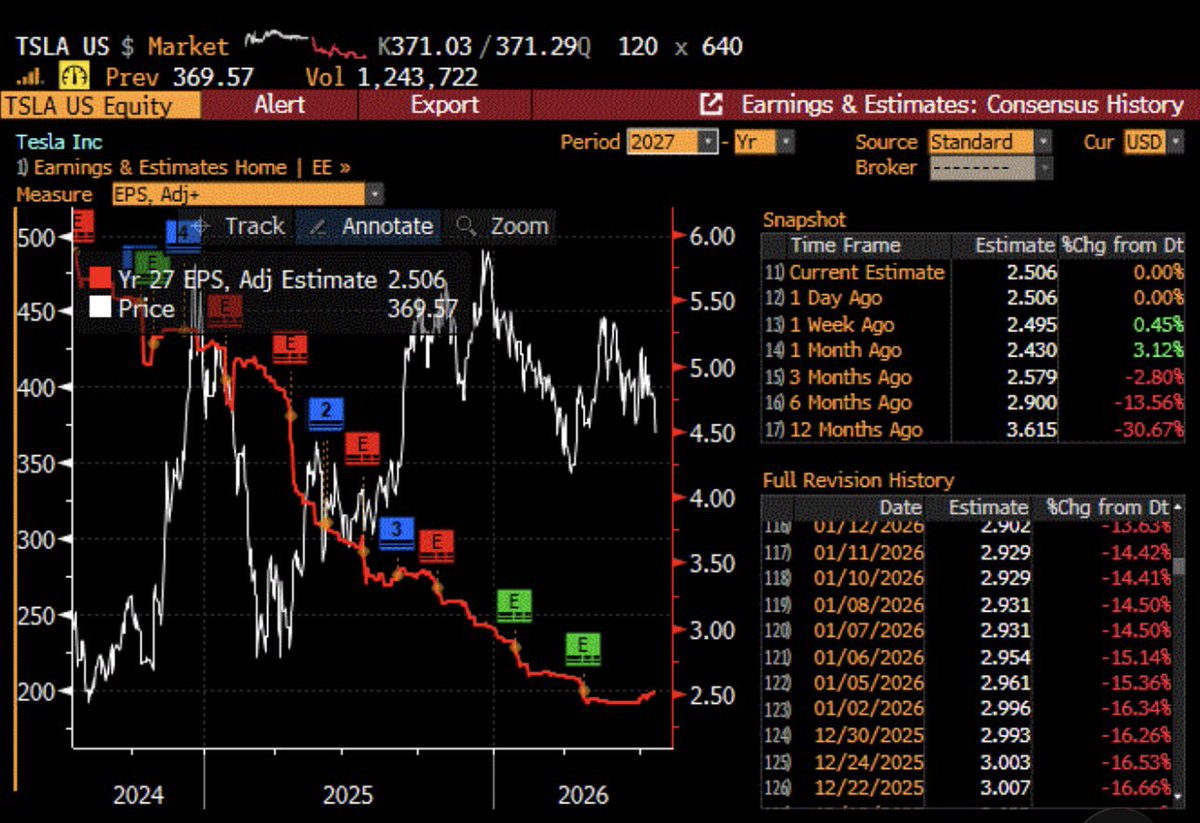
That said, even with $TSLA -18% YTD, it’s difficult to get excited about it with 2027 Adj EPS estimates falling (-16% YTD), unsupervised autonomy rapidly becoming a commodity, and a 2026 P/E of 187x vs +35% long-term eps growth (5.3x PEG). If I had to post a price at which I would seriously consider buying $TSLA again, it’s probably ~$250 (2030 EPS $7.72 x 2x PEG x 35% growth, discounted back to the present at a 14.2% cost of equity (4.6% risk free rate, 6% ERP, 1.6x beta) and a 20% fair value discount.
What will drive the stock higher is faster scale-up of unsupervised autonomy without safety monitors and with just 40 or so in operation (per Grok), that doesn’t seem like it’s happening yet.
I asked Grok if there has ever been a company in the history of the stock market like $SPCX with more than $1 trillion market cap that traded for over 40x forward EV/Rev?
Grok’s response: No, there has never been a company with a sustained >$1 trillion market cap trading at over 40x forward EV/Revenue. $SPCX stock is in uncharted territory and will likely continue to decline under the weight of its extreme valuation.
$NVDA was the closest candidate but even it falls short on forward EV/Rev multiple above 40x at a trillion-dollar scale.
• NVDA first hit ~$1T market cap in May 2023 and has since reached $4T–$5T+.
• Trailing EV/Rev peaked at ~44.9x historically.
• Forward (NTM) EV/Rev has been significantly lower, typically in the 10–25x range during its $1T+ period, reflecting aggressive revenue growth forecasts (often 50%+ YoY in data center/AI). Recent valuations hover around 11–13x forward revenues in analyst models.
High forward EV/Revenue multiples (>40x) would imply extreme optimism not supported by consensus estimates even at Nvidia’s peak hype. Its forward P/E has exceeded 40x at times, but revenue multiples compress faster due to scaling sales. https://t.co/vnuUsz70Ej
Other Trillion-Dollar Stocks
• $TSLA: Currently exceeds $1T market cap (e.g., 2021 and later). Forward EV/Rev has stayed well below 40x (often 8–15x range), with high volatility but no sustained extremes at that cap. https://t.co/LDDBopHZQZ
• Mature mega-caps ( $AAPL, $MSFT, $GOOG, $AMZN, $META, etc.): Forward EV/Rev is typically single-digit to low/mid-teens, even at peak valuations, due to enormous revenue bases.
Many here criticize my $SPCX posts as overly analytical and not giving enough credit to Elon’s longer term record of success. This is not about respect for Elon, whom I respect greatly. This is about rule #1 in investing - don’t conflate the quality of a business with the value of its stock. SPCX may be a great, uniquely positioned business but with a $1.7 trillion market cap it shouldn’t mathematically be worth 40x forward revenue when no company - not $AMZN, not $NVDA, not $TSLA - has ever sustained that.
Don’t say I didn’t warn you.
$SPCX now sits at $126/share - a stunning 45% reversal in just one month from its post-IPO peak of $226 and well below its IPO price of $135. SPCX still trades at FY’2026 EV/Revs of 45x.
Iconic Wall Street investor Peter Lynch was not a fan of buying into small IPO floats, and liked to say that IPO stood for “it’s probably overpriced”.
The totally unproven plans to build data centres in space were endlessly dissected. The SPCX prospectus spelled out the ridiculous total addressable market the company was claiming: $US28.5 trillion, close to the entire GDP of the United States. SpaceX’s losses were disclosed and discussed.
Indeed, there may not have been an IPO in world history as closely scrutinised as this one. If investors still wanted to buy in despite all the risks, they deserved what they got.
That’s fair enough, at one level, but it ignores the cynical way that SpaceX, its investment bankers and its advisors structured this IPO to engineer short-term gain – and a $US500 billion fee pool – with seemingly little concern for long-term investors.
As Schroders head of Australian equity Martin Conlon wrote this week, investment banks know that “the vast pools of money directed towards rules-based investment processes”, such as passive investing and algorithmic trading, have changed the way markets work.
And so they successfully lobbied index market operators such as Nasdaq and FTSE Russell to – in the words of Conlon – pervert and game the rules so that large, loss-making companies such as SpaceX could gain almost immediate inclusion in major sharemarket indices.
The SpaceX float raised a historic $US85 billion in its IPO - 3x the size of the next largest IPO in history. But the bankers knew that they could create a “highly imbalanced supply/demand situation, where a free float of less than $US100 billion would set the price for more than $US2 trillion in paper market value.
Here we are today and SPCX still looks ridiculously overvalued at 45x 2026 EV/Revs. Yet 80% of the 36 WS analysts who have initiated coverage of SPCX have buy ratings on the stock. And only one - Morningstar, which presumably can’t earn future banking fees on SPCX - has a sell rating. That says it all.
Source: Financial Review
U.S. stocks tumbled Friday as the global chipmaker selloff intensified, driven by Chinese startup Moonshot’s Kimi K3 AI model rivaling OpenAI and Anthropic. Investors fear the breakthrough echoes last year’s DeepSeek shock, questioning the justification for massive AI capital spending. $NVDA fell 1.6%, $TSLA dropped 1.5%, and $SPCX lost 3.4% to $127, well below last month’s $135 IPO price. $NFLX plunged 9% on weak guidance. Iran tensions escalated for a sixth day, boosting Brent crude +1.7% to $87/bbl. S&P 500 2026 EPS estimates have continued to rise to $346 (+25% YoY) on AI and energy gains. I remain cautious on TSLA due to negative long-term earnings revisions, increased unsupervised autonomous competition, and a seemingly extended valuation. For more detail, see my pre-mkt summary for Subscribers that I post every morning at this time.